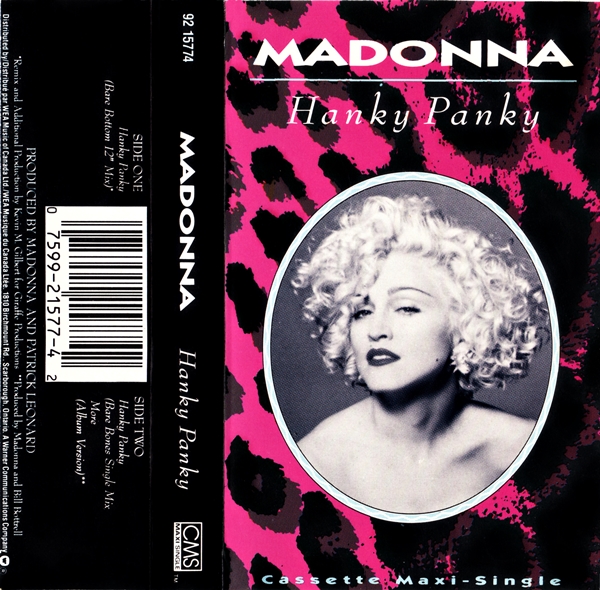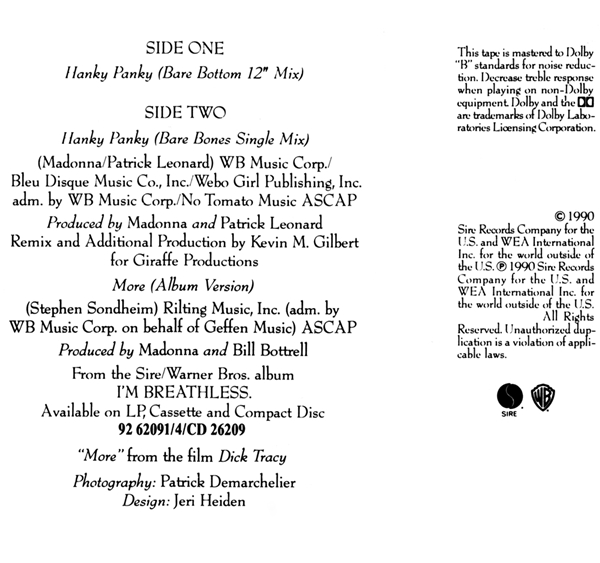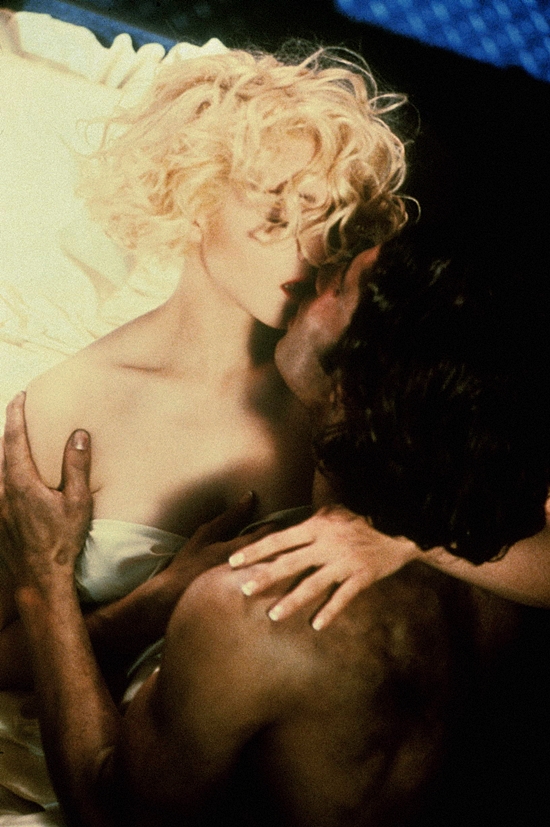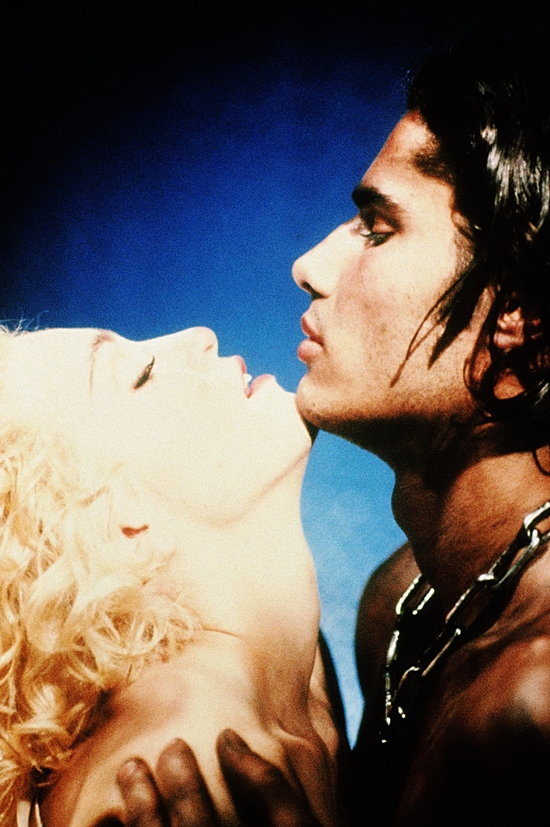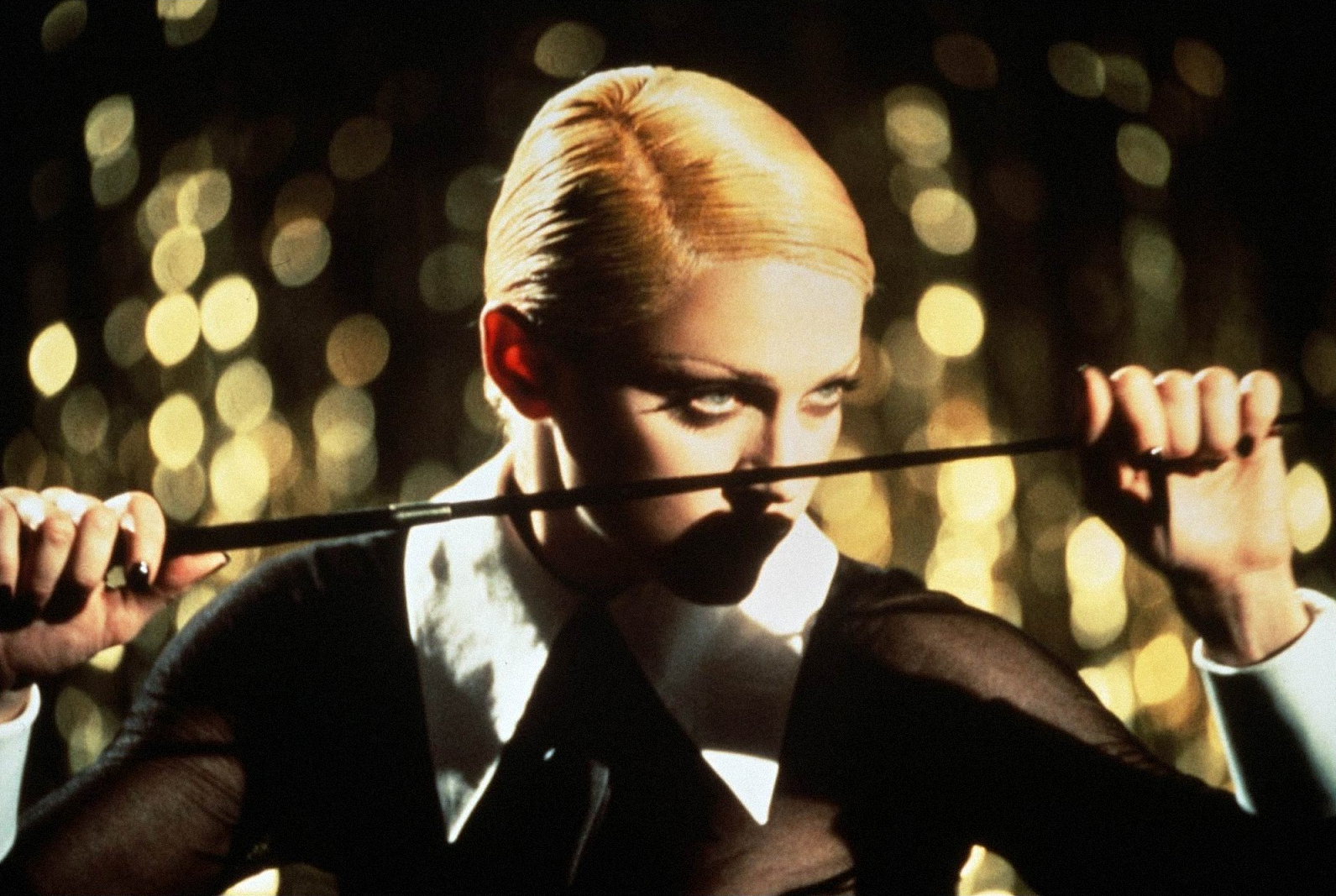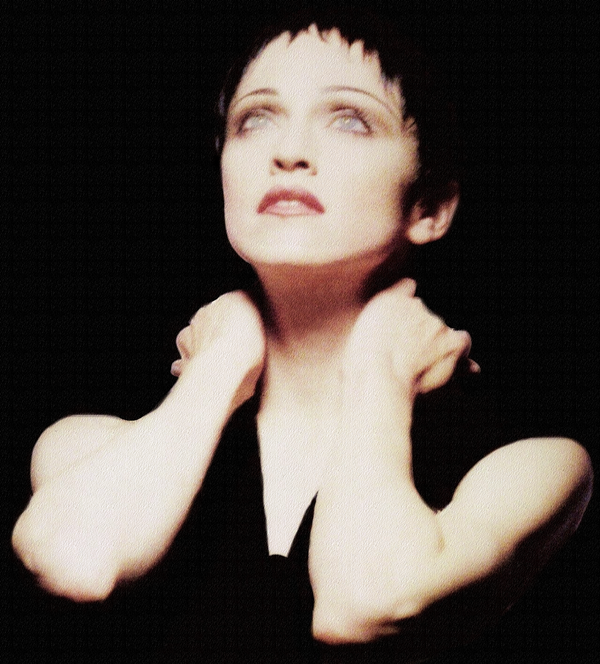
On August 25 1990, Hanky Panky peaked at #18 on the Canadian Top 100 Singles chart (RPM). At the time it was Madonna’s lowest charting Canadian single since Borderline‘s peak of #25 in September, 1984. A handful of later releases would subsequently peak lower on the same chart, however, including Bad Girl (#20 – 1993), Bedtime Story (#46 – 1995) and Human Nature (#64 – 1995).
Tag Archives: Music Videos
Today in Madonna History: August 24, 2014
On August 24 2014, Madonna was featured in a Forbes Magazine piece written by Hugh McIntyre examining the Most Expensive Music Videos Of All Time:
Of all the expensive music videos made over time (and there are quite a few), the top five are created by only two artists: Michael Jackson and Madonna. This shouldn’t come as much of a surprise, as those two legends are some of the only ones who would have enough clout to rustle up millions for a four-minute movie. While other artists typically use music videos as a way of selling more copies of a certain song or album, these two turned the music video into an art form, attempting to top themselves with each new project. (*Adjusted for inflation to 2013 dollars.)
5. Michael Jackson — “Black or White,” $6.9 million* (originally $4 million)
The lead single from Jackson’s Dangerous needed a video that would be many things all at once—fun, meaningful, and above all else, memorable.4. Madonna — “Bedtime Story,” $7.7 million* (originally $5 million)
“Bedtime Story” is the first of three Madonna music videos on this list, though the single it was made to promote is not one of the singer’s greatest successes. Directed by Mark Romanek, who would also direct the music video that ends up surpassing “Bedtime” as the single most expensive of all time. Not one to miss a publicity opportunity, Madonna premiered the video at movie theatres in New York City, Chicago, and Santa Monica. These days, it is housed permanently in a collection at the Museum of Modern Art in New York.3. Madonna — “Die Another Day,” $7.9 million* (originally $6.1 million)
While the song received mixed reviews from critics, Madonna’s Bond song went on to be the best-selling dance song of 2002 and 2003, and its video was nominated for a Grammy. The James Bond-inspired video has the legendary pop star fighting herself, which was a mixture of green screens and intricate and expensive special effects. A few years ago, Billboard ranked the song the #6 song from the Bond franchise.2. Madonna — “Express Yourself,” $9.4 million* (originally $5 million)
Madonna’s “Express Yourself” video cost $5 million to make back in 1989, making it the most expensive video ever made at the time. The clip, which was inspired by 1927 German science fiction film Metropolis was directed by David Fincher, who would go on to be nominated for Academy Awards for also directing both The Curious Case of Benjamin Button and The Social Network. The video sees the singer dressing in a masculine fashion, yet being as sexual as ever.1. Michael Jackson and Janet Jackson — “Scream,” $10.7 million* (originally $7 million)
The video for “Scream,” the first single off Michael’s HIStory: Past, Present and Future, Book I album is really one for the books, and one of the few videos that everybody remembers seeing for the first time.
(Source: Forbes Magazine – The Most Expensive Music Videos of All Time)
Today in Madonna History: August 22, 1992
On August 22 1992, Madonna filmed scenes for the Erotica music video at The Kitchen in New York City with fashion photographer/director/designer Fabien Baron. The scenes filmed consisted of Madonna in the character of her Sex book alter-ego, Dita, miming the lyrics to the song. The remainder of the video consisted of a selection of 8mm footage previously shot by Baron during the making of the Sex book.
Baron also served as art director for the Sex book, the Erotica album and single, and later for the Bedtime Stories album and its singles Secret and Take A Bow. He also directed the commercial for her fragrance, Truth Or Dare by Madonna, in 2012.
“She put that book out at the best moment. She timed it very well. She knows what she’s doing. And such drive. Some people want to lift stones and see what’s under it. She’ll be on a beach with millions of stones and want to lift every one of them.” – Fabien Baron
Today in Madonna History: August 21, 1993
On August 21 1993, Billboard magazine interviewed director Mark Romanek for a feature article about Madonna’s music video for Rain:
One rarely finds the use for such adjectives as “Zen-like,” spare, and sentimental in describing an outrageous, outspoken, and extreme performer like Madonna. Yet the artist’s new Maverick -Sire-Warner Bros. video “Rain,” directed by Mark Romanek for Satellite Films, conjures those very images against the understated elegance of a tenderly soothing ballad. The result is a Madonna who is chic yet vulnerable, glamorous yet sweet.
“The contradiction you face in shooting a Madonna video is that people expect something rather grand from her, and yet the feeling of the times is that things need to be simplified and stripped away,” says Romanek. The director admits he was a bit intimidated by the prospect of shooting a video that would mark a departure from Madonna’s ostentatious antics of the past. “The song is a bit sentimental, and you just can’t do something psychosexual and subversive with it,” he notes. “My challenge was to come up with something that seems glamorous and expensive, yet is spare and Zen-like at the same time.” Romanek chose to interpret “Rain” as an exercise in media manipulation and image-making. The clip is reeled as a video-within-a-video, as Madonna, the doe-eyed ingenue, performs for a Japanese film crew.
Music buffs may recognize the “director” in the clip as the photogenic composer Ryuichi Sakamoto. “By making it a Japanese thing, we made Madonna more vulnerable; she’s away from home, more out-of-place,” says Romanek. “It creates a nice subtext and makes her more sympathetic.” And by shooting a “crew” shooting a clip, Romanek created the kind of prefab, artificial scenario that would underscore the true emotion of “Rain.”
“We knew we needed some rain, but we didn’t want the clip to be too clichéd or too literal,” he notes. “So we figured if we have to have rain, let’s have fake rain.” That fake rain was contained in two tall “walls” that stand on either side of a simply clad Madonna. One shot looks deceptively plain, but as Romanek explains, “the amount of equipment, pipes, and lights that are hidden in that image, so that the walls appear to stand as simply as possible and look aesthetically correct, was huge.”
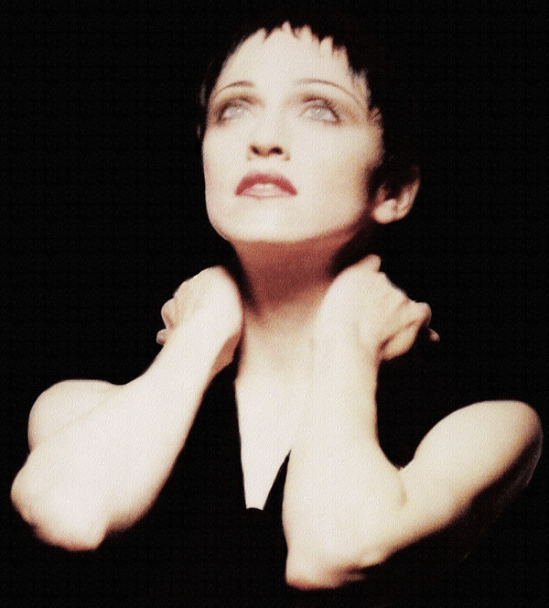
To further capture the crystalline essence of the song, Romanek and cinematographer Harris Savides chose to lens a number of rare, color closeups of Madonna’s face and features. But they were faced with the technical challenge of updating the traditional “Garbo lighting” used since film’s earliest days to flatter a star’s most arresting features. Madonna agreed to undergo a half day of camera tests, after which a new German lighting fixture was chosen to achieve a thoroughly modern, yet classic, effect. Icy blue eyes stare directly into the camera as full, lush lips sing the lyrics into an old-fashioned microphone. Of all the sequences in the “Rain” video, Romanek says he is proudest of these close-ups. It’s one of the hardest things to make something as simple as that possible,” the director says. “You need that kind of icon, like Madonna, to make a shot like that work.”
The Satellite crew spent four days making sure such aesthetically correct shots would work, including a windswept storm sequence on a stage, and an overhead shot of Madonna surrounded by a bed of open, black umbrellas. In nearly every shot, the graphic image is so compelling that the camera need never move.
Romanek, a founding director of Satellite, shares credit for “Rain” with producer Krista Montagna, stylist David Bradshaw, and editors John Murray and Jim Haygood. The clip’s cinematographer Savides and art director Jan Peter Flack have been nominated for an MTV Video Music Award.

Today in Madonna History: July 30, 1990
On July 30 1990, Madonna’s I’m Breathless album was certified double platinum (for shipment of two million units) in the USA.
In a 1994 interview with Q magazine, Madonna professed a particular fondness for the album:
“I would have to say the favourite record that I’ve made is the soundtrack to Dick Tracy. I love every one of those songs.”
Today in Madonna History: July 28, 1990
On July 28 1990, Hanky Panky hit its peak position of number-ten on the Billboard Hot 100 in the U.S.
The rarely seen official video for Hanky Panky was recorded at the May 27th 1990 concert in Toronto, Canada. Rather than use live audio from the tour, Warner opted to overdub the live performance with the album version. The video was broadcast for a few weeks and then withdrawn from rotation in most countries. Although no official reason was given, it is assumed that due to the low-budget nature of the video, it was only ever intended to serve as an initial promotional push for the song, with its subsequent withdrawal from rotation being part of the plan.
Today In Madonna History: July 26, 1986
On July 26 1986, Papa Don’t Preach spent its third and final week at number-one on the UK singles chart. It was certified Gold by BPI on August 1st, 1986 for shipment of over 500,000 copies, based on certification thresholds at that time. With a chart run extending for 15 weeks, the single ranked #8 overall in the UK’s year-end charts tally.
The song was a massive hit across Europe, topping the Eurochart for an incredible eleven week stretch from August 2nd through October 11th, 1986 when it was finally overtaken by none other than Madonna herself with the follow-up single, True Blue.
Although Justify My Love is often cited as being the first-ever video single, it is interesting to note that it was actually not the first Madonna music video to be marketed commercially as a single. Possibly an attempt to cash-in on the success and controversy surrounding Papa Don’t Preach or more likely as a means of testing out new marketing possibilities for a hybrid laserdisc/cd format, Warner issued limited quantities of Papa Don’t Preach as a CD Video in the US, UK and Japan containing three audio tracks along with the music video. Perhaps anticipating the limited appeal of the format, Warner did not bother modifying the track-listing to include the appropriate b-sides in either the UK (Ain’t No Big Deal) or Japan (Think Of Me), instead opting to issue the US b-side (Pretender) on all three pressings. Stranger still was the release date – 1988 – two years after the standard single hit stores. Needless to say, this early attempt to market a music video single did not stir public interest the way it would in 1990, and the concept went into hibernation mode until Madonna gave audiences a video single they were willing to pay for.