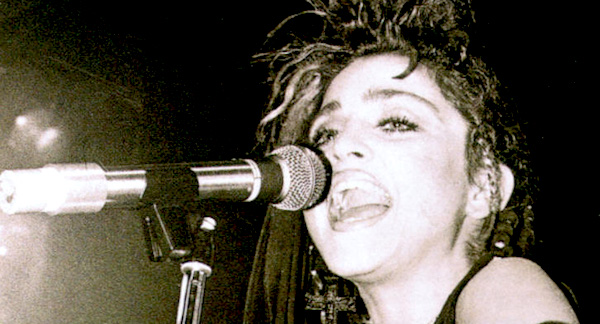






On September 24 1983, Madonna performed Physical Attraction, Everybody, Holiday and Burning Up at Uncle Sam’s Club in Levittown, New York.


On September 24 1983, Madonna performed Physical Attraction, Everybody, Holiday and Burning Up at Uncle Sam’s Club in Levittown, New York.


On July 27 1983, Madonna’s eponymous debut album was released by Sire Records. The record was renamed Madonna: The First Album for the 1985 international re-release of the album. When a remastered version of the album was issued on CD in 2001 (with bonus tracks) and later on vinyl (without bonus tracks), the original artwork was restored and the album title reverted to simply Madonna across all markets.
The album included 8 tracks (produced by Reggie Lucas, *John “Jellybean” Benitez & **Mark Kamins):
Five singles were issued from the album (the release chronology of some singles varied by market/country):
“Madonna was unhappy with the whole album, so I went in and sweetened up a lot of music for her, adding some guitars to ‘Lucky Star’, some voices, some magic… I just wanted to do the best job I could do for her. When we would playback ‘Holiday’ or ‘Lucky Star’, you could see that she was overwhelmed by how great it all sounded. You wanted to help her, you know? As much as she could be a bitch, when you were in a groove with her, it was very cool, very creative.”
— John “Jellybean” Benitez talking about Madonna and the album.
“I’ve refrained over the years in addressing aspects of Madonna’s career because I’m not a person who likes negative discussions. But what I will say is that in Madonna’s ascent to fame and fortune, there’s been a pretty vicious competition for credit in being involved. In other words, someone will say, ‘I launched Madonna.’ If I talk to a lot of people today, I will say I was Madonna’s first producer. I produced six of the eight tracks on her first record. I would say nine times out of 10, their response will be, ‘Oh yeah, I thought Jellybean did that.’ But Jellybean didn’t do that. Jellybean was a remixer, and we didn’t have time to remix records. It wasn’t something that I was interested in doing. Somewhere in this process of publicists and personal relationships, somehow he came out as the guy. Just for the record, one tires in a lifetime of hearing someone taking credit for something that you’ve done. Jellybean produced ‘Holiday’ and he remixed a couple of tracks, but remixing tracks for radio isn’t the same thing as producing one of the major breakout pop stars of the 1980s…it’s almost like I was fired or something. I wasn’t fired. I finished the record…and they put it out and sold a bunch of records. And everybody else ran around trying to take credit for it because it was so big that they couldn’t help themselves. … I must say, Madonna was great to work with in the studio. She really put in the work. She was a creative person.”
— Reggie Lucas, producer of Madonna’s first album.

Although its authenticity is unconfirmed, this is said to be an early track list of the album.

On May 21 1983, Madonna’s Burning Up/Physical Attraction hit #3 on USA Hot Dance Music/Club Play chart.
Burning Up was written by Madonna and Physical Attraction was written by Reggie Lucas. Both were produced by Lucas with additional remixing by Jellybean Benitez on the latter.
Interestingly, the original copyright claim filed for the song Physical Attraction, which remains on file at the U.S. Library Of Congress, lists Madonna as its sole writer and Only Child Music (who handled Madonna’s songwriting publishing prior to the creation of Webo Girl) as its publisher, with no mention of Lucas or his publishing company, Likasa Music.
Burning Up went through several incarnations both before and after its official release. The earliest recording of the song to have surfaced is a live performance by Madonna with her band Emmy, likely from 1980. Although the lyrics underwent only minor revisions in later years, its initial guitar-driven arrangement and melody were relatively loose – if not underdeveloped. A more focused beat-driven version was recorded by Madonna with Stephen Bray in early 1982 and was featured on the four-track demo tape that brought her to the attention of Sire Records. In addition to the originally released version that appeared on the 12″ single, there are also two noticeably different album mixes of Burning Up. Early vinyl pressings of her debut LP featured a longer version with alternate guitar and synth parts and more prominently mixed backing vocals. This alternate album mix resurfaced in 1985 as the b-side to the Angel single in the UK, but it has never been officially released in digital or CD format.

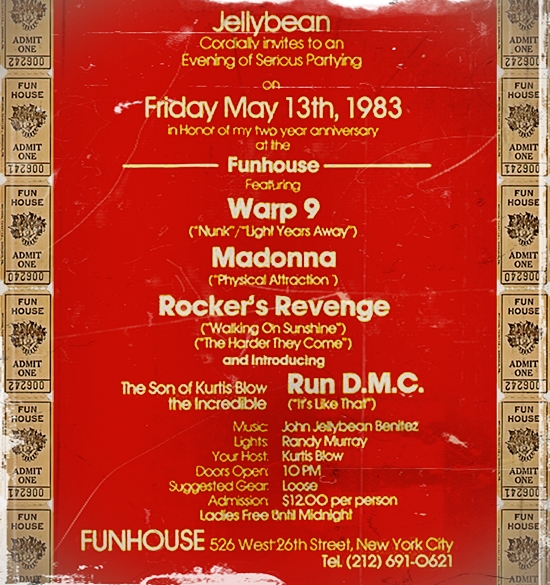
On May 13 1983, Madonna performed Physical Attraction during a track date at the FunHouse in New York City.
Located at 526 West 26th St, the FunHouse (1979-1985) was a breeding ground for the new electronic sounds of the street and helped to make its resident disc jockey, Jellybean Benitez, one of dance music’s first superstar DJ’s.
Of course, Jellybean’s close association with Madonna certainly didn’t hinder his growing popularity either. His first working collaboration with Madonna was to remix Physical Attraction, the b-side to her sophomore single on Sire Records, Burning Up/Physical Attraction, which may explain why it was chosen over the more frequently performed lead track for her performance at the FunHouse. The same remix of Physical Attraction was later used on her debut album, together with new remixes Jellybean provided for Burning Up and Lucky Star alongside his first full production for Holiday.

On April 30 1983, Madonna’s second single – the double A-side Burning Up/Physical Attraction – moved into the Top 10 on Billboard’s Dance/Disco Top 80 chart (now known as Hot Dance/Club Play), leaping from #18 to #9.
Interestingly, the release charted as Physical Attraction/Burning Up throughout its run on the Dance chart. When two songs are promoted together to dance clubs, Billboard will generally position the track that earns the higher number of spins first in its Dance chart entry.
The same Billboard issue also saw some early radio support for Madonna, as New York City’s WKTU-FM featured Physical Attraction among their top playlist adds for the week.


On March 9 1983, Madonna’s second single, the classic double A-side Burning Up/Physical Attraction, was released on 12″ vinyl.
The sleeve of the single featured a series of sketches of Madonna created by her close friend, Martin Burgoyne.


On October 13 1983, Madonna performed Burning Up, Everybody and Holiday at Camden Palace’s Thursday Party Night in London, England.
The following article about Madonna’s performance was originally published on October 15 1983 by The Guardian:
This could be the way pop promotion is going – new artists launched not with a full concert, but with the live equivalent of a video clip.
The scene at the Camden Palace in the early hours was like something from a British version of Flashdance. The place was packed with the usual exotically dressed clientele – there to see and be seen rather than just listen to the music – when the dancing was interrupted by what’s known on the American disco scene as a “track date.”
Pioneered by the likes of Grace Jones, this is a cut-price promotion device in which a disco artist suddenly appears for half an hour, singing live to backing tapes.
This demonstration was by a white girl in her early twenties, known simply as Madonna, a dancer who moved to New York from the Mid-West as an ambitious teenager and is currently the most important new figure in the American dance scene.
She succeeded partly because she makes great records and partly because she has turned the boring idea of a track date into an exotic event.
Dressed in holocaust chic – black top, black skirt and leggings, lots of bare midriff, and hair in ringlets – she sang well, with a husky, black-sounding voice, and danced even better. She hurtled around the stage, mostly swivelling her hips like a belly-dancer while performing her songs like Lucky Star and the stirring Holiday.
Given a full set and a live band behind her, Madonna would seem to have the makings of a major star, so it’s no wonder she is now being managed by the man who guided Michael Jackson’s recent career.