Today in Madonna History: September 4, 1993

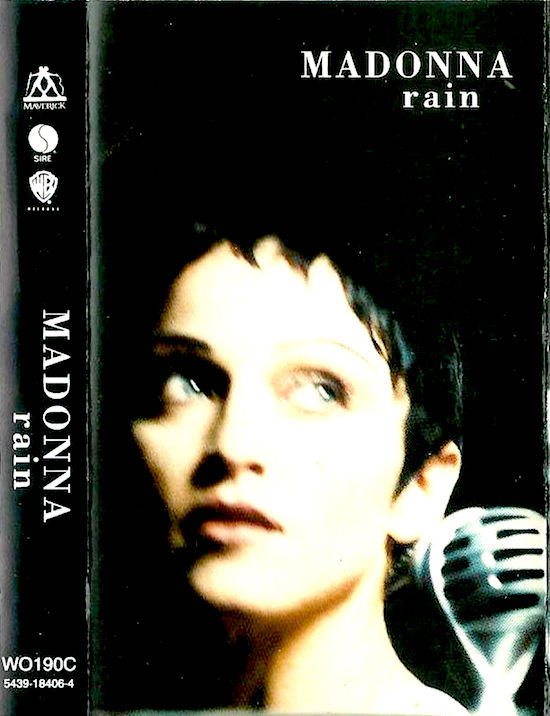
rain_uk_cassette_single-1 rain_uk_cassette_single-2 rain_uk_cassette_single-3

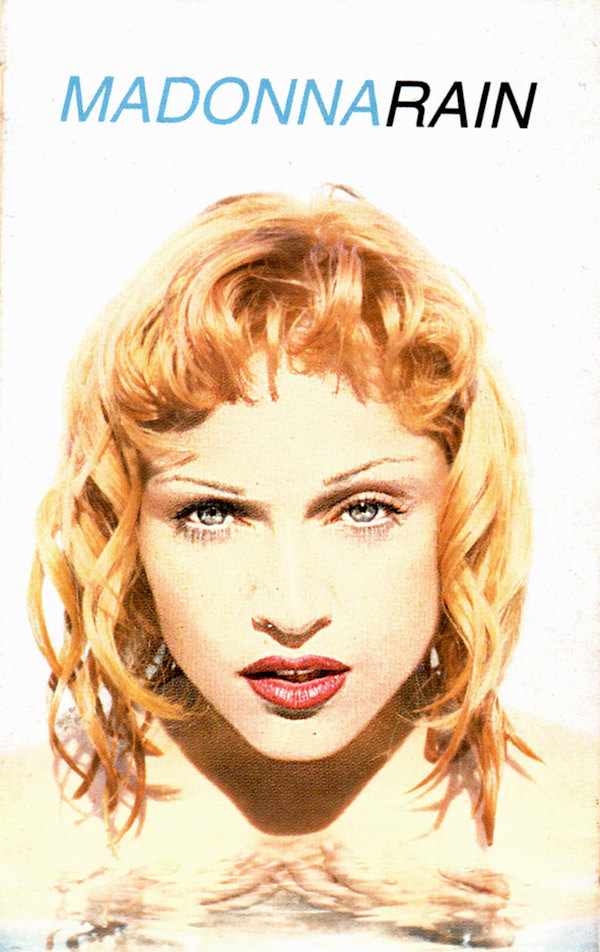
On September 4 1993, Madonna’s fifth single taken from her Erotica album, Rain, moved to #17 on the Billboard Hot 100 in the USA (after 7 weeks on the chart).

Rain is a gorgeous romantic moment from Madonna’s sorely under-appreciated Erotica opus. A slow and seductive rhyme base surrounded by cascading, sparkling, synths inspires a sweet and charming vocal…A wonderfully constructed, memorable tune that deserves as much attention (and airplay) as it can garner.”

– Billboard Magazine

Today in Madonna History: September 2, 1993

byebyebaby_vma_mtv_madonna 1993 MTV Movie Awards

On September 2 1993, Madonna opened the 1993 MTV Video Music Awards performing Bye Bye Baby.  She cavorted on stage with three scantily clad women in a brothel-style setting, dressed in tuxedos and top hats, in a choreographed, highly sexual routine.  According to choreographer Alex Magno, he wanted to do Justify My Love or The Beast Within on MTV, but Madonna decided that they might be too controversial for live television and abandoned the idea. Nevertheless, Bye Bye Baby was chosen and performed with the choreography they had been practicing for The Girlie Show World Tour, since it represented the whole idea behind the tour.  Louis Virtel from The Backlot ranked the performance at number eight on a list for Madonna’s 11 Greatest VMA Moments. He praised Madonna’s rendition of the song at the Video Music Awards, calling it “a hell of a VMA performance” and a “killer cinematic throwback”.

Today in Madonna History: August 21, 1993

On August 21 1993, Billboard magazine interviewed director Mark Romanek for a feature article about Madonna’s music video for Rain:

One rarely finds the use for such adjectives as “Zen-like,” spare, and sentimental in describing an outrageous, outspoken, and extreme performer like Madonna. Yet the artist’s new Maverick -Sire-Warner Bros. video “Rain,” directed by Mark Romanek for Satellite Films, conjures those very images against the understated elegance of a tenderly soothing ballad. The result is a Madonna who is chic yet vulnerable, glamorous yet sweet.

“The contradiction you face in shooting a Madonna video is that people expect something rather grand from her, and yet the feeling of the times is that things need to be simplified and stripped away,” says Romanek. The director admits he was a bit intimidated by the prospect of shooting a video that would mark a departure from Madonna’s ostentatious antics of the past. “The song is a bit sentimental, and you just can’t do something psychosexual and subversive with it,” he notes. “My challenge was to come up with something that seems glamorous and expensive, yet is spare and Zen-like at the same time.” Romanek chose to interpret “Rain” as an exercise in media manipulation and image-making. The clip is reeled as a video-within-a-video, as Madonna, the doe-eyed ingenue, performs for a Japanese film crew.

Music buffs may recognize the “director” in the clip as the photogenic composer Ryuichi Sakamoto. “By making it a Japanese thing, we made Madonna more vulnerable; she’s away from home, more out-of-place,” says Romanek. “It creates a nice subtext and makes her more sympathetic.” And by shooting a “crew” shooting a clip, Romanek created the kind of prefab, artificial scenario that would underscore the true emotion of “Rain.”

“We knew we needed some rain, but we didn’t want the clip to be too clichéd or too literal,” he notes. “So we figured if we have to have rain, let’s have fake rain.” That fake rain was contained in two tall “walls” that stand on either side of a simply clad Madonna. One shot looks deceptively plain, but as Romanek explains, “the amount of equipment, pipes, and lights that are hidden in that image, so that the walls appear to stand as simply as possible and look aesthetically correct, was huge.”

To further capture the crystalline essence of the song, Romanek and cinematographer Harris Savides chose to lens a number of rare, color closeups of Madonna’s face and features. But they were faced with the technical challenge of updating the traditional “Garbo lighting” used since film’s earliest days to flatter a star’s most arresting features. Madonna agreed to undergo a half day of camera tests, after which a new German lighting fixture was chosen to achieve a thoroughly modern, yet classic, effect. Icy blue eyes stare directly into the camera as full, lush lips sing the lyrics into an old-fashioned microphone. Of all the sequences in the “Rain” video, Romanek says he is proudest of these close-ups. It’s one of the hardest things to make something as simple as that possible,” the director says. “You need that kind of icon, like Madonna, to make a shot like that work.”

The Satellite crew spent four days making sure such aesthetically correct shots would work, including a windswept storm sequence on a stage, and an overhead shot of Madonna surrounded by a bed of open, black umbrellas. In nearly every shot, the graphic image is so compelling that the camera need never move.

Romanek, a founding director of Satellite, shares credit for “Rain” with producer Krista Montagna, stylist David Bradshaw, and editors John Murray and Jim Haygood. The clip’s cinematographer Savides and art director Jan Peter Flack have been nominated for an MTV Video Music Award.

Today in Madonna History: July 17, 1993

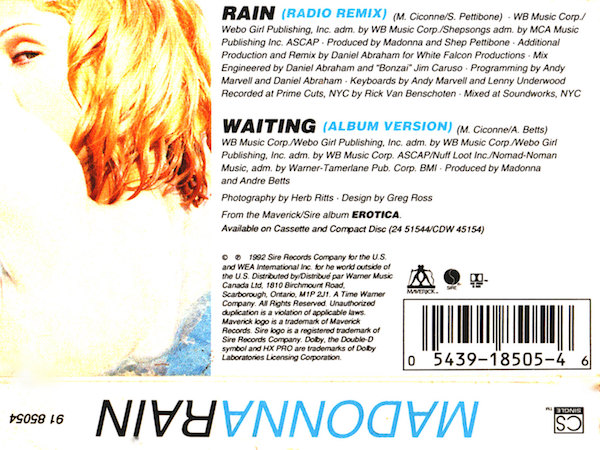
On July 17 1993, Rain was released as a single in North America. It was the fourth and final North American single from the Erotica album.

Following a cold reception to Madonna’s previous North American single – the bleak-but-beautiful Bad Girl Rain was given a glossy makeover by French record producer Daniel Abraham (who had recently completed a similar assignment with the video remix of Fever) to help ensure that it would receive a warmer welcome from radio programmers. The U.S. promotional CD that was serviced to radio by Maverick/Warner offered the choice between the sweetened “Radio Remix” (in full-length and edited form) or an edited album version, the latter of which was fittingly used in the song’s gorgeous music video.

As her label had correctly predicted, radio indeed favored the smoother sound of the “Radio Remix” over the darker, more dynamic (and in our opinion, more interesting) production-work of the album mix.

While not an all-out smash hit, Rain was the first single from the Erotica album to impact Billboard’s Hot AC chart, where it reached the Top 10, and it is generally viewed as an initial recovery step following the backlash Madonna had faced in the wake of the Sex book.

rain lyrics 550

Written and produced by Madonna & Shep Pettibone (unlike the majority of the tracks from Erotica, Tony Shimkin has not been added as co-writer, according to the Warner-Chappel publishing database), Rain was one of the earliest songs conceived during the Erotica album sessions. It appears as the first track on a two-cassette collection of demos from the album sessions submitted to the U.S. Library Of Congress for copyright registration.

The infamously sought-after set is often referred to by fans as The Rain Tapes because of the song’s prominent placement in its sequencing and also due to the likely unintentional visual prominence of the song’s title in the handwritten sleeve notes that accompanied the tapes.

Shep Pettibone created the song’s interesting use of panning percussion by digitally cutting and splicing samples of percussion breaks from an extended version of Scritti Politti’s 1985 hit, Perfect Way (and no, he was not involved with creating the remix). Although no sample credit was given on the album, considering the royalties the band would have earned for their inclusion on Madonna’s Who’s That Girl soundtrack, perhaps she figured that they owed her one.

Rain US Cassette Maxi Single Inner Sleeve

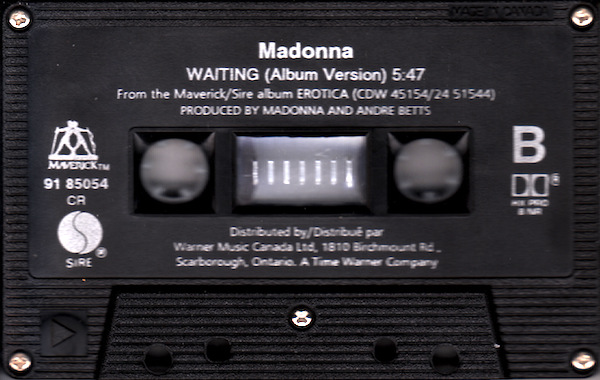
The Rain maxi-single was perhaps most notable for its inclusion of a non-album track, Up Down Suite, which was for all intents and purposes a dub remix of album outtake, Goodbye To Innocence (which remained unreleased at the time, aside from some vocal samples used in a promo-only remix of Fever). A new remix (featuring Everlast) of the Erotica album track, Waiting, was also included on the North American maxi-single, while its album version served as the single’s North American b-side.

With its poetically poignant and emotionally charged lyrics, percussive urgency and one of Madonna’s most ambitious uses of layered self-harmonization (not to mention it being accompanied by one of the most beautiful music videos ever created), it isn’t difficult to understand why Rain remains an enduring fan favorite.

“It’s strange
I feel like I’ve known you before
And I want to understand you
More and more and more
When I’m with you
I feel like a magical child
Everything strange
Everything wild

Waiting is the hardest thing
I tell myself that if I believe in you
In the dream of you
With all my heart and all my soul
That by sheer force of will
I will raise you from the ground
And without a sound you’ll appear
And surrender to me, to love”

Today in Madonna History: May 15, 1993

fever-promo-stand

On May 15 1993, Madonna’s Fever hit number-one on Billboard’s Hot Dance/Club chart in the USA. Fever was the fourth single from the Erotica album and was the b-side to Bad Girl in North America.

Today in Madonna History: May 14, 1993

arsenio-hall-1 arsenio-hall-2

On May 14 1993, the 1000th episode of The Arsenio Hall Show aired, featuring Madonna as the headline act.

The 1000th episode was an AIDS benefit concert and it was filmed at the Hollywood Bowl.

Madonna performed Fever as well as The Lady Is A Tramp with Anthony Keidis from the Red Hot Chilli Peppers.

Today in Madonna History: May 11, 1993

madonna-fever-video-2 550

On May 11 1993, the music video for Fever premiered on MTV. The video was directed by Stéphane Sednaoui.