On August 24 2014, Madonna was featured in a Forbes Magazine piece written by Hugh McIntyre examining the Most Expensive Music Videos Of All Time:
Of all the expensive music videos made over time (and there are quite a few), the top five are created by only two artists: Michael Jackson and Madonna. This shouldn’t come as much of a surprise, as those two legends are some of the only ones who would have enough clout to rustle up millions for a four-minute movie. While other artists typically use music videos as a way of selling more copies of a certain song or album, these two turned the music video into an art form, attempting to top themselves with each new project. (*Adjusted for inflation to 2013 dollars.)
5. Michael Jackson — “Black or White,” $6.9 million* (originally $4 million)
The lead single from Jackson’s Dangerous needed a video that would be many things all at once—fun, meaningful, and above all else, memorable.
4. Madonna — “Bedtime Story,” $7.7 million* (originally $5 million)
“Bedtime Story” is the first of three Madonna music videos on this list, though the single it was made to promote is not one of the singer’s greatest successes. Directed by Mark Romanek, who would also direct the music video that ends up surpassing “Bedtime” as the single most expensive of all time. Not one to miss a publicity opportunity, Madonna premiered the video at movie theatres in New York City, Chicago, and Santa Monica. These days, it is housed permanently in a collection at the Museum of Modern Art in New York.
3. Madonna — “Die Another Day,” $7.9 million* (originally $6.1 million)
While the song received mixed reviews from critics, Madonna’s Bond song went on to be the best-selling dance song of 2002 and 2003, and its video was nominated for a Grammy. The James Bond-inspired video has the legendary pop star fighting herself, which was a mixture of green screens and intricate and expensive special effects. A few years ago, Billboard ranked the song the #6 song from the Bond franchise.
2. Madonna — “Express Yourself,” $9.4 million* (originally $5 million)
Madonna’s “Express Yourself” video cost $5 million to make back in 1989, making it the most expensive video ever made at the time. The clip, which was inspired by 1927 German science fiction film Metropolis was directed by David Fincher, who would go on to be nominated for Academy Awards for also directing both The Curious Case of Benjamin Button and The Social Network. The video sees the singer dressing in a masculine fashion, yet being as sexual as ever.
1. Michael Jackson and Janet Jackson — “Scream,” $10.7 million* (originally $7 million)
The video for “Scream,” the first single off Michael’s HIStory: Past, Present and Future, Book I album is really one for the books, and one of the few videos that everybody remembers seeing for the first time.
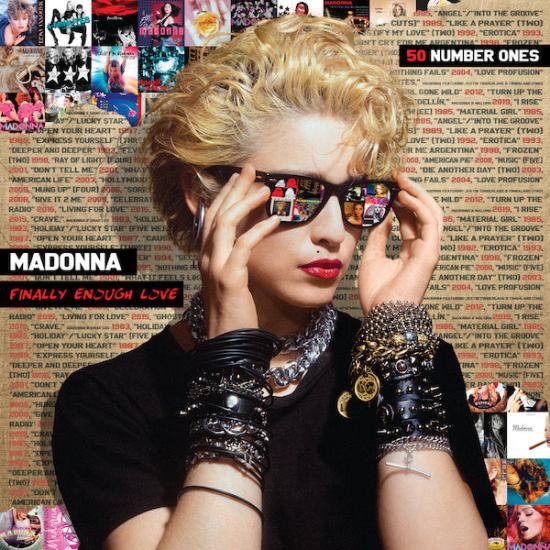
On May 4 2022, Warner Bros. issued the press release for Finally Enough Love: 50 Number Ones:
Madonna made history once again when she topped the Dance Club Songs chart for the 50th time, making her the first and only recording artist to have 50 #1 hits on any single Billboard chart.
To celebrate this historic milestone, Madonna curated two new collections: FINALLY ENOUGH LOVE: 50 NUMBER ONES, a new 50-track collection that includes her favorite remixes of those chart-topping dance hits that have filled clubs worldwide for four decades, and an abridged 16-track version, simply titled FINALLY ENOUGH LOVE.
These new collections will mark the first album releases to be part of the newly announced partnership between Madonna and Warner Music Group, which will feature an extensive series of catalog releases across her groundbreaking career.
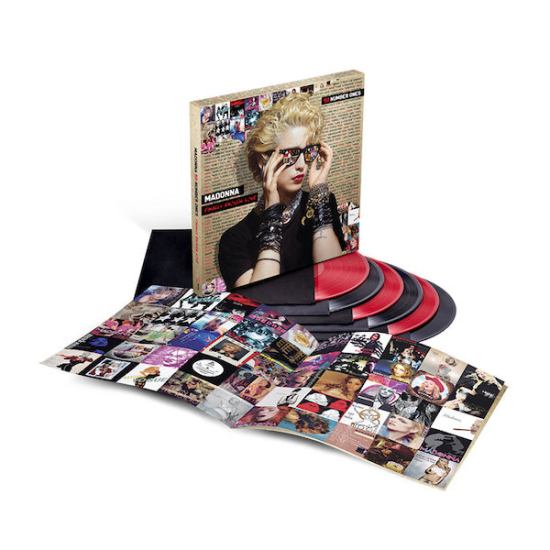
50 NUMBER ONES spans her entire dance club chart reign with dozens of remixes by the world’s top producers. In addition to fan favorites, the collection also includes a selection of rare remix recordings, with more than 20 being officially released for the first time or making their commercial/digital debut. The collection will be available digitally on August 19, along with a 3-CD ($29.98) version. A limited edition, 6-LP version on red and black vinyl ($149.98) will also be available, exclusively at Madonna’s official store and Rhino.com. Pre-order now.
The 16-track version, FINALLY ENOUGH LOVE, will be available for streaming on June 24, with 1-CD ($14.98) and 180-gram 2-LP ($34.98) versions coming on August 19. Pre-order and Pre-save now.
As a first listen to these collections, the “You Can Dance Remix Edit” of “Into The Groove” is available today digitally for the first time. Listen Now.
Boasting more than 220 minutes of remixes, FINALLY ENOUGH LOVE: 50 NUMBER ONES flows in mostly chronological order, showcasing the many musical reinventions that made Madonna an international icon, from 1983’s “Holiday” to 2019’s “I Don’t Search I Find,” with remixes by some of the biggest and most influential DJs of all time including Shep Pettibone, William Orbit, Honey Dijon, and Avicii.
On several songs, Madonna is joined by other incredible artists, including Britney Spears (“Me Against The Music”); Justin Timberlake and Timbaland (“4 Minutes”); and Nicki Minaj (“Bitch I’m Madonna.”) Each remix was newly remastered for the collection by Mike Dean, who produced Madonna’s two most-recent studio albums, Rebel Heart (2015) and Madame X (2019).
Both of these new collections also highlight You Can Dance, Madonna’s first ever remix collection. Celebrating 35 years this year, You Can Dance has sold more than five million copies worldwide and is still the second best-selling remix album of all time. The collection also pays homage to “Everybody,” Madonna’s first single, celebrating its 40th Anniversary on October 6. Madonna redesigned the album’s chronology by picking three edits from You Can Dance, including “Into The Groove”, “Everybody” and “Physical Attraction,” which reflects the underground club vibes that inspired her first recordings as a Sire artist.
Along with those rarities, these albums also introduce versions that are seeing their first ever official release, including the “Alternate Single Remix” of “Keep It Together,” the “Offer Nissim Promo Mix” of “Living For Love,” and more.
In advance of the debut of FINALLY ENOUGH LOVE in June, one of the 50 chart toppers – “Causing A Commotion” – was spotlighted early as an exclusive release for this year’s Record Store Day on April 23. Three remixes of the track appeared on the limited edition, five-track, red vinyl 12” EP Who’s That Girl Super Club Mix.
Expect more surprises to be revealed later this year around the celebration of Madonna’s 40 years in music.
FINALLY ENOUGH LOVE
16-Track Album
Streaming June 24
1-CD, 2-LP & Digital Download Versions Out August 19
Track Listing
1. “Everybody” (You Can Dance Remix Edit) +#
2. “Into The Groove” (You Can Dance Remix Edit) +#
3. “Like A Prayer” (Remix/Edit)
4. “Express Yourself” (Remix/Edit)
5. “Vogue” (Single Version) +
6. “Deeper And Deeper” (David’s Radio Edit) +#
7. “Secret” (Junior’s Luscious Single Mix)
8. “Frozen” (Extended Club Mix Edit)
9. “Music” (Deep Dish Dot Com Radio Edit)
10. “Hollywood” (Calderone & Quayle Edit) +#
11. “Hung Up” (SDP Extended Vocal Edit)
12. “Give It 2 Me” (Eddie Amador Club 5 Edit) °+
13. “Girl Gone Wild” (Avicii’s UMF Mix)
14. “Living For Love” (Offer Nissim Promo Mix) *+
15. “Medellín” (Offer Nissim Madame X In The Sphinx Mix) – Madonna and Maluma
16. “I Don’t Search I Find” (Honey Dijon Radio Mix)
FINALLY ENOUGH LOVE: 50 NUMBER ONES
50-Track Album
3-CD, 6-LP, Streaming & Digital Download Versions Out August 19
Track Listing
1. “Holiday” (7” Version) +
2. “Like A Virgin” (7” Version)
3. “Material Girl” (7” Version)
4. “Into The Groove” (You Can Dance Remix Edit) +#
5. “Open Your Heart” (Video Version) +
6. “Physical Attraction” (You Can Dance Remix Edit) +#
7. “Everybody” (You Can Dance Remix Edit) +#
8. “Like A Prayer” (Remix/Edit)
9. “Express Yourself” (Remix/Edit)
10. “Keep It Together” (Alternate Single Remix) *+
11. “Vogue” (Single Version) +
12. “Justify My Love” (Orbit Edit)
13. “Erotica” (Underground Club Mix)
14. “Deeper And Deeper” (David’s Radio Edit) +#
15. “Fever” (Radio Edit) +
16. “Secret” (Junior’s Luscious Single Mix)
17. “Bedtime Story” (Junior’s Single Mix)
18. “Don’t Cry For Me Argentina” (Miami Mix Edit)
19. “Frozen” (Extended Club Mix Edit)
20. “Ray Of Light” (Sasha Ultra Violet Mix Edit) +#
21. “Nothing Really Matters” (Club 69 Radio Mix) +
22. “Beautiful Stranger” (Calderone Radio Mix)
23. “American Pie” (Richard ‘Humpty’ Vission Radio Mix)
24. “Music” (Deep Dish Dot Com Radio Edit)
25. “Don’t Tell Me” (Thunderpuss Video Remix) +#
26. “What It Feels Like For A Girl” (Above And Beyond Club Radio Edit)
27. “Impressive Instant” (Peter Rauhofer’s Universal Radio Mixshow Mix) +#
28. “Die Another Day” (Deepsky Radio Edit) +#
29. “American Life” (Felix Da Housecat’s Devin Dazzle Edit) *+
30. “Hollywood” (Calderone & Quayle Edit) +#
31. “Me Against The Music” (Peter Rauhofer Radio Mix) + – Britney Spears feat. Madonna
32. “Nothing Fails” (Tracy Young’s Underground Radio Edit) *+
33. “Love Profusion” (Ralphi Rosario House Vocal Edit) +#
34. “Hung Up” (SDP Extended Vocal Edit)
35. “Sorry” (PSB Maxi Mix Edit) +#
36. “Get Together” (Jacques Lu Cont Vocal Edit) +
37. “Jump” (Axwell Remix Edit)
38. “4 Minutes” (Bob Sinclar Space Funk Edit) + – feat. Justin Timberlake & Timbaland
39. “Give It 2 Me” (Eddie Amador Club 5 Edit) +#
40. “Celebration” (Benny Benassi Remix Edit)
41. “Give Me All Your Luvin’” (Party Rock Remix) – feat. LMFAO & Nicki Minaj
42. “Girl Gone Wild” (Avicii’s UMF Mix)
43. “Turn Up The Radio” (Offer Nissim Remix Edit) *+#
44. “Living For Love” (Offer Nissim Promo Mix) *+
45. “Ghosttown” (Dirty Pop Intro Remix)
46. “Bitch I’m Madonna” (Sander Kleinenberg Video Edit) +# – feat. Nicki Minaj
47. “Medellín” (Offer Nissim Madame X In The Sphinx Mix) – Madonna and Maluma
48. “I Rise” (Tracy Young’s Pride Intro Radio Remix)
49. “Crave” (Tracy Young Dangerous Remix) – feat. Swae Lee
50. “I Don’t Search I Find” (Honey Dijon Radio Mix)
* previously unreleased
+available digitally for the first time
# available commercially for the first time
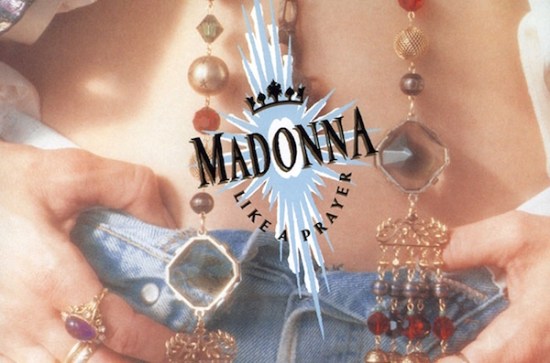
On March 22 2017, The Huffington Post published an article titled, “Why Madonna’s Like A Prayer Is The Most Important Album Ever Made By A Female Artist.”
28 years ago this week, Madonna released what is not only her best album to date, but also what could be the most important release ever by a female artist. That’s not to say that Like a Prayer is the best album ever by a female artist, but it’s pretty close. After six years of being considered pop fluff and a disco dolly, Madonna was finally taken seriously by most music critics in 1989. Still, Like a Prayer deserved even more than bewildering critical acclaim.
If Madonna and misogyny weren’t practically synonyms, Like a Prayer would have not only won several Grammys in 1990 (it didn’t even earn any major nominations), but it would be widely praised for its songwriting and production 28 years later. If a man delivered the same type of vocals Madonna did on Like a Prayer, critics would note that his voice isn’t technically perfect, but distinct, melodic, and full of emotion. When it comes to Madonna, who certainly could never hit the notes of Aretha Franklin or Whitney Houston, it’s just easier for people to say that she “can’t sing.”
For people (especially millennials) to understand how important Like a Prayer is to culture and music, they have to comprehend the repressive environment Madonna’s album arrived to in March of 1989. The late 1980s was ruled by the religious right, who believed AIDS was a curse God gave to the gay community. Women who were outspoken or wore revealing clothes were referred to as sluts, whores, bitches, etc. Police brutality among African Americans was still widely accepted without much of a backlash. And interracial dating was still considered a taboo.
The pamphlet on AIDS Madonna included with each copy of Like a Prayer alone proves that the notion of Madonna being a bad role model and having a bad influence on Generation X (especially women and teenagers) just isn’t true. Madonna educated many about AIDS and safe sex at a time when schools, the media, and religious institutions stayed away from the topic. A move like this in 1989 could have hurt a showbiz career, but Madonna survived and thrived by doing the right thing and, possibly, helping to save lives at the same time.
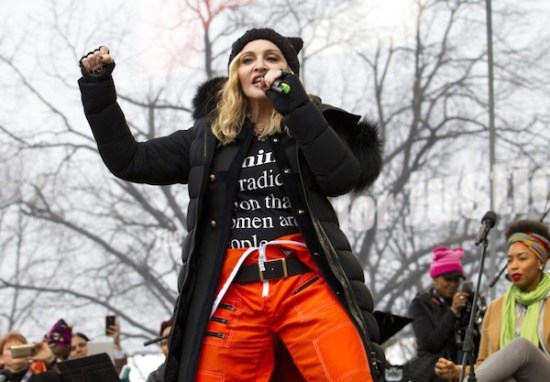
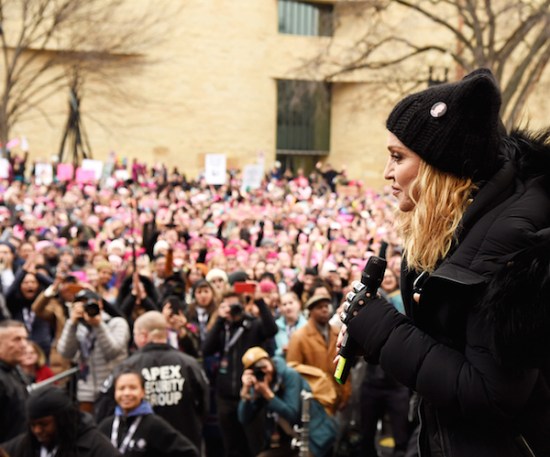
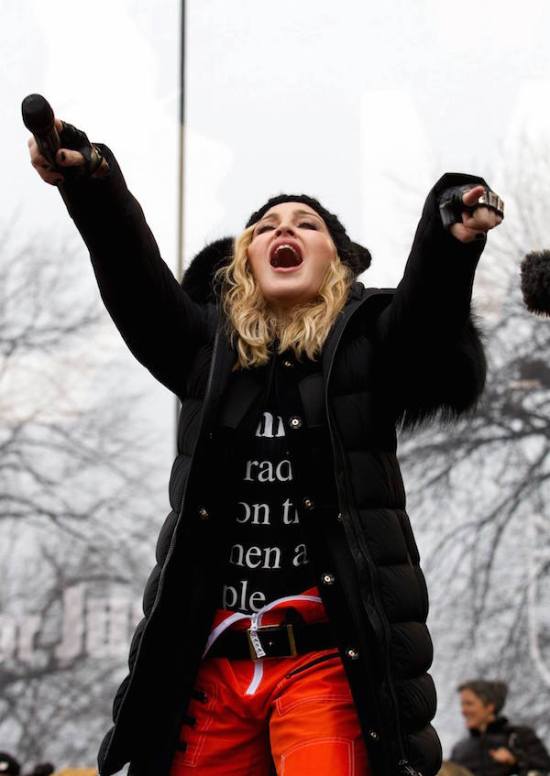
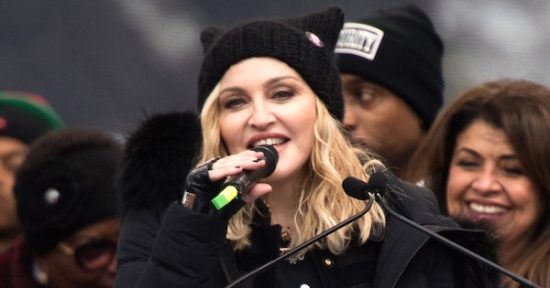
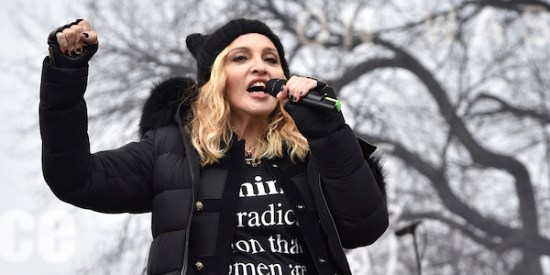
On January 22 2017, Madonna released this statement in response to her controversial statements made during her speech at the Women’s March on Washington:
“Yesterday’s Rally was an amazing and beautiful experience. I came and performed Express Yourself and thats exactly what i did.
However I want to clarify some very important things. I am not a violent person, I do not promote violence and it’s important people hear and understand my speech in it’s entirety rather than one phrase taken wildly out of context.
My speech began with ” I want to start a revolution of love.” ♥️ I then go on to take this opportunity to encourage women and all marginalized people to not fall into despair but rather to come together and use it as a starting point for unity and to create positive change in the world.
I spoke in metaphor and I shared two ways of looking at things — one was to be hopeful, and one was to feel anger and outrage, which I have personally felt. However, I know that acting out of anger doesn’t solve anything. And the only way to change things for the better is to do it with love.
It was truly an honor to be part of an audience chanting we choose love.”
On November 26 1992, Rolling Stone magazine published their review of Madonna’s Erotica album, written by Arion Berger:
It took Madonna ten years, but she finally made the record everyone has accused her of making all along. Chilly, deliberate, relentlessly posturing. Erotica is a post-AIDS album about romance — it doesn’t so much evoke sex as provide a fetishistic abstraction of it. She may have intended to rattle America with hot talk about oral gratification and role switching, but sensuality is the last thing on the album’s mind. Moving claustrophobically within the schematic confines of dominance and submission, Erotica plays out its fantasies with astringent aloofness, unhumid and uninviting. The production choices suggest not a celebration of the physical but a critique of commercial representations of sex — whether Paul Verhoeven’s, Bruce Weber’s or Madonna’s — that by definition should not be mistaken for the real thing. It succeeds in a way the innocent post-punk diva of Madonna and the thoughtful songwriter of Like a Prayer could not have imagined. Its cold, remote sound systematically undoes every one of the singer’s intimate promises.
Clinical enough on its own terms when compared with the lushness and romanticism of Madonna’s past grooves, Erotica is stunningly reined in; even when it achieves disco greatness, it’s never heady. Madonna, along with co-producers Andre Betts and Shep Pettibone, tamps down every opportunity to let loose — moments ripe for a crescendo, a soaring instrumental break, a chance for the listener to dance along, are over the instant they are heard. Erotica is Madonna’s show (the music leaves no room for audience participation), and her production teases and then denies with the grim control of a dominatrix.
Against maraca beats and a shimmying horn riff, Erotica introduces Madonna as “Mistress Dita,” whose husky invocations of “do as I say” promise a smorgasbord of sexual experimentation, like the one portrayed in the video for Justify My Love. But the sensibility of Erotica is miles removed from the warm come-ons of Justify My Love, which got its heat from privacy and romance — the singer’s exhortations to “tell me your dreams.” The Madonna of Erotica is in no way interested in your dreams; she’s after compliance, and not merely physical compliance either. The song demands the passivity of a listener, not a sexual partner. It’s insistently self-absorbed — Vogue with a dirty mouth, where all the real action’s on the dance floor.
Look (or listen) but don’t touch sexuality isn’t the only peep-show aspect of this album; Erotica strives for anonymity the way True Blue strove for intimacy. With the exception of the riveting Bad Girl, in which the singer teases out shades of ambiguity in the mind of a girl who’d rather mess herself up than end a relationship she’s too neurotic to handle, the characters remain faceless. It’s as if Madonna recognizes the discomfort we feel when sensing the human character of a woman whose function is purely sexual. A sex symbol herself, she coolly removes the threat of her own personality.
Pure disco moments like the whirligig Deeper and Deeper don’t need emotional resonance to make them race. But the record sustains its icy tone throughout the yearning ballads (Rain, Waiting) and confessional moods (Secret Garden). Relieved of Madonna’s celebrity baggage, they’re abstract nearly to the point of nonexistence — ideas of love songs posing as the real thing. Even when Madonna draws from her own life, she’s all reaction, no feeling: The snippy Thief of Hearts takes swipes at a man stealer but not out of love or loyalty toward the purloined boyfriend, who isn’t even mentioned.
By depersonalizing herself to a mocking extreme, the Madonna of Erotica is sexy in only the most objectified terms, just as the album is only in the most literal sense what it claims to be. Like erotica, Erotica is a tool rather than an experience. Its stridency at once refutes and justifies what her detractors have always said: Every persona is a fake, the self-actualized amazon of Express Yourself no less than the breathless baby doll of Material Girl. Erotica continually subverts this posing to expose its function as pop playacting. The narrator of Bye Bye Baby ostensibly dumps the creep who’s been mistreating her, but Madonna’s infantile vocal and flat delivery are anything but assertive — she could be a drag queen toying with a pop hit of the past. Erotica is everything Madonna has been denounced for being — meticulous, calculated, domineering and artificial. It accepts those charges and answers with a brilliant record to prove them.
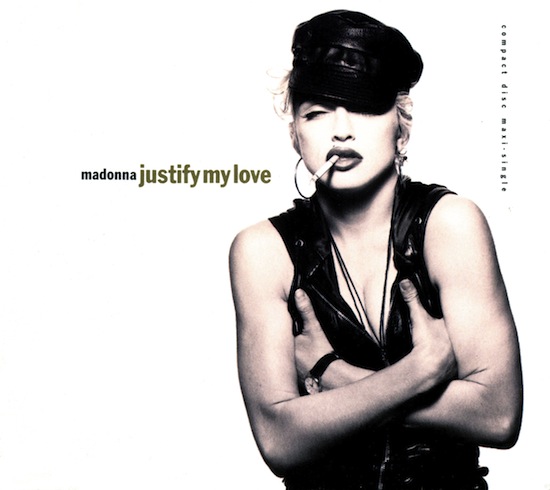
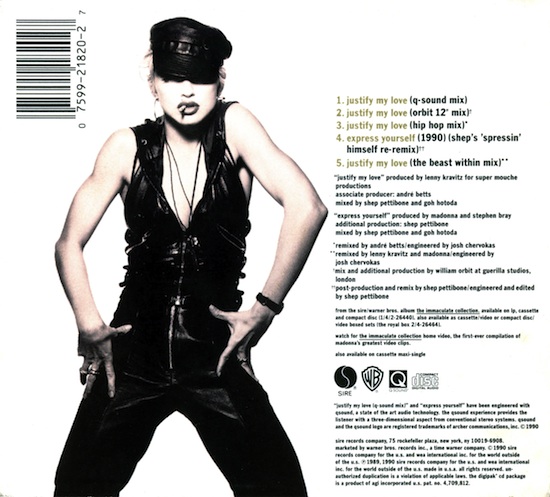
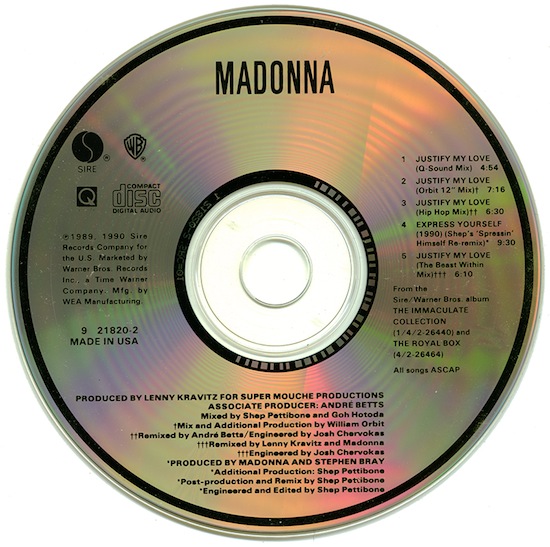
On November 6 1990, Madonna’s Justify My Love single was released as the first single from The Immaculate Collection, Madonna’s first greatest hits collection.
In the United States, Justify My Love peaked at number one for two weeks on the Billboard Hot 100 Singles chart. It also topped the Billboard Top 40 Tracks and Billboard Hot Dance Club Play charts.