Today in Madonna History: July 17, 1993

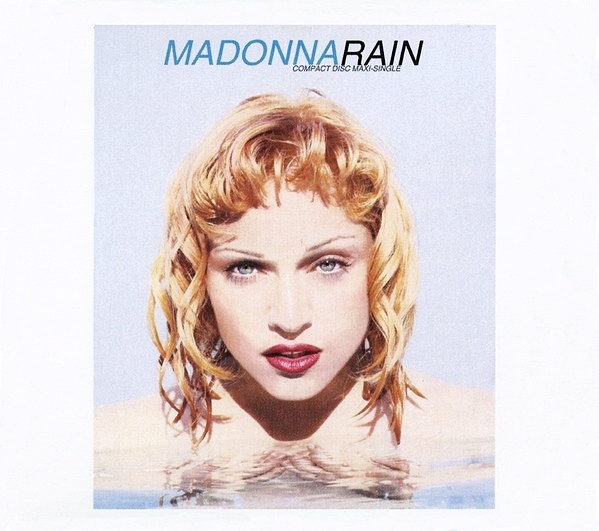
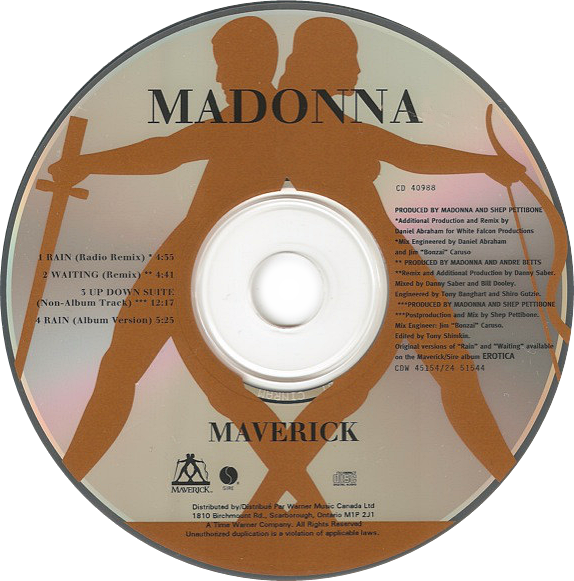
On July 17 1993, Rain was released as a single in North America. It was the fourth and final North American single from the Erotica album.

Following a cold reception to Madonna’s previous North American single – the bleak-but-beautiful Bad Girl Rain was given a glossy makeover by French record producer Daniel Abraham (who had recently completed a similar assignment with the video remix of Fever) to help ensure that it would receive a warmer welcome from radio programmers. The U.S. promotional CD that was serviced to radio by Maverick/Warner offered the choice between the sweetened “Radio Remix” (in full-length and edited form) or an edited album version, the latter of which was fittingly used in the song’s gorgeous music video.

As her label had correctly predicted, radio indeed favored the smoother sound of the “Radio Remix” over the darker, more dynamic (and in our opinion, more interesting) production-work of the album mix.

While not an all-out smash hit, Rain was the first single from the Erotica album to impact Billboard’s Hot AC chart, where it reached the Top 10, and it is generally viewed as an initial recovery step following the backlash Madonna had faced in the wake of the Sex book.

rain lyrics 550

Written and produced by Madonna & Shep Pettibone (unlike the majority of the tracks from Erotica, Tony Shimkin has not been added as co-writer, according to the Warner-Chappel publishing database), Rain was one of the earliest songs conceived during the Erotica album sessions. It appears as the first track on a two-cassette collection of demos from the album sessions submitted to the U.S. Library Of Congress for copyright registration.

The infamously sought-after set is often referred to by fans as The Rain Tapes because of the song’s prominent placement in its sequencing and also due to the likely unintentional visual prominence of the song’s title in the handwritten sleeve notes that accompanied the tapes.

Shep Pettibone created the song’s interesting use of panning percussion by digitally cutting and splicing samples of percussion breaks from an extended version of Scritti Politti’s 1985 hit, Perfect Way (and no, he was not involved with creating the remix). Although no sample credit was given on the album, considering the royalties the band would have earned for their inclusion on Madonna’s Who’s That Girl soundtrack, perhaps she figured that they owed her one.

Rain US Cassette Maxi Single Inner Sleeve

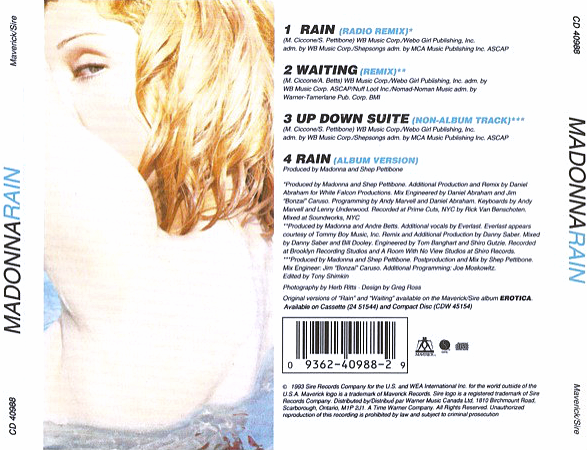
The Rain maxi-single was perhaps most notable for its inclusion of a non-album track, Up Down Suite, which was for all intents and purposes a dub remix of album outtake, Goodbye To Innocence (which remained unreleased at the time, aside from some vocal samples used in a promo-only remix of Fever). A new remix (featuring Everlast) of the Erotica album track, Waiting, was also included on the North American maxi-single, while its album version served as the single’s North American b-side.

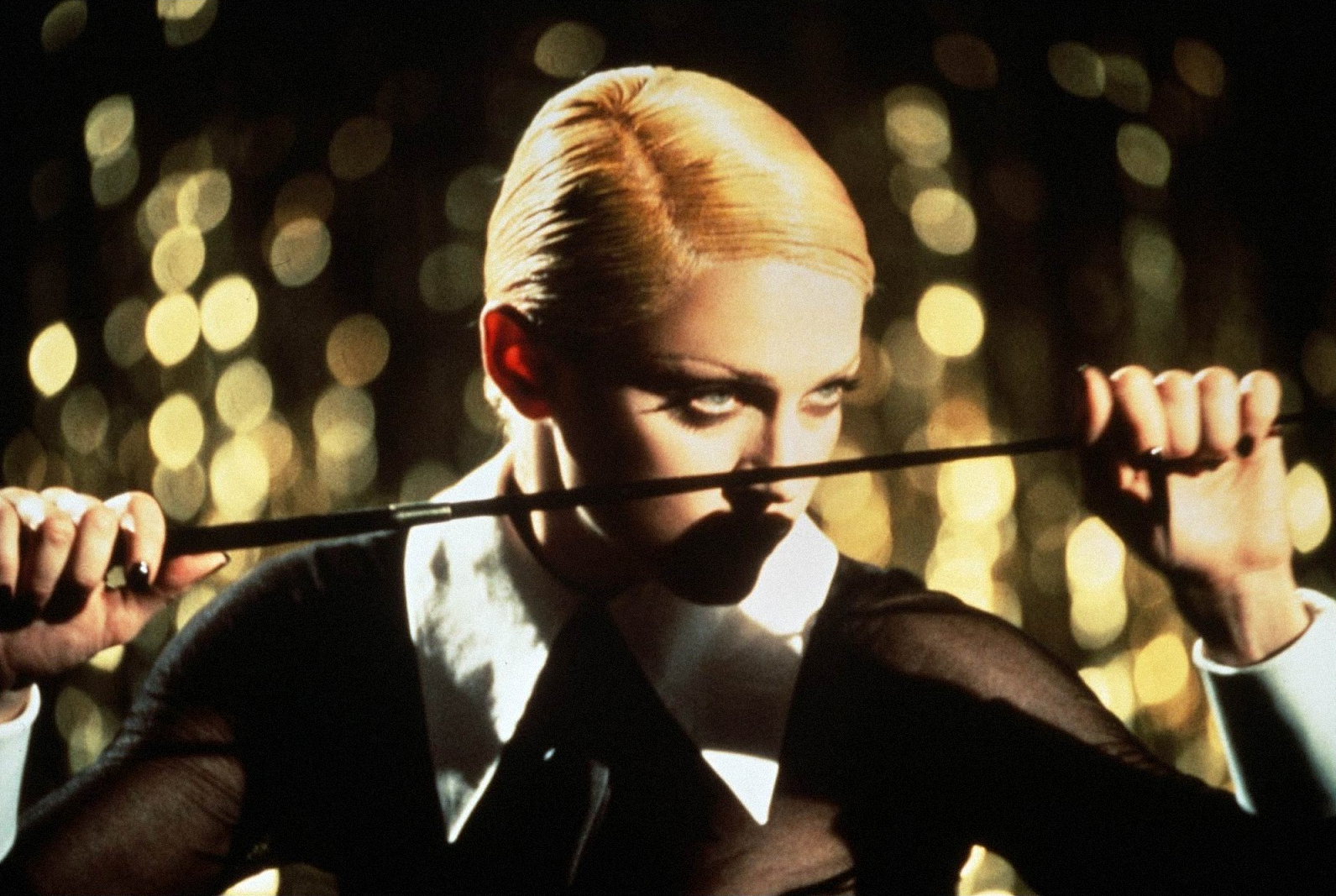
With its poetically poignant and emotionally charged lyrics, percussive urgency and one of Madonna’s most ambitious uses of layered self-harmonization (not to mention it being accompanied by one of the most beautiful music videos ever created), it isn’t difficult to understand why Rain remains an enduring fan favorite.

“It’s strange
I feel like I’ve known you before
And I want to understand you
More and more and more
When I’m with you
I feel like a magical child
Everything strange
Everything wild

Waiting is the hardest thing
I tell myself that if I believe in you
In the dream of you
With all my heart and all my soul
That by sheer force of will
I will raise you from the ground
And without a sound you’ll appear
And surrender to me, to love”

Today In Madonna History: July 15, 1995

On July 15 1995, Madonna’s Human Nature single peaked at #46 on the Billboard Hot 100 in the U.S.

Human Nature was written and produced by Madonna and Dave Hall, with its bass and percussion parts sampled from the track What You Need by Main Source.

The North American Human Nature single was backed with the album version of Sanctuary, which was produced by Madonna & Dallas Austin with additional remixing by Nellee Hooper.

Sanctuary was originally written by Anne Preven and Scott Cutler of the short-lived 90’s band, Ednaswap, best known for Nathalie Imbruglia’s cover of their original song, Torn. Madonna was passed a demo tape of Sanctuary by a friend of Preven and Cutler, who heard an early version of it and thought “Madonna would love this song!” Madonna’s version came out before Ednaswap had even signed a record deal, and the song deviated significantly from the demo. Preven originally thought Madonna had ruined the song, going so far as meeting with Madonna to plead for changes. However, upon hearing the song as part of the whole album, Preven had a change of heart and “understood what [Madonna] was going for.”

The most significant change was Austin and Madonna’s interpolation of Sanctuary with an instrumental demo Austin had created which centers around a looped sample from Herbie Hancock’s Watermelon Man (the funk-based arrangement from his 1973 album, Head Hunters). Madonna also provided additional lyrical and melodic contributions.

While Austin’s instrumental demo that was worked in to Sanctuary later leaked to the internet, Ednaswap did not release their own version of the song and their original demo recording has yet to surface online.

Today in Madonna History: June 30, 1997

On June 30 1997, Madonna began recording sessions for what would become her Ray Of Light album at Larrabee North Recording Studios, Universal City, Los Angeles.

Madonna had already spent several months writing songs and producing demos with Patrick Leonard, Rick Nowels and Babyface (although none of the Babyface material would make the final cut) by the time she entered the studio with co-producers William Orbit and Marius De Vries. Leonard would return to the project to assist with arrangements, earning him a co-producer’s credit on four of the album’s tracks. Madonna would add lyrics and melody to at least a half-dozen previously composed Orbit demos during these sessions as well, with six of their songs making the final cut.

One song that came very close to being included on the album, Has To Be, was dropped due to Madonna’s desire to limit the number of songs on the album to lucky number thirteen. In a final toss-up between Has To Be and To Have And Not To Hold, the former was nixed in favor of the latter. Has To Be would fortunately make it to the ears of fans, however, due to its inclusion as a bonus track on the Japanese edition of the Ray Of Light album, and as the international b-side to the Ray Of Light single.

Has To Be was born as a collaboration between Madonna and Patrick Leonard. Recently surfaced demos from their writing session include two early versions of the song – the first is a piano-based arrangement in a similar style to the previous Madonna/Leonard collaboration, Something To Remember, while the second demo is an experimental synth-based reworking.

After entering the studio with William Orbit, Madonna adapted Has To Be to one of Orbit’s previously composed electronic soundscapes. Although the original Orbit instrumental piece with celestial voices has never been commercially released, it had previously aired on Orbit’s weekly radio series, Stereo Odyssey, on California’s KCRW prior to his involvement with Madonna. A sound file of the original instrumental that has circulated among fans is a recording from one of these broadcasts.

Although the released version of Has To Be is substantially different from the early Leonard demos, enough elements from its original melody lines (which were based on Leonard’s piano phrases) were carried over to warrant a three-way publishing split between Madonna/Orbit/Leonard for its official release.

Despite its relative obscurity, in fan circles Has To Be often ranks among her most beloved ballads.

Today in Madonna History: June 29, 1998

Ray of Light Canadian CD Single cover insert back Ray of Light Canadian CD Single tray insertRay of Light Canadian CD Single disc

On June 29 1998, Madonna’s Ray of Light single peaked at #3 on RPM’s Top 100 Canadian Singles chart.

As with all the Canadian singles from the Ray of Light album, the title track was issued by Warner Music Canada as a 2-track CD single and as a CD maxi-single. In the U.S., the album’s CD singles were issued in cardboard sleeves with “draw pack” trays and the CD maxi-singles in “FLP digipak” cases, while in Canada the two configurations for each of the album’s four domestic singles were packaged in standard CD jewel cases with printed inserts.

Today in Madonna History: June 27, 2015

On June 27 2015, Bitch I’m Madonna earned Top Breakout and Most Added track on Billboard’s Hot Dance Club Play chart in the U.S.

Today in Madonna History: May 31, 1986

On May 31 1986, Madonna’s Live To Tell hit #1 for 3 weeks on US Hot Adult Contemporary singles chart.

The haunting and dramatic ballad, written and produced by Madonna & Patrick Leonard, was the first commercially released collaboration between the pair – a songwriting partnership that is viewed by many fans as one of her most creatively successful.

Leonard had previously been involved with Madonna’s Virgin Tour as musical director, and when Madonna agreed to participate in Live Aid in the Summer of 1985, she asked him to collaborate on a new song for the performance, which evolved into Love Makes The World Go Round.

Although both songs would find their way on to Madonna’s next studio album, True Blue, at the time of Live To Tell’s release the album’s title had not yet been decided. Instead, the song was used to promote Sean Penn’s film At Close Range, in which it was featured alongside an original score composed by Leonard.

He had initially composed the music that evolved into Live To Tell for another film he had been invited to score for Paramount, titled Fire With Fire. The producers of the film passed on the theme. Leonard recalled the subsequent series of events that led to the song’s completion in The Billboard Book of Number One Hits by Random House:

“Madonna said ‘This song would be great for Sean’s new movie.’ She wrote the lyrics–she just wrote them on the spot, which is what we always do. I don’t think we’ve ever taken more than three hours to complete a song from start to finish. She sang it on the demo only once and left with the cassette. That day I went to work with Michael Jackson on some transcriptions for material he was writing for the Bad album. The phone rang at Michael’s and it was Sean. He said ‘I’m over at the director’s house and Madonna just brought the song over. We love it and we’d like to talk to you about it.’ … We re-cut the song, but we used the same vocal. She only sang it once for the demo and that was the vocal we used because it was so innocent and so shy. She had a legal pad in her hand and you can hear the paper. It’s as raw as raw can be and that’s part of what gave it all its charm.”

When the demo recording of Live To Tell eventually surfaced, it became evident that Madonna had in fact re-recorded the first verse, but all remaining vocals do indeed appear to have been carried over from the demo to the final mix (along with a generously added dose of reverb to smooth over the rough edges of the demo take).

Given the song’s dark undercurrents and unresolved narrative, it was a bold choice for a single release. It marked a dramatic shift from the yearning love song, Crazy For You – her only other ballad to have been issued as a single at the time. But any radio programmers who were hesitant to consider Madonna as a serious artist simply couldn’t deny the artistry of the song and nor could record buyers, with the combined support sending Live To Tell straight to the top of the pop charts.

Live To Tell was Madonna’s third #1 single on the Billboard Hot 100, and her first #1 on the Adult Contemporary chart, where it would reign for three weeks.

Today in Madonna History: May 28, 1994

On May 28 1994, I’ll Remember (Theme From The Motion Picture With Honors) peaked at #2 on Billboard’s Hot 100 Singles Sales chart (one week), Hot 100 Airplay chart (five weeks) and Top 40 Mainstream chart (three weeks).

This combined push allowed the single to reach its overall peak of #2 on the Hot 100 Singles chart.

Had the single’s slower growing success on the Hot AC chart (which would peak at #1 for four weeks beginning June 11th) aligned with its sales peak on May 28th, I’ll Remember might have advanced to the top spot on the Hot 100. Instead, a very respectable four-week run at #2 would have to do.