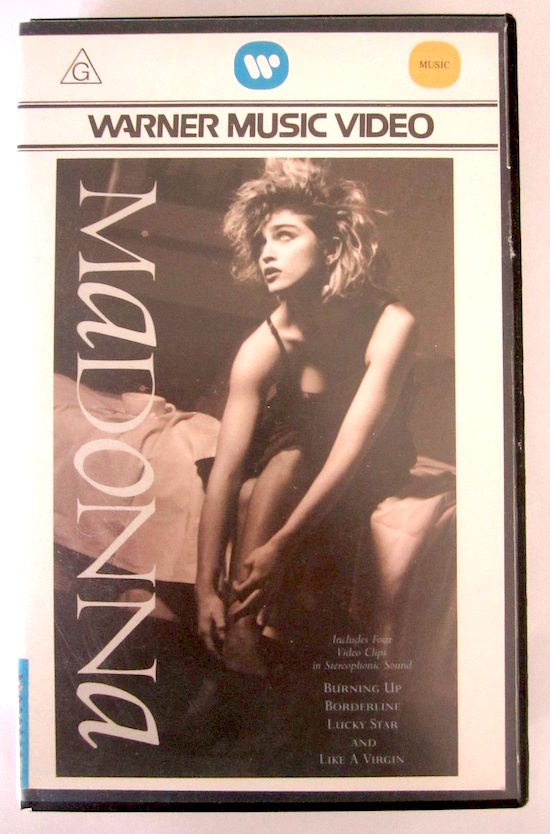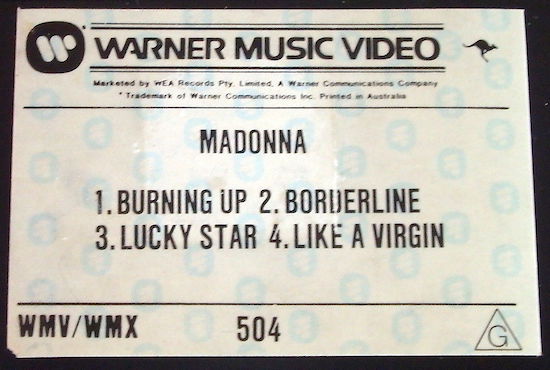
On May 31 1985, Madonna The Videos was certified platinum for shipment of 50,000 units in the USA.
The photos above show the Australian release of Madonna The Videos on VHS.

On May 31 1985, Madonna The Videos was certified platinum for shipment of 50,000 units in the USA.
The photos above show the Australian release of Madonna The Videos on VHS.
On May 23 1985, Madonna accepted a Canadian Quadruple Platinum certification award for shipment of over 400,000 copies of her second album, Like A Virgin, within Canada. The award was presented by WEA Canada’s VP of sales Garry Newman to Madonna and Sire Records president Seymour Stein prior to her sold-out Toronto concert at Maple Leaf Gardens.
Like A Virgin was eventually certified (in July, 1992) with the rare Canadian Diamond certification for shipment of over one million copies in Canada. The only other Madonna album to date to receive Diamond certification in Canada is True Blue, which managed to achieve the feat within a year of its release. To date, only eighteen albums in total (by any artist or musical group) have received a Diamond certification in Canada.
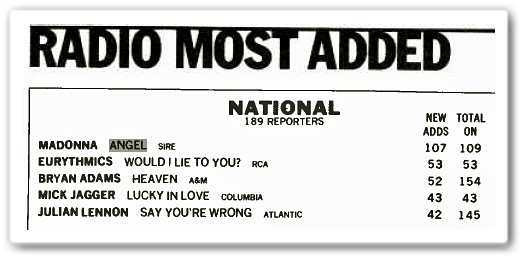
On April 27 1985, Madonna’s Angel single was briefly reviewed in Billboard magazine as it entered the Hot 100 at #48.
The Angel 12-inch single would be issued commercially in North America in late May. It included an extended dance mix of the titular track, but let’s be real, people bought it for Into The Groove on the flip – it being the only North American home for the classic dance floor gem until a remixed version appeared on You Can Dance in 87. In Canada, young cassette-loving buyers’ interest in the b-side prompted Warner Canada to issue the first Madonna cassette maxi-single, as the format would eventually be known.
On April 10 1985, Madonna’s Angel single was released by Sire Records. Angel was the third single released from the Like a Virgin album.
Written by Steve Bray and Madonna, it was one of the first songs developed for the project and, according to Madonna, was inspired by a girl who is saved by an angel, and she falls in love with Him.
Lyrics:
Why am I standing on a cloud
Every time you’re around
And my sadness disappears
Every time you are nearBridge:
You must be an angel
I can see it in your eyes
Full of wonder and surprise
And just now I realizeChorus:
Oooh you’re an angel
In disguise, I can see it in your eyesWalking down a crowded avenue
Other faces seem like nothing next to you
And I can’t hear the traffic rushing by
Just the pounding of my heart and that’s why(bridge)
(chorus, repeat)You’re an angel
You’re an angel, baby
You’re an angel
You must be an angelNow I believe that dreams come true
‘Cause you came when I wished for you
This just can’t be coincidence
The only way that this makes sense is that(chorus, repeat)
You’re an angel
You’re an angel, baby
You’re an angel
You must be an angel, babyClouds just disappear
On February 15 1985, the Vision Quest original motion picture soundtrack was released on Geffen Records. To promote the release, music videos for Crazy For You and Gambler were both serviced to MTV together in late January.
Despite Gambler only being released as a single in markets outside North America, its video received moderate rotation from MTV nonetheless – possibly due to the fact that there were no competing videos produced for the final two singles from Like A Virgin.
Gambler was Madonna’s last entirely self-written single until the 2007 release of the charity single, Hey You. Other singles for which she received sole writing credit include Everybody (which was in fact a Stephen Bray co-write, however a publishing arrangement granted him sole credit for another of their collaborations, Ain’t No Big Deal, in trade), Burning Up, Lucky Star and Sidewalk Talk. Album tracks Think Of Me, I Know It and Shoo-Bee-Doo were also entirely self-written.
A third Madonna song that was recorded for the Vision Quest soundtrack, Warning Signs, was eventually dropped from the project. A cassette copy of the song, which is also credited to Madonna alone, was submitted to the Library of Congress for copyright registration in February of 1984, at the same time as Gambler.
With Stephen Bray having confirmed his involvement in the song’s production (which he described as “a cool synth track”), it appears that its production credits would mirror those of Gambler, which was produced by Jellybean Benitez and arranged by Bray. Given that early press for Vision Quest (including an on-set interview with Madonna herself) mentioned the inclusion of three new songs, footage of Madonna performing Warning Signs was likely filmed but ended up on the cutting room floor. Surprisingly, this additional footage has never resurfaced and the song has never leaked.
On February 2 1985, Sidewalk Talk peaked at #1 on the Billboard Hot Dance/Club Play chart. The song was written by Madonna, who also contributed vocals on the chorus and bridge while the verses were performed by Catherine Buchanan. Madonna gifted the song to producer/remixer/DJ/boyfriend Jellybean Benitez for use on his debut EP, Wotupskii!!?! and it was promoted to clubs by EMI Records in October, 1984. It was eventually issued as a commercial single, peaking at #18 on the Billboard Hot 100 on February 1st, 1986.
Sidewalk Talk was arranged by Stephen Bray & Benitez with vocal arrangement by Madonna, according to the album’s liner notes. Madonna’s lyrics to the song recall her early years in New York and some of the challenges she encountered adjusting to big city life.