Today in Madonna History: August 14, 1984

madonna-thefirstalbum1983albumcover2 Madonna1_lg

On August 14 1984, Madonna’s self-titled debut album was certified platinum by the RIAA to commemorate U.S. sales of more than one-million copies.

The album would eventually be certified five times platinum in the U.S.

Today in Madonna History: August 5, 2008

On August 5 2008, Madonna’s Give It 2 Me was released as a CD maxi-single by Warner Bros. Records in the U.S. It included amazing club remixes by Eddie Amador, Paul Oakenfold, Fedde Le Grand, Tong & Spoon, Jody den Broeder, and a ragga mix by Sly & Robbie.

The single was also issued in the U.S. as a double-vinyl 12-inch set, a 12-inch vinyl picture disc and as a double-vinyl 7-inch set coupled with her previous single, 4 Minutes. Though no Canadian pressings of the single were issued, the U.S. CD maxi-single was distributed to Canadian retailers with a Warner Music Canada special import sticker.

Give It 2 Me was the second single from Hard Candy. It was written by Madonna & Pharrell Williams with production by Madonna & The Neptunes. An early demo version of the song with alternate lyrics, titled Infinity, would eventually surface online.

Today in Madonna History: July 25, 1998

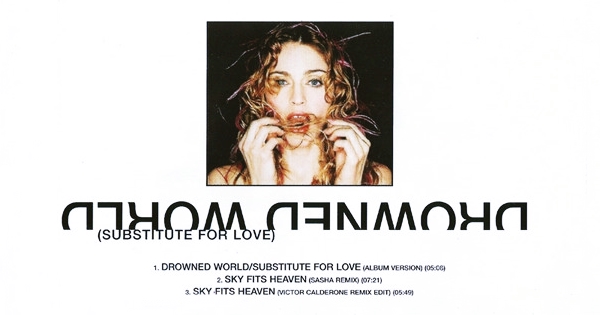
madonna_drowned_world_substitute_for_love-uk single 550

On July 25 1998, the music video for Drowned World/Substitute For Love premiered in Europe. The video was directed by Walter Stern and was filmed on June 26 & 27 1998 at London’s famous Claridge’s Hotel and Piccadilly Circus.

The video caused some controversy when the British press reported that it would feature scenes of Madonna’s car being chased by paparazzi on mopeds, concluding that it was a reference to the death of Diana, Princess of Wales, the previous year. Liz Rosenberg responded by denying that the scenes were intended to draw comparison to Diana’s death and insisting that the video was about Madonna’s own relationship with fame.

Sadly the video was not serviced to video channels in North America, and with online steaming and downloadable videos not yet prevalent at the time, most fans outside of Europe were only able to enjoy the video for the first time when it appeared on the 93:99 video collection over a year later.

Today in Madonna History: July 11, 1987

On July 11 1987, Madonna’s Who’s That Girl made its U.S. chart debut at #43 on the Billboard Hot 100. The single entered the Hot 100 Airplay chart at #32 in the same issue.

Today in Madonna History: June 28, 1986


On June 28 1986, Billboard magazine reported that Madonna made a surprise appearance at WEA International’s annual manager’s meeting with Seymour Stein in New York earlier that month where she previewed tracks from her forthcoming album, True Blue.

Today in Madonna History: June 23, 1998

Ray Of Light Video Single_cover 550 Ray Of Light Video Single_back cover 550 Ray Of Light Video Single_tape 550 Ray Of Light Video Single_card insert

On June 23 1998, the music video for Ray of Light was released by Warner Reprise Video as a limited edition video single of 40,000 VHS copies. It sold 7,381 copies within its first month of release, becoming one of the best-selling video singles of the Nielsen SoundScan era. Madonna’s previous video single release, Justify My Love, which predated SoundScan, was certified quadruple-Platinum by the RIAA (for shipment of over 200,000 copies).

The reason behind Ray of Light being issued as a video single were twofold. Madonna was very pleased with the outcome of her first collaboration with director Jonas Åkerlund and her record company felt that there would be enough interest to warrant its commercial release. Secondly, Warner’s marketing team correctly sensed that the song’s then-experimental sound would be a tough sell at radio, so the decision was made to pull out all the stops to ensure the release outperformed on the sales chart. Another prong in this strategy was the inclusion of album outtake Has To Be as the b-side to the two-track single, while excluding it from the maxi-single in an attempt to persuade fans to purchase the single in multiple formats. The strategy proved successful, with the song’s number-five debut and peak on the Billboard Hot 100 mainly due to its sales strength. According to Billboard, the music video single boosted its first-week sales by roughly 7%, helping it to secure its place in the top-five.

Shortly after Ray of Light‘s release as a video single, Billboard magazine published an article musing on whether renewed interest in the relatively obscure format could ever prove lucrative for the music industry. A video buyer for a major retail chained remarked:

“Madonna’s Ray of Light video single is a success because she has a fervent fan base. There are very few artists with videos that consistently get people’s attention, but Madonna is one of those artists. It’s too early to tell if there’s a true market for video singles. Right now, it seems like record companies are trying video singles to see what happens. I think we’re going to see the lines becoming more blurred in how audio and video singles are marketed.”

Indeed. Within the next five years (and two Madonna video singles later), the emergence of online file sharing would obliterate the physical singles market in North America, and video streaming sites would soon spell an end to the prospect of marketing music video singles as a physical format. In digital form, however, music video singles may be selling in larger numbers than ever due to increased availability through iTunes. Strangely, however, sales of music videos through iTunes are not reported to Billboard and no longer count towards a single’s chart position (reportedly due to iTunes’ monopoly on digital sales of the format), while streams of music videos through sites like YouTube and Vevo are used in Billboard’s chart methodology.

Today in Madonna History: June 16, 1984

borderline promotional print 550
On June 16 1984, Borderline became Madonna’s first Top 10 hit when the single peaked at #10 on the Billboard Hot 100 in the U.S.

Thanks to Rex!