Today in Madonna History: August 20, 2001

On August 20 2001, Sal Cinquemani published this review of Madonna’s Music album in Slant magazine:

After her hugely successful and critically-lauded Ray Of Light, Madonna could have gone in one of several possible directions: (1) a more hardcore trance route, enlisting a world-class DJ like Sasha (who remixed a few tracks from Ray Of Light and whom Madonna allegedly dismissed after collaborating on several tracks early in the recording process of this new album); (2) staying in safe territory by writing and recording once again with William Orbit, the mastermind behind Ray Of Light; or (3) a weird, more experimental direction, commissioning someone like French electronica guru Mirwais Ahmadzai. Madonna once told producer Shep Pettibone “You can never do the same thing twice…ever,” but two new collaborations with Orbit, “Runaway Lover” and “Amazing,” prove that when you do, it will probably be completely uninteresting. “Runaway Lover” sounds like a Ray Of Light outtake with uninspired couplets like “It doesn’t pay to give away what you lack/You’ll never get your money back.” But amid the clichés, Madonna throws in profound food for thought like “You get your education from your lovers.” “Amazing” is incredibly catchy and has a Supremes-like melody but that’s where it ends. The track borrows the drum loop Orbit used in “Beautiful Stranger” (which was originally the loop from his “Ray Of Light” remix), and proves that he may not have had enough tricks up his sleeve for an entire new album anyway (and perhaps Madonna knew that).

As such, Madonna enlisted Mirwais for most of the rest of the album in question, Music. The title track, a retro hands-in-the-air club song reminiscent of Debbie Deb’s “When I Hear Music” and Madonna’s own “Into The Groove,” is the singer’s best dance floor-beckoning track since “Vogue.” She sings “Music makes the people come together” like a track off of her debut album, and as an added bonus she uses words like “bourgeoisie” and “acid-rock” with equal abandon. If you can get past the initial horror of hearing Madonna’s voice get the Cher “Believe” treatment on “Nobody’s Perfect,” another Mirwais collaboration, you’ll find a brilliant song full of genuine sorrow. The track opens with an intentionally imperfect and somber “I feel so sad,” and it is indeed believable. Lyrics like “What did you expect? I’m doing my best” are sung with an intriguing juxtaposition of human emotion and mechanically detached vocalizations. Though hard to swallow at first (like most on the album), the track is one of the singer’s best creations. With its distorted vocals and grinding electronic burps, “Paradise (Not For Me)” is another distinctive Mirwais production. At a turning point in the song, Madonna awkwardly struggles to speak the words “There is a light above my head/Into your eyes my face remains” while strings swell and bring the song to a climax. It is at this point that “Paradise” resembles the cinematic grandeur of tracks like “Frozen,” and it is also one of the few moments throughout Music that recalls the spiritual introspection of Ray Of Light.

Two tracks take a striking folk direction. “I Deserve It” finds Madonna once again singing with a warm yet detached voice, but this time her vocals are completely untouched by effects. “Gone” ends the album and is possibly one of Madonna’s best performances. In the vein of “Live To Tell,” the song seems to sum up everything Madonna has tried to tell us about being the most famous woman in the world. Earlier attempts have seemed obvious and sometimes trite (“Goodbye To Innocence,” “Survival,” “Drowned World”), but this song seems to be particularly telling. It is also, perhaps, the most human she has ever been. Self-deprecation and vulnerability have never been Madonna’s strong-suits, but the way she sings “I won’t let it happen again/I’m not very smart” could make you wonder. Music seems more like a collection of songs than a cohesive album, and it is an unexpected answer to Ray Of Light. But strangely, in an attempt to make a “fun,” less-introspective album, Madonna has revealed more of herself than ever. No longer shrouded with pedantic spirituality, she has become even more human, exposing her fears on tracks like “Nobody’s Perfect” and “Paradise,” her soul on “Don’t Tell Me” and “What It Feels Like For A Girl,” and revealing her joys on “Impressive Instant” and “Music.”
Today in Madonna History: December 2, 2000

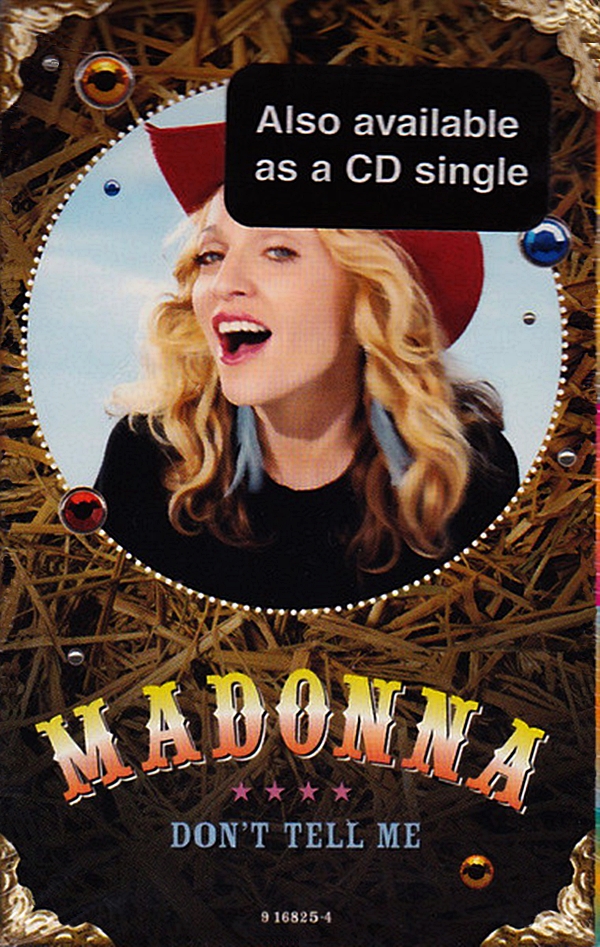
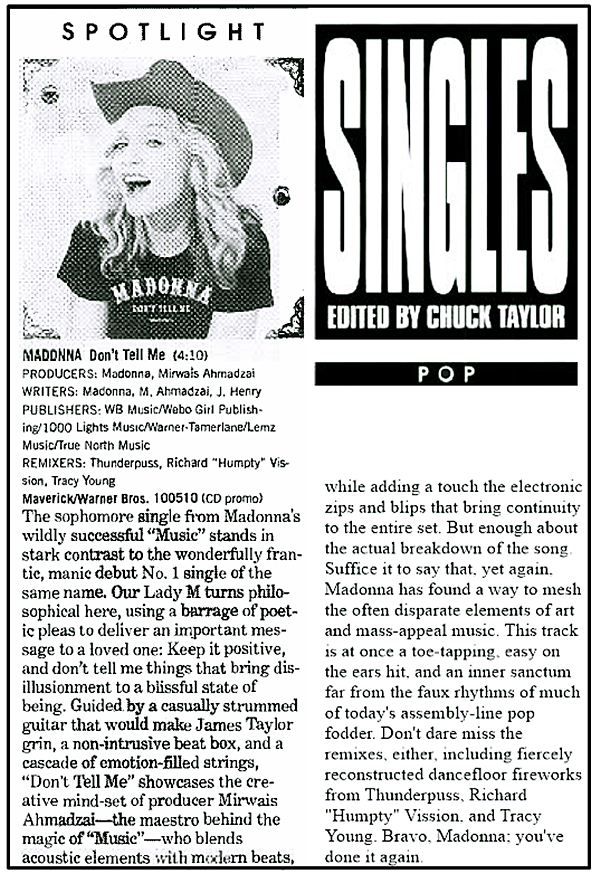
On December 2 2000, Madonna’s Don’t Tell Me single was reviewed by Chuck Taylor in Billboard magazine.

Don’t Tell Me was Madonna’s final single to be released on cassette in the U.S., while Warner Bros. U.K. would issue Madonna’s next two singles in the format, with the last being 2002’s Die Another Day.

In Canada – the first market to consistently issue Madonna’s singles in the format (the cassette maxi-single of Angel was the first in 1985) – her final cassette single was 1995’s Bedtime Story and her last cassette maxi-single was 1994’s I’ll Remember.

Today in Madonna History: November 21, 2000

don-t-tell-me-madonna-single-cd-1 don-t-tell-me-madonna-single-cd-2 don-t-tell-me-madonna-single-cd-3 don-t-tell-me-madonna-single-cd-4 don-t-tell-me-madonna-single-cd-5 don-t-tell-me-madonna-single-cd-6

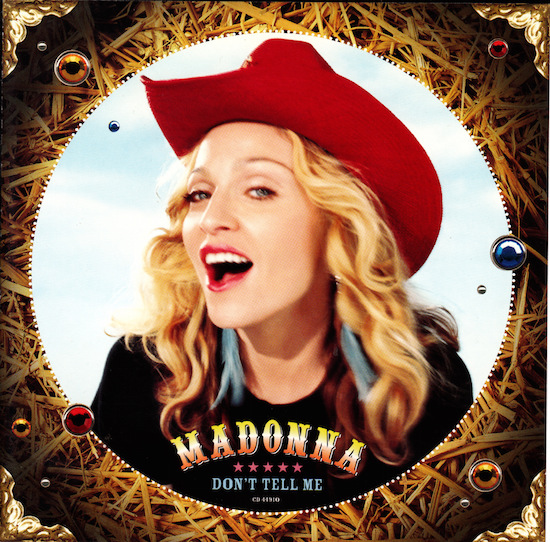
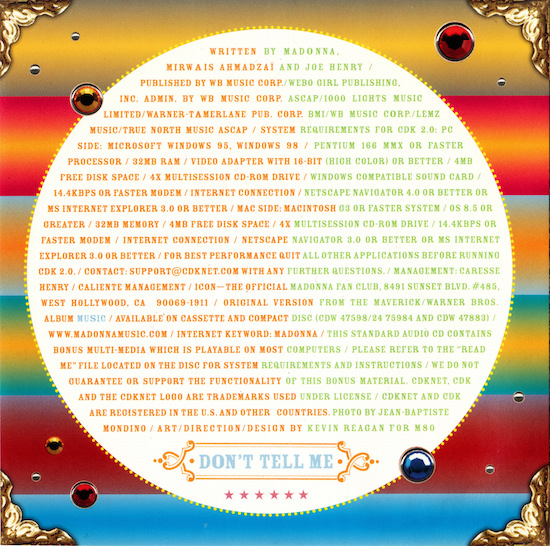
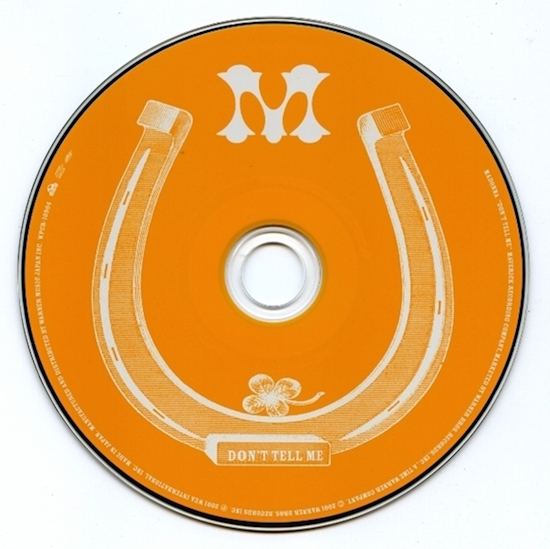
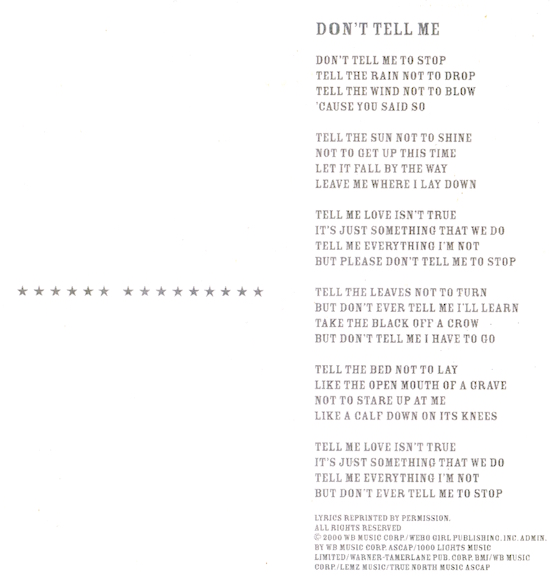
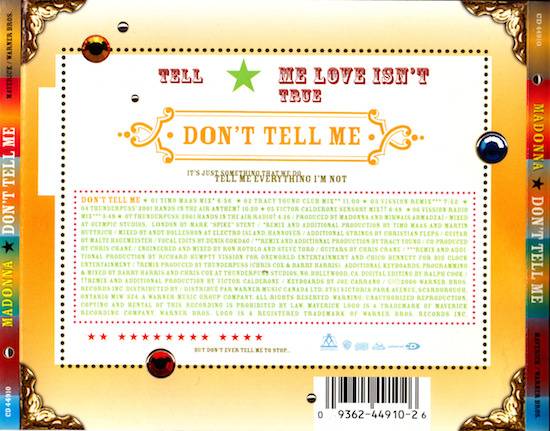
On November 21 2000, the second single from Madonna’s Music album, Don’t Tell Me, was released by Maverick Records. The b-side for Don’t Tell Me was Cyber-Raga.

During an interview for Interview Magazine, in March 2001, Madonna discussed the lyrics for Don’t Tell Me:

“To me it is a romantic song. Just, you know, rip my skin off, do not tell me who I should love, or how I should love. Don’t tell me to give up. To me, in a way it’s like that Frank Sinatra song, ‘If I can make it there, I’ll make it anywhere’.”

The North American CD maxi-single included the following versions of Don’t Tell Me:

Don’t Tell Me – (Timo Maas Mix) – 6:55
Don’t Tell Me – (Tracy Young Club Mix) – 11:01
Don’t Tell Me – (Vission Remix) – 7:52
Don’t Tell Me – (Thunderpuss’ 2001 Hands in the Air Anthem) – 10:20
Don’t Tell Me – (Victor Calderone Sensory Mix) – 6:48
Don’t Tell Me – (Vission Radio Mix) – 3:38
Don’t Tell Me – (Thunderpuss’ 2001 Hands in the Air Radio) – 4:26
Don’t Tell Me – (Music Video)

Today in Madonna History: November 3, 2000

Letterman (2000) 2

On November 3 2000, Madonna guested on CBS-TV’s Late Show With David Letterman to promote the Music album. She performed an acoustic version of the album’s second single, Don’t Tell Me.

The performance featured several firsts for Madonna: her first live performance to promote the Music album; her first TV appearance following the birth of her son Rocco; her first performance on guitar since her pre-fame days in NYC band Emmy; her first unplugged/acoustic live performance; her first live performance with longtime guitarist Monte Pittman; and her first (and only) musical performance on the Late Show.

Despite being promoted as such, it was not, however, Madonna’s first time back to the Late Show after her infamously censored 1994 appearance. She had made a brief, unscheduled visit to the set to drop off a valentine for Letterman during a 1995 taping of the show.

Today in Madonna History: September 11, 2000

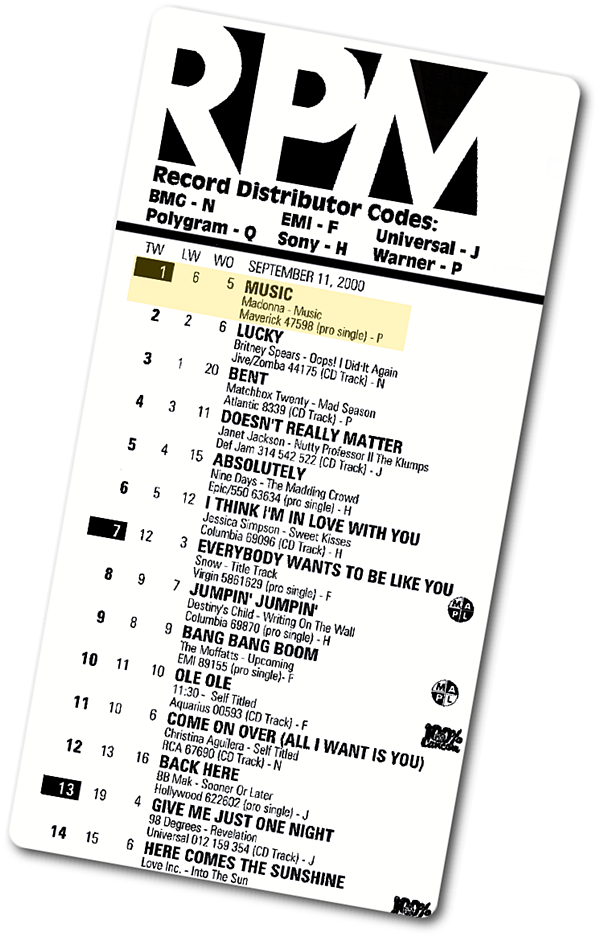
On September 11 2000, Madonna’s Music single hit #1 on the Top Canadian Singles chart in RPM magazine. The single spent an incredible nine weeks at #1 on the chart, making it Madonna’s biggest hit during the RPM chart era in Canada.

Music also holds the distinction of being the final song ever to reach the top of the RPM Top Canadian Singles chart, as the magazine ceased publication during the song’s ninth week at #1. RPM served as the voice of the Canadian music industry and its official chart authority for over thirty-five years.

Madonna’s Music album also hit #1 on RPM’s Top Albums chart during the first two weeks of October, 2000.

In an unusual move, Warner Canada chose to issue the Music single commercially in three different CD configurations: a two-track with non-album b-side Cyberraga, a standard CD maxi-single with full-length remixes, and finally as a set of remix edits – something that would more commonly be reserved for radio in promo-only form.

Both the song and much of the album of the same title bore the fruit of Madonna’s first collaboration with French electronic artist, Mirwais Ahmadzaï. His second solo album, Production, released a few months earlier, featured Madonna’s Paradise (Not For Me) – which would also resurface on Music.

Mirwais worked with Madonna collaborators Jean-Baptiste Mondino (Naïve Song) and Stéphane Sednaoui (Disco Science & I Can’t Wait) on music videos for the Production album, while the latter director also photographed its cover. Madonna, meanwhile, selected Mondino to shoot the cover of her Music album and to direct the video for its second single (Don’t Tell Me).

Several years before directing her Fever video, Sednaoui first captured Madonna as a photographer on the set of the Justify My Love video – directed by Mondino.

Today In Madonna History: March 16, 2001

madonna_what_it_feels_like_camaro

On March 16 2001, MTV and VH1 networks announced that Madonna’s new video for What It Feels Like For A Girl would be broadcast only once on March 20 at 11:30 pm because of the controversy over its violent content.

Today in Madonna History: October 28, 2000

On October 28 2000, Madonna’s Music album spent its fourth and final consecutive week at #1 on Eurochart Top 100 Albums.

The album would slide two positions to #3 on the chart dated November 4th.