Today in Madonna History: August 20, 2001

august-20-2000-1 august-20-2000-2 august-20-2000-3

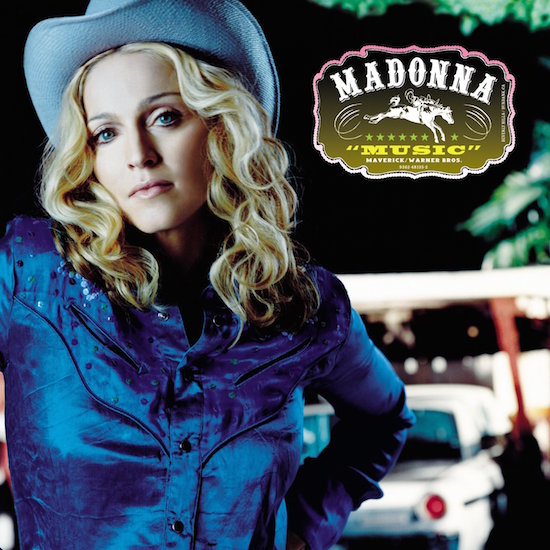
On August 20 2001, Sal Cinquemani published this review of Madonna’s MUSIC album in Slant magazine:

After her hugely successful and critically-lauded Ray Of Light, Madonna could have gone in one of several possible directions: (1) a more hardcore trance route, enlisting a world-class DJ like Sasha (who remixed a few tracks from Ray Of Light and whom Madonna allegedly dismissed after collaborating on several tracks early in the recording process of this new album); (2) staying in safe territory by writing and recording once again with William Orbit, the mastermind behind Ray Of Light; or (3) a weird, more experimental direction, commissioning someone like French electronica guru Mirwais Ahmadzai. Madonna once told producer Shep Pettibone “You can never do the same thing twice…ever,” but two new collaborations with Orbit, “Runaway Lover” and “Amazing,” prove that when you do, it will probably be completely uninteresting. “Runaway Lover” sounds like a Ray Of Light outtake with uninspired couplets like “It doesn’t pay to give away what you lack/You’ll never get your money back.” But amid the clichés, Madonna throws in profound food for thought like “You get your education from your lovers.” “Amazing” is incredibly catchy and has a Supremes-like melody but that’s where it ends. The track borrows the drum loop Orbit used in “Beautiful Stranger” (which was originally the loop from his “Ray Of Light” remix), and proves that he may not have had enough tricks up his sleeve for an entire new album anyway (and perhaps Madonna knew that).

As such, Madonna enlisted Mirwais for most of the rest of the album in question, Music. The title track, a retro hands-in-the-air club song reminiscent of Debbie Deb’s “When I Hear Music” and Madonna’s own “Into The Groove,” is the singer’s best dancefloor-beckoning track since “Vogue.” She sings “Music makes the people come together” like a track off of her debut album, and as an added bonus she uses words like “bourgeoisie” and “acid-rock” with equal abandon. If you can get past the initial horror of hearing Madonna’s voice get the Cher “Believe” treatment on “Nobody’s Perfect,” another Mirwais collaboration, you’ll find a brilliant song full of genuine sorrow. The track opens with an intentionally imperfect and somber “I feel so sad,” and it is indeed believable. Lyrics like “What did you expect? I’m doing my best” are sung with an intriguing juxtaposition of human emotion and mechanically detached vocalizations. Though hard to swallow at first (like most on the album), the track is one of the singer’s best creations. With its distorted vocals and grinding electronic burps, “Paradise (Not For Me)” is another distinctive Mirwais production. At a turning point in the song, Madonna awkwardly struggles to speak the words “There is a light above my head/Into your eyes my face remains” while strings swell and bring the song to a climax. It is at this point that “Paradise” resembles the cinematic grandeur of tracks like “Frozen,” and it is also one of the few moments throughout Music that recalls the spiritual introspection of Ray Of Light.

Two tracks take a striking folk direction. “I Deserve It” finds Madonna once again singing with a warm yet detached voice, but this time her vocals are completely untouched by effects. “Gone” ends the album and is possibly one of Madonna’s best performances. In the vein of “Live To Tell,” the song seems to sum up everything Madonna has tried to tell us about being the most famous woman in the world. Earlier attempts have seemed obvious and sometimes trite (“Goodbye To Innocence,” “Survival,” “Drowned World”), but this song seems to be particularly telling. It is also, perhaps, the most human she has ever been. Self-deprecation and vulnerability have never been Madonna’s strong-suits, but the way she sings “I won’t let it happen again/I’m not very smart” could make you wonder. Music seems more like a collection of songs than a cohesive album, and it is an unexpected answer to Ray Of Light. But strangely, in an attempt to make a “fun,” less-introspective album, Madonna has revealed more of herself than ever. No longer shrouded with pedantic spirituality, she has become even more human, exposing her fears on tracks like “Nobody’s Perfect” and “Paradise,” her soul on “Don’t Tell Me” and “What It Feels Like For A Girl,” and revealing her joys on “Impressive Instant” and “Music.”
Today in Madonna History: July 21, 2001

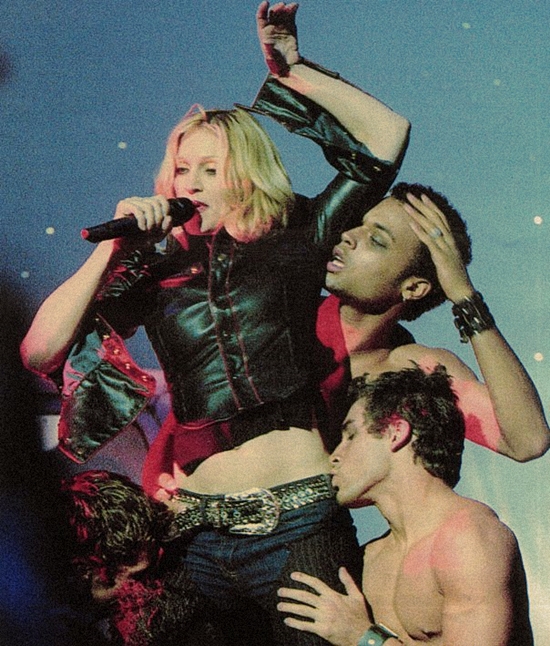
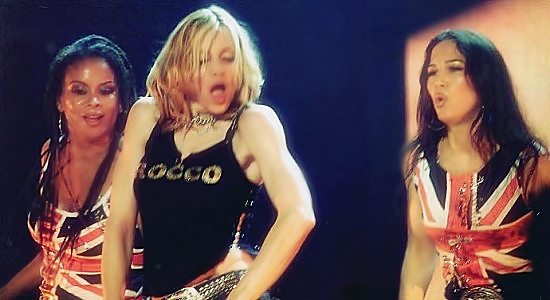
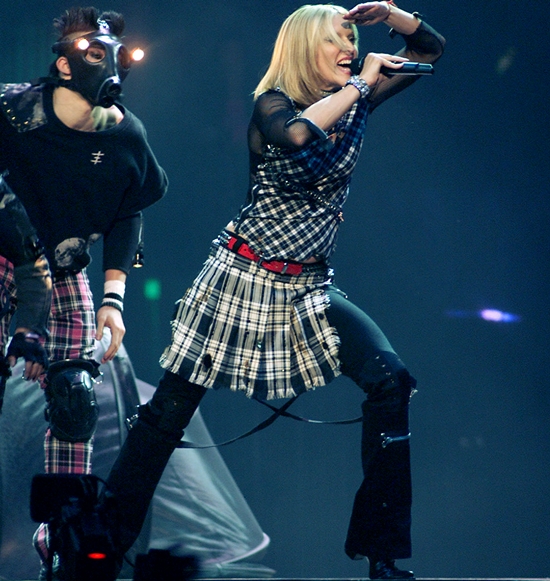
Madonna performing during the first show in the North American leg of her 'Drowned World Tour 2001' at the First Union Center in Philadelphia, Pa., 7/21/01. Photo by Frank Micelotta/ImageDirect.

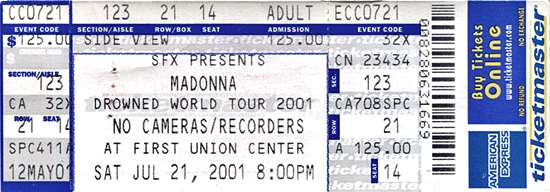
madonna dwt ticket philadelphia july 21 2001

Madonna performing during the first show in the North American leg of her 'Drowned World Tour 2001' at the First Union Center in Philadelphia, Pa., 7/21/01. Photo by Frank Micelotta/ImageDirect.

On July 21 2001, Madonna kicked off the U.S. leg of her Drowned World Tour with the first of two sold-out concerts at the First Union Centre (now the Wells Fargo Centre) in Philadelphia.

For the first time in her career, Madonna altered one of her tour set lists by performing You’ll See in the place Gone at select shows during the U.S. leg of the tour. You’ll See made its live debut at the July 21st show in Philadelphia and was performed again the following night. The decision to alter the set list was rumoured to have been made in response to European reviews of the tour, which despite being generally favorable, often lamented the show’s overabundance of new material and lack of hits.

Personally, we were pleased that the Ray Of Light and Music albums were the primary focus of the Drowned World Tour. If she had instead focused on hits, it is likely that these two essential Madonna albums would have been treated similarly to Bedtime Stories–an album from which she has yet to perform anything other than its four released singles.

Were you disappointed at the time by the lack of hits and the focus on recent album cuts during the Drowned World Tour? Have your views shifted at all in retrospect?

Today in Madonna History: March 22, 2001

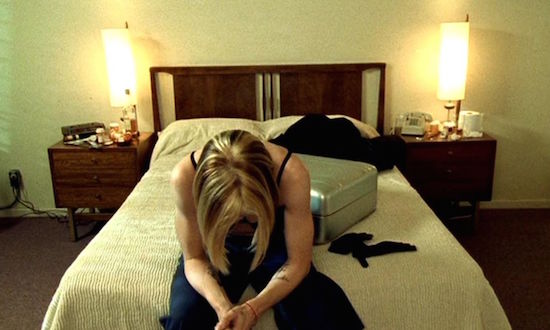
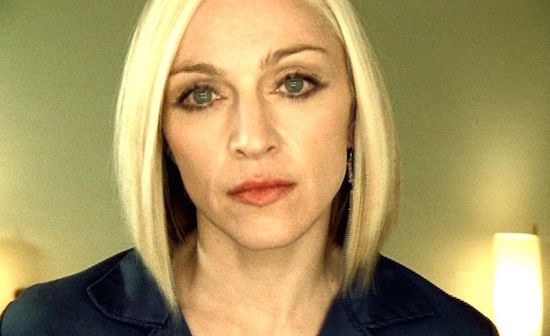
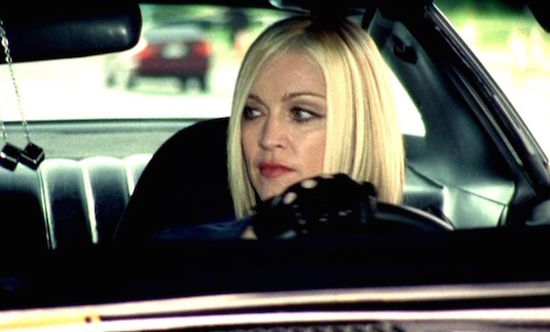
WIFLFAG-Video-1 WIFLFAG-Video-2 WIFLFAG-Video-3 WIFLFAG-Video-3b WIFLFAG-Video-4 WIFLFAG-Video-5 WIFLFAG-Video-8 WIFLFAG-Video-8a WIFLFAG-Video-8b WIFLFAG-Video-8c WIFLFAG-Video-8d WIFLFAG-Video-9

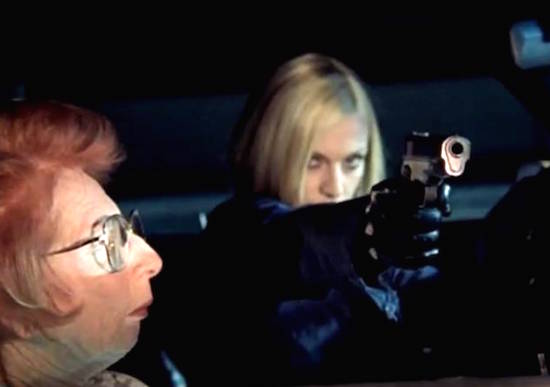
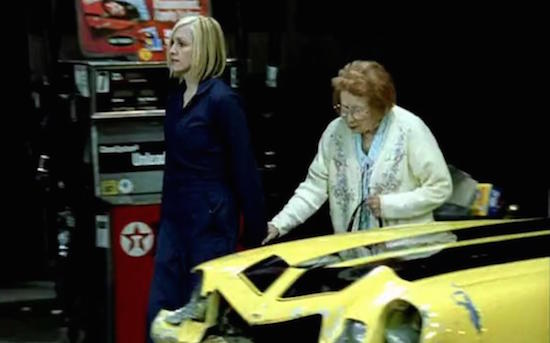
On March 22 2001, Madonna’s What It Feels Like For A Girl music video premiered.

The video was directed by Madonna’s then-husband, Guy Ritchie, and was deemed to be “Too Hot for TV” by MTV and VH1 because the video depicted gunplay, assault and suicide.

MTV released this statement about the video and their decision to ban it:

It’s been some time since Madonna ruffled the feathers of MTV or VH1 execs with a controversial video — perhaps not since 1992’s Erotica clip — so just under a decade later, the first lady of shock pop is out to prove she can still make ’em sweat.

Unlike the steamy segments of Erotica, 1990’s Justify My Love, and the one that started it all, Like a Prayer, it’s not the sexual content of What It Feels Like for a Girl that raises the red flag, it’s the violence — a concerted no-no in the post-Columbine, and more recently post-Santana, decision-making process.

The music in the video, it should be noted, is a dance remix of the version found on Madonna’s latest album, Music. The album cut will serve as the LP’s third single.

 Directed by her husband, British filmmaker Guy Ritchie (Snatch, Lock, Stock and Two Smoking Barrels), the clip depicts gunplay, violent assault and suicide — elements MTV and VH1 prohibit in any videos they air. In it, the pop diva portrays a self-described “nihilistic pissed-off chick” who cruises around town inflicting damage on any man that crosses her path.
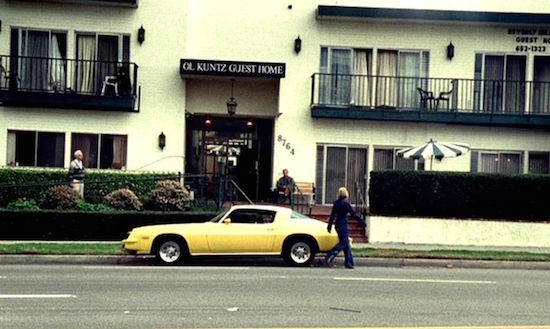
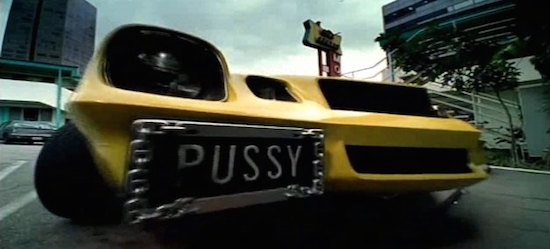
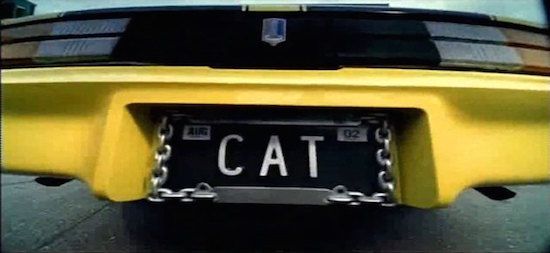
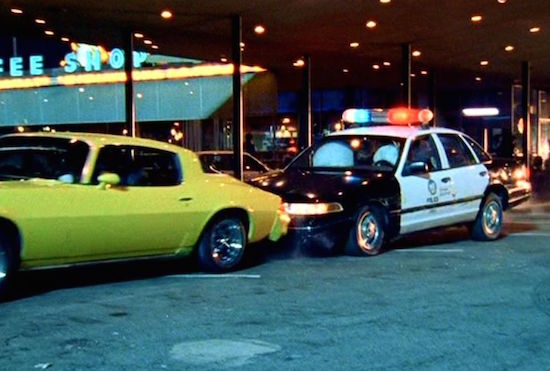
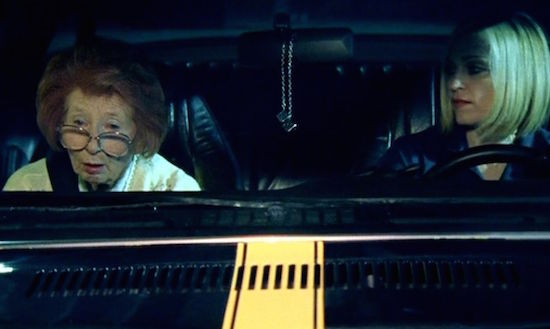
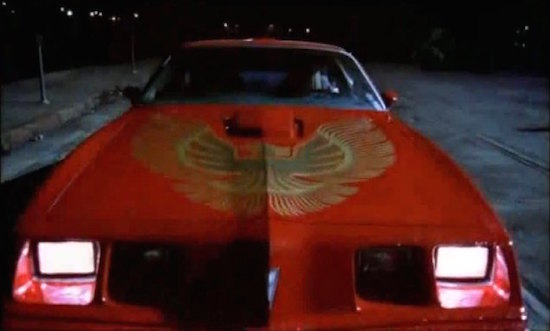
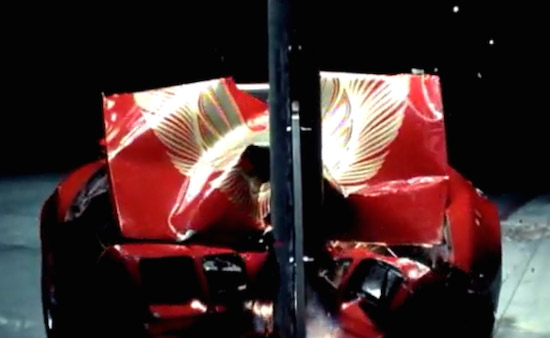
After picking up Grandma at the “Ol Kuntz Guest Home,” Madonna crashes into a car full of men who wink at her, threatens male police officers with a squirt gun before sideswiping their vehicle, and mugs a man at an ATM with a stun gun before wrapping her stolen car around a lamppost in what appears to be an intentional act.

The video “shows my character acting out a fantasy and doing things girls are not allowed to do,” Madonna said in a written statement distributed by her record label, Warner Bros. “This is an angry song and I wanted a matching visual with an edgy dance mix.”
Although What It Feels Like for a Girl won’t be added to the music channel’s regular rotation, MTV and VH1 will air the clip just once.

Today in Madonna History: January 16, 2001

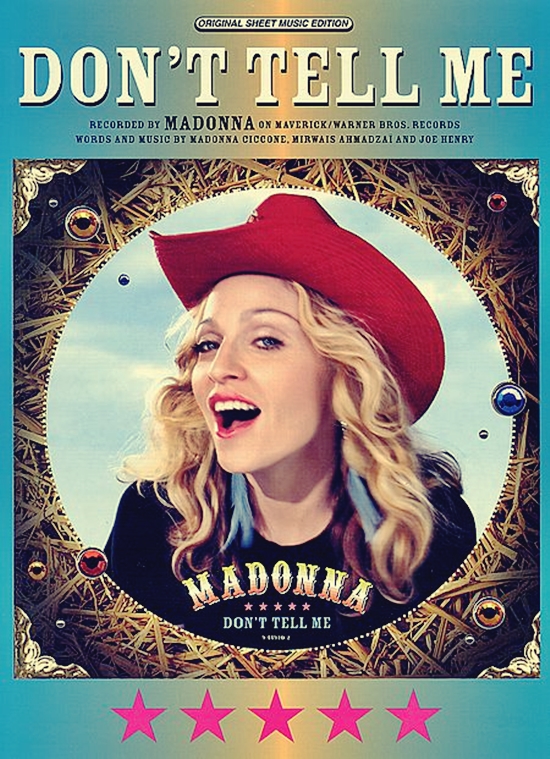
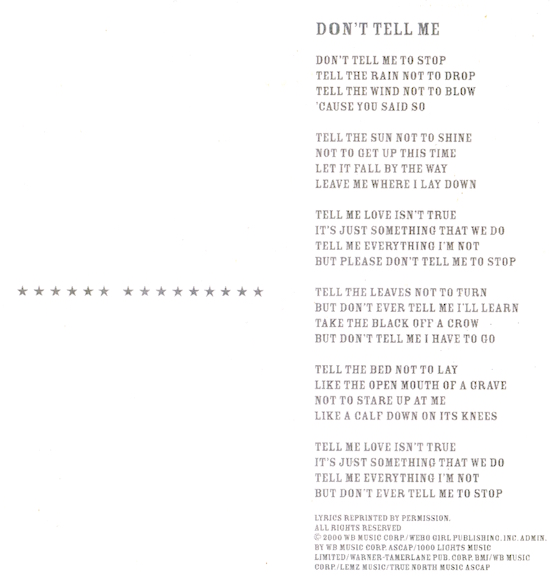
don't tell me sheet music 550

On January 16 2001, Don’t Tell Me was released commercially in North America as the second single from Music.

Written by Madonna, Mirwais & Joe Henry, the song was Madonna’s first collaboration with her brother-in-law, whom she had known since high school. Henry sent a demo (then titled Stop) to Madonna after his wife, Melanie, insisted that her sister would love the song. Madonna & Mirwais drastically altered the music and melody and renamed the song Don’t Tell Me. Henry released his version on his eighth studio album, Scar, in May 2001.

The maxi-single featured remixes by Thunderpuss, Timo Mass, Victor Calderone, Richard “Humpty” Vission and Tracy Young. Don’t Tell Me was the last Madonna release to be issued on cassette single in the U.S. and was also available on 2-track CD single, CD Maxi-Single (enhanced with the music video) and as a double 12″ vinyl set. In Canada, it was released only on CD maxi-single.

Today in Madonna History: November 28, 2000

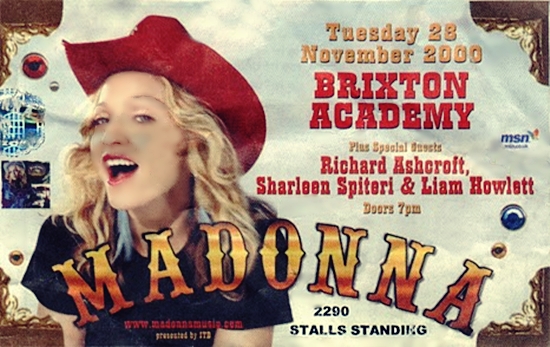
brixton 4 550 brixton 1 brixton 2 550

On November 28 2000, Madonna performed a mini-set at London’s Brixton Academy. The show was part of the Don’t Tell Me Promo Tour, which began only two months after the birth of her second child, Rocco, and consisted of a few small club dates as well as television performances and interviews to promote the second single from her Music album. Aside from the promotional aspect, Madonna also used the club shows as an opportunity to test the waters for performing live shows again following a seven-year hiatus from touring. The Brixton gig closely mirrored her set at New York’s Roseland Ballroom several weeks earlier, with one notable exception being the addition of Holiday to the UK set-list.

The full London set-list consisted of:

  1. Impressive Instant
  2. Runaway Lover
  3. Don’t Tell Me
  4. What It Feels Like For A Girl
  5. Holiday
  6. Music

The Brixton Academy performance was streamed live across the internet to an estimated 9 million viewers.

Today in Madonna History: November 24, 2000

SnapShot(67)2

On November 24 2000, Madonna performed Don’t Tell Me and Music live on French television program Nulle Part Ailleurs.

Today in Madonna History: November 21, 2000

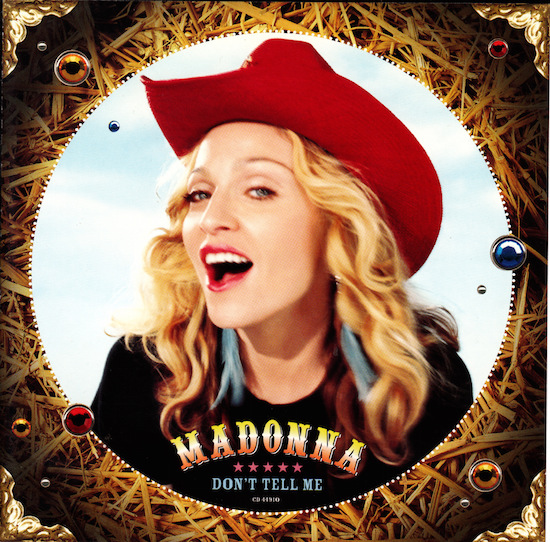
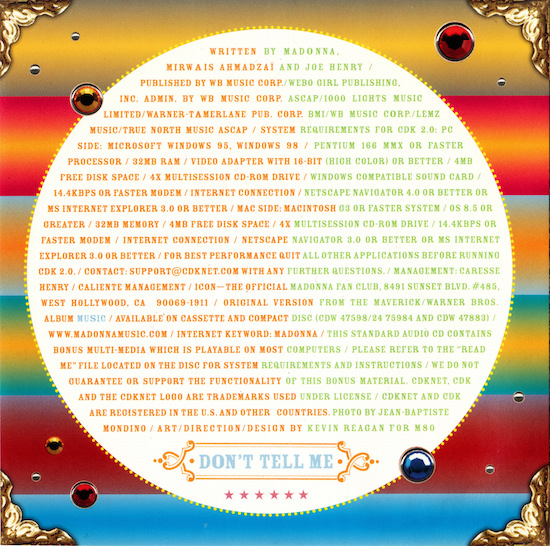
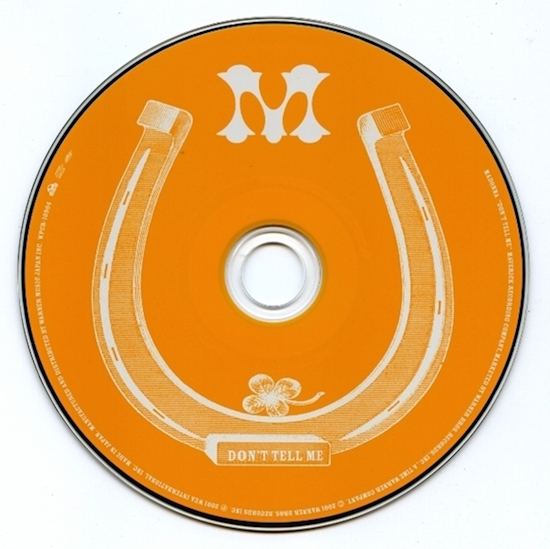
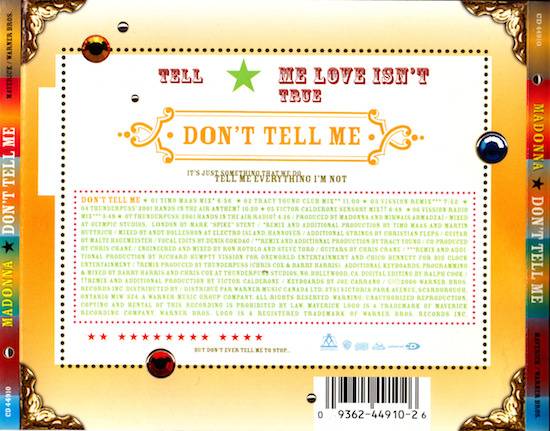
don-t-tell-me-madonna-single-cd-1 don-t-tell-me-madonna-single-cd-2 don-t-tell-me-madonna-single-cd-3 don-t-tell-me-madonna-single-cd-4 don-t-tell-me-madonna-single-cd-5 don-t-tell-me-madonna-single-cd-6

On November 21 2000, the second single from Madonna’s Music album, Don’t Tell Me, was released by Maverick Records. The b-side for Don’t Tell Me was Cyber-Raga.

During an interview for Interview Magazine, in March 2001, Madonna discussed the lyrics for Don’t Tell Me:

“To me it is a romantic song. Just, you know, rip my skin off, do not tell me who I should love, or how I should love. Don’t tell me to give up. To me, in a way it’s like that Frank Sinatra song, ‘If I can make it there, I’ll make it anywhere’.”

The North American CD maxi-single included the following versions of Don’t Tell Me:

Don’t Tell Me – (Timo Maas Mix) – 6:55
Don’t Tell Me – (Tracy Young Club Mix) – 11:01
Don’t Tell Me – (Vission Remix) – 7:52
Don’t Tell Me – (Thunderpuss’ 2001 Hands in the Air Anthem) – 10:20
Don’t Tell Me – (Victor Calderone Sensory Mix) – 6:48
Don’t Tell Me – (Vission Radio Mix) – 3:38
Don’t Tell Me – (Thunderpuss’ 2001 Hands in the Air Radio) – 4:26
Don’t Tell Me – (Music Video)