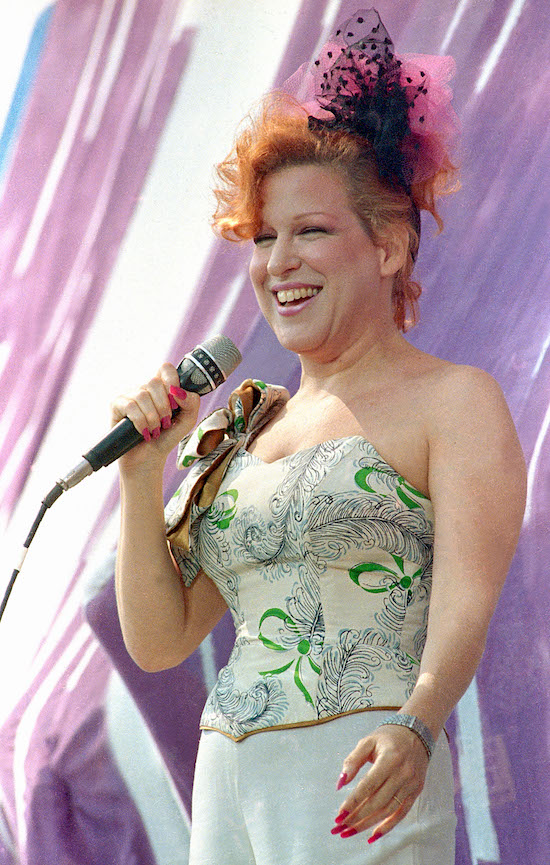
On July 13 1985, Bette Midler introduced Madonna at Live Aid’s charity concert in Philadelphia:
“I want you to know I have no idea why I was asked to introduce this next act — because you all know, I am the soul of good taste and decorum. However we are thrilled to be able to introduce to you today a woman whose name has been on everyone’s lips for the last six months. A woman who pulled herself up by her bra straps and has been known to let them down occasionally.”
Madonna was happy to tell the global audience of 1.9 billion viewers: “I ain’t taking off shit today.”
On July 6 1985, Angel/Into The Groove reached #1 on the Billboard Hot Dance Club Play chart in the U.S., where it spent a single week. It was Madonna’s fourth release to top the Dance chart.
Due to the fact that both sides of the commercial single received a substantial amount of club play, the release charted as Angel/Into The Groove on the Hot Dance Club Play chart. This is despite the fact that Sire/Warner had actually promoted the single to clubs without Into The Groove, as the U.S. club promo 12-inch contained Angel on both sides.
Despite her U.S. label’s apparent attempt to underexpose Into The Groove in order to keep the focus on her Like A Virgin album, its inclusion on the Angel commercial single unquestionably helped to propel the release to the top of the Dance chart. With the video in heavy rotation on MTV, radio DJ’s had to procure the commercial 12″ of Angel in order to appease heavy listener requests for Into The Groove, since radio promo pressings of Angel featured the Remix/Edit on the flip-side instead.
On June 22 1985, Angel/Into The Groove spent its second week at #1 on the Hot Maxi-Single Sales chart (then titled 12 inch Single Sales). It also inched its way closer to the top of the Hot Dance/Club Play chart (then titled simply Club Play), moving from #3 to #2.
Mainly driven by the popularity of Into The Groove (which was available exclusively on the Angel maxi-single in North America) with its heavy rotation on MTV, in clubs and its prominent appearance in the hit film Desperately Seeking Susan, the release would spend a total of twelve weeks in the top-5 of the Hot Maxi-Single Sales chart, including seven non-consecutive weeks at #1. Being a niche format that rarely generated enough mainstream interest to earn certification-level sales, Angel/Into The Groove has the distinction of being only the fourth maxi-single in history be certified Gold in the U.S.
In Canada, interest in Into The Groove prompted Warner Music Canada to issue Madonna’s first North American cassette maxi-single in addition to the standard 12 inch vinyl. The experiment clearly proved successful, as Warner Music Canada would continue to offer her subsequent releases in both formats several years before the U.S. followed suit.
On June 7 1986, Madonna’s Live To Tell hit #1 on the Billboard Hot 100 in the USA, giving Madonna her third #1 single.
Written by Madonna and Patrick Leonard, Live To Tell was Madonna’s fourth soundtrack song in two years (Crazy For You, Into The Groove, Gambler & Live To Tell), and it was also the lead single from Madonna’s True Blue album.
On May 26, 1990, Madonna is honoured with Pop Artist Of The Decade, Dance Artist Of The Decade and Dance Single Of The Decade (for Into The Groove) in Billboard magazine’s Music Of The 80’s Poll.
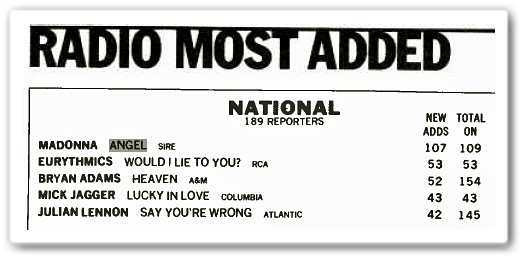
On April 27 1985, Madonna’s Angel single was briefly reviewed in Billboard magazine as it entered the Hot 100 at #48.
The Angel 12-inch single would be issued commercially in North America in late May. It included an extended dance mix of the titular track, but let’s be real, people bought it for Into The Groove on the flip – it being the only North American home for the classic dance floor gem until a remixed version appeared on You Can Dance in 87. In Canada, young cassette-loving buyers’ interest in the b-side prompted Warner Canada to issue the first Madonna cassette maxi-single, as the format would eventually be known.