On September 18 2019, the New York Times published a review (Jon Pareles) of Madonna’s opening Madame X Tour show held the night before at the BAM Howard Gilman Opera House in Brooklyn:
Madonna Is Still Taking Chances
Her Madame X show reimagines pop spectacle for a theater stage, merging her newest music and calls for political awareness with striking intimacy.
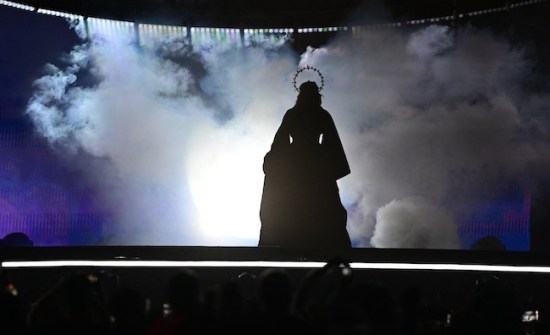
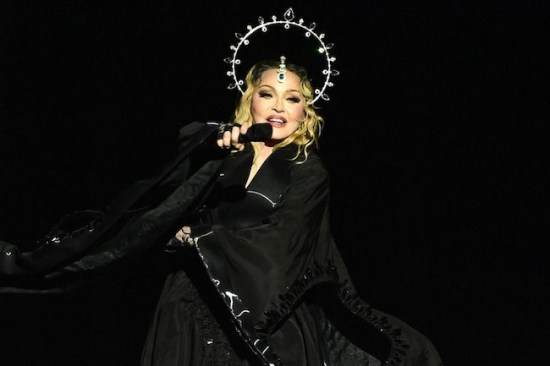
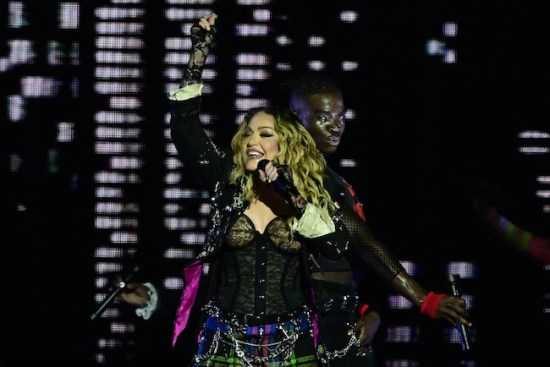
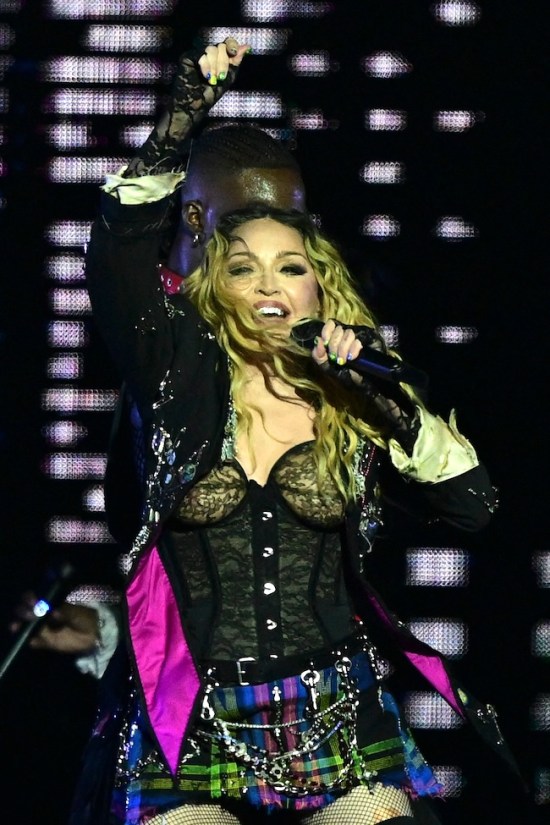
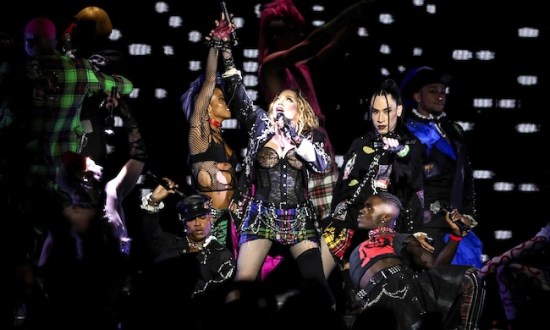
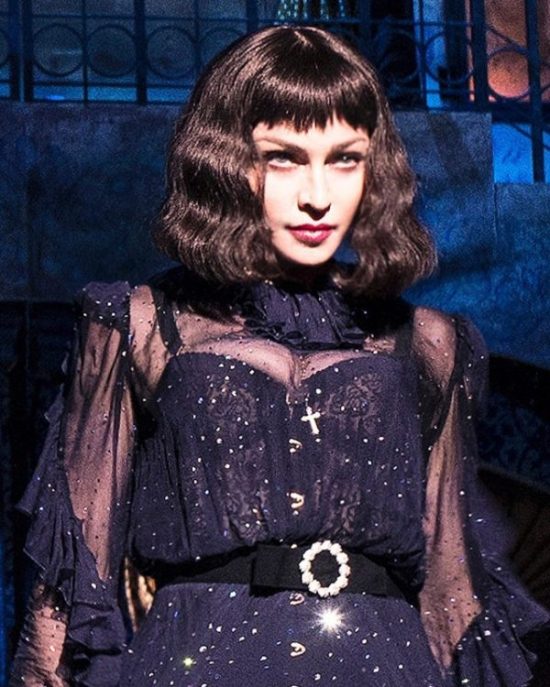
“I’m not here to be popular. I’m here to be free,” Madonna declared to a packed, adoring audience on Tuesday night at the Brooklyn Academy of Music’s Howard Gilman Opera House. It was the premiere of her Madame X Tour, named after the album she released in June that she has said was influenced by the music in Lisbon, her adopted home. The show follows her decades of arena spectacles by scaling the same kind of razzle-dazzle — dancers! costumes! video! choir! — for a theater stage.
Unlike jukebox musicals or “Springsteen on Broadway,” Madame X is a concert focusing on new songs and the present moment. In other words, Madonna is still taking chances. She will reach arena-size attendance in only a handful of venues on the eight-city tour, but with much longer engagements; the Gilman Opera House holds 2,098, and she booked 17 shows there, through Oct. 12. Onstage, “selling” a selfie Polaroid to an audience member who happened to be Rosie O’Donnell, she claimed, “I’m not making a dime on this show.”
Concertgoers arrived to what was billed as a phone-free experience. Cellphones and smart watches were locked into bags at the door, though quickly unlocked afterward. It helped prevent online spoilers; it certainly removed the distractions of waving screens. (No photography was permitted, including press.)
As both album and show, Madame X is Madonna’s latest declaration of a defiant, self-assured, flexible identity that’s entirely comfortable with dualities: attentive parent and sexual adventurer, lapsed Catholic and spiritual seeker, party girl and political voice, self-described “icon” and self-described “soccer mom,” an American and — more than ever — a world traveler.
Yes, she is 61, but her music remains determinedly contemporary, with the drum-machine sounds of trap, collaborations with hip-hop vocalists (Quavo and Swae Lee, shown on video) and the bilingual, reggaeton-flavored Latin pop sometimes called urbano (with the Colombian singer Maluma, also shown on video). The concert, with most of its music drawn from the Madame X album, was packed with pronouncements, symbols and enigmatic vignettes to frame the songs. Madonna often wore an eye patch with an X on it, no doubt a challenge to her depth perception as a dancer.
By the time Madonna had completed just the first two songs, she had already presented an epigraph from James Baldwin — “Artists are here to disturb the peace” — that was knocked out onstage by one of the concert’s recurring figures, a woman (sometimes Madonna herself) at a typewriter.
Gunshots introduced God Control, which moves from bitter mourning about gun deaths to happy memories of string-laden 1970s disco, while Madonna and dancers appeared in glittery versions of Revolutionary War finery, complete with feathered tricorn hats, only to be confronted by police with riot shields. Dark Ballet had Joan of Arc references, a montage of gothic cathedrals and scary priests, a synthesizer excerpt from Tchaikovsky’s “Nutcracker” and Madonna grappling with masked dancers, until cops pulled her off the piano she had been perched on. The signifiers were already piling up.
And there were more. Film-noir detectives pursued and interrogated Madonna in another disco-tinged song, I Don’t Search I Find; Crave, which warns, “My cravings get dangerous,” flaunted a full-sized disco ball. A pair of robotic but sinuous dancers, with red lights for eyes, flanked Madonna as she sat at a piano for the ominous Future, while the video screen filled with images of urban and environmental destruction. She surrounded herself with a choir of brightly robed women and geometric Arabic designs in Come Alive, which used the metal castanets and triplet rhythm of Moroccan gnawa music to back her as, once again, Madonna’s lyrics rejected unwanted opinions and restrictions.
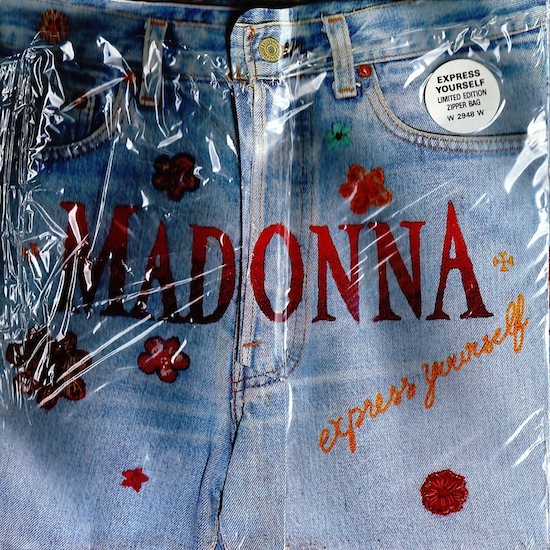
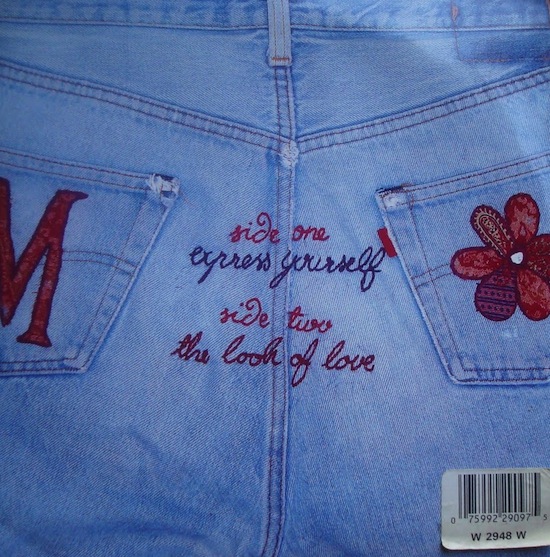
The songs Madonna chose from her past were mostly exhortations and pushbacks, sometimes coupled with direct political statements. She sang part of Papa Don’t Preach, reversing its decision to “keep my baby,” then spoke directly about supporting abortion rights. Dancing while surrounded by video imagery of pointing fingers, she revived Human Nature, which already testified — a full 25 years ago — to Madonna’s tenacity and determination to express herself uncensored. When it ended, her daughters Mercy James, Estere and Stella were onstage, and the singers and a full-throated audience shared an a cappella Express Yourself.The concert’s unquestioned showstopper was Frozen, a somber ballad from the 1998 album Ray Of Light that offers healing: “If I could melt your heart, we’d never be apart.” Madonna appeared as a tiny figure onstage, surrounded by giant video projections of a dancer moving from a self-protective clutch to a tentative, then joyful unfurling and back. It was her oldest daughter, Lourdes, affirming the family connection in movement.
Since 2017 Madonna has lived in Lisbon, where her son David plays soccer, and she spoke about savoring the city’s music: the Portuguese tradition of fado and music from Portugal’s former empire, particularly from the Cape Verde Islands near Senegal. One of the show’s most elaborate backdrops simulated a club in Lisbon.
But appreciation doesn’t equal mastery. Madonna was backed by the Portuguese guitarra player Gaspar Varela, the grandson of the fado singer Celeste Rodrigues, in an earnest, awkward fado-rooted song, Killers Who Are Partying from the Madame X album; she also performed a Cape Verdean classic, Sodade, made famous by Cesária Évora.
Reminding the audience that she had sung in Cape Verdean Creole and other languages, Madonna boasted, “This is a girl who gets around. This is a girl who does her homework.” But in the songs themselves, she only sounded like a well-meaning tourist.
Madonna was more suited to the harder beat of Batuka a song based on the matriarchal, call-and-response Cape Verdean tradition of batuque. Backed by more than a dozen batuque drummers and singers — Orquestra Batukadeiras — and doing some hip-shimmying batuque moves, Madonna conveyed the delight of her discovery, even as the hand-played beat gave way to electronic percussion.
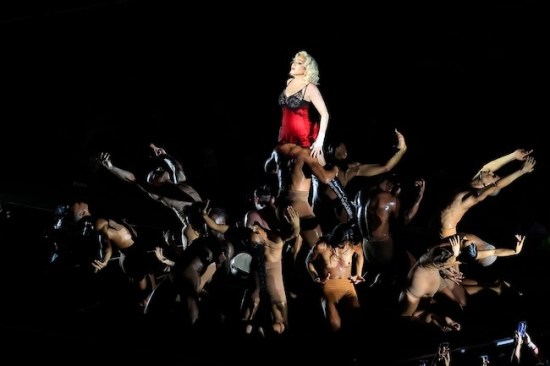
Forty-one musicians, dancers and singers appeared throughout the two-hour-plus show, which came with the same wardrobe changes as any of Madonna’s large-scale extravaganzas (one, before Vogue, was executed before the audience, shielded by a dressing table). The singer wasn’t onstage for one of the most powerful dance moments, a break between acts when a row of performers convulsed gracefully at the lip of the stage to irregular breaths, set to a recording of Madonna intoning lyrics from Rescue Me.
Madonna spoke to and with the audience repeatedly, taking advantage of the intimacy of the room to tell bawdy jokes, apologize for starting the show late and sip a fan’s beer. But in songs and stage patter, she sometimes conflated self-realization and self-absorption with social progress. Contrasting freedom and slavery after Come Alive, she announced that slavery “begins with ourselves,” forgetting that the slave trade was not the same as being “slaves to our phones.”
Yet with Madonna, the spirit is more about sounds and images than literalism. I Rise, which ends both the album and the concert, samples a speech by Emma Gonzalez, a survivor of the shooting at Marjory Stoneman Douglas High School in Parkland, Fla. then goes on to some clumsy lyrics. But in a small theater, with a gospelly beat, raised fists, images of protests worldwide, a rainbow flag, and Madonna and her troupe parading up the aisle — close enough for fans to touch — there was no denying the conviction.
Set List:
- God Control
- Dark Ballet
- Human Nature
- Express Yourself
- Madame X Manifesto (video interlude)
- Vogue
- I Don’t Search I Find
- Papa Don’t Preach / American Life
- Coffin (video interlude)
- Batuka
- Fado Pechincha (with Gasper Varela)
- Killers Who Are Partying
- Crazy
- Welcome to My Fado Club / La Isla Bonita
- Sodade
- Medellín
- Extreme Occident
- Rescue Me” (video interlude)
- Frozen
- Come Alive
- Future
- Crave
- Like a Prayer
- I Rise