Today in Madonna History: December 2, 2000

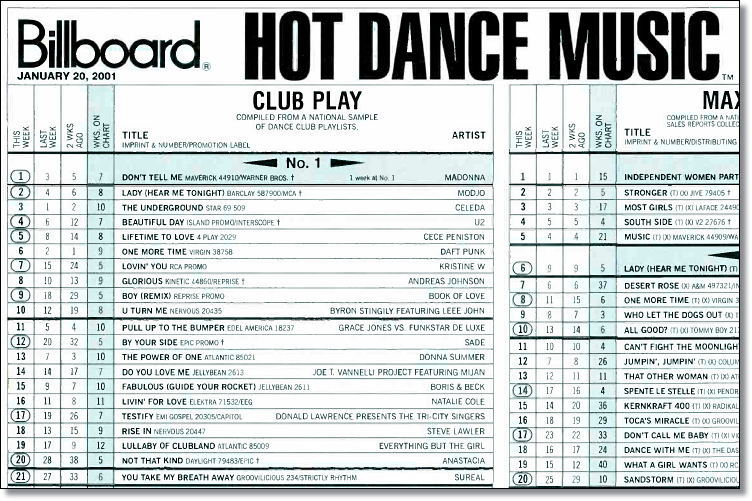
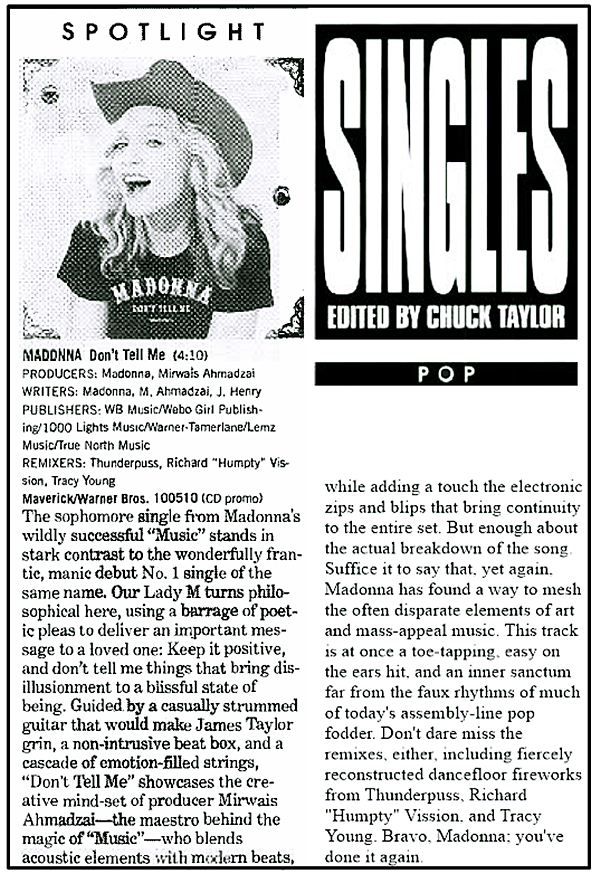
On December 2 2000, Madonna’s Don’t Tell Me single was reviewed by Chuck Taylor in Billboard magazine.

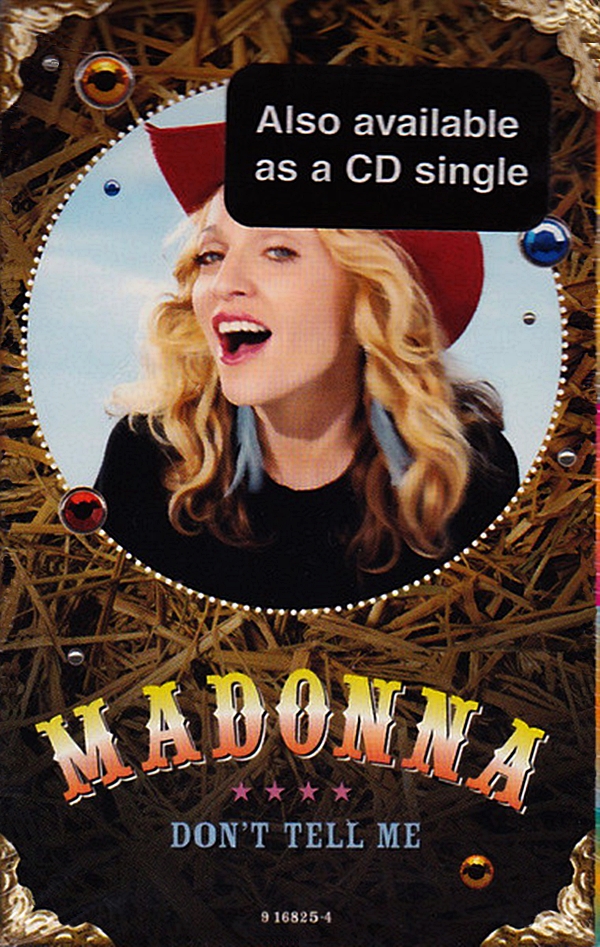
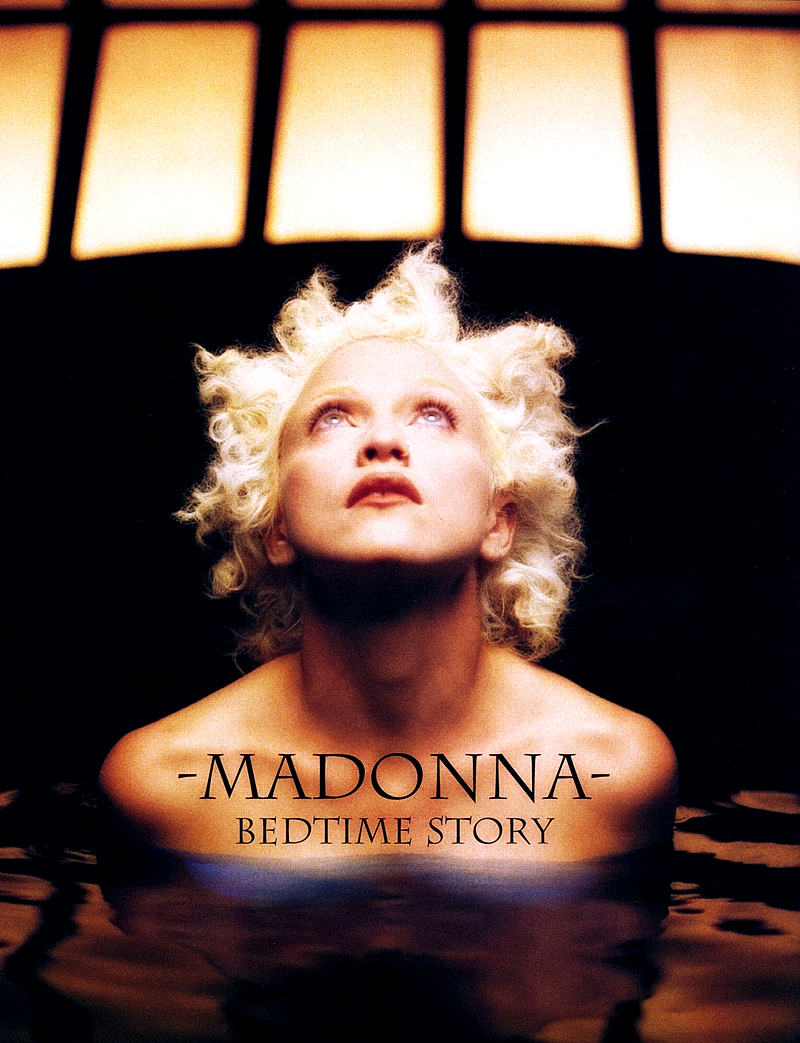
Don’t Tell Me was Madonna’s final single to be released on cassette in the U.S.  In the U.K., Warner Bros. issued Madonna’s next two singles in the format, with the last being 2002’s Die Another Day. In Canada – the first market to regularly issue Madonna’s singles on cassette (beginning with the cassette maxi-single for Angel in 1985) – her final cassette single was 1995’s Bedtime Story, while her final cassette maxi-single was 1994’s I’ll Remember.

Today in Madonna History: November 24, 1984

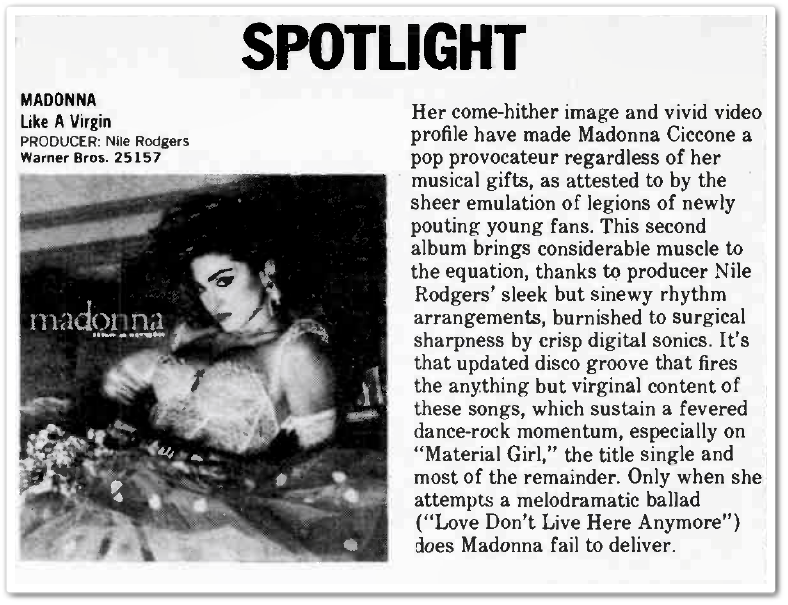
On November 24 1984, Madonna’s Like A Virgin album was reviewed in Billboard magazine.

Check out Malcolm Middleton’s excellent cover of Stay, a pre-fame Madonna & Stephen Bray collaboration that later became the closing track on Like A Virgin:


Today in Madonna History: October 29, 1983

madonna_holiday_oct_29-83-a madonna_holiday_oct_29-83-b madonna_holiday_oct_29-83-c

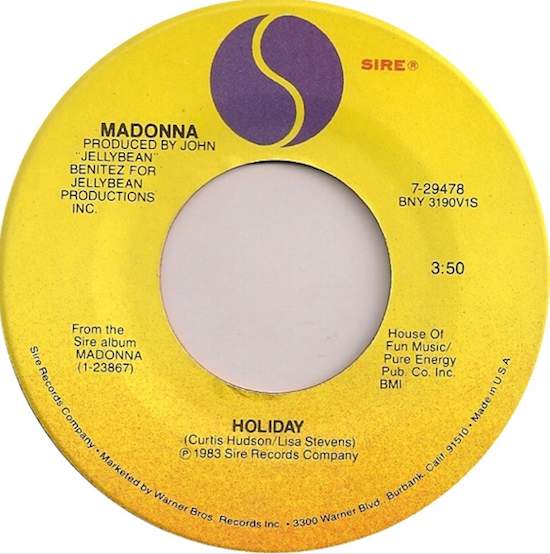
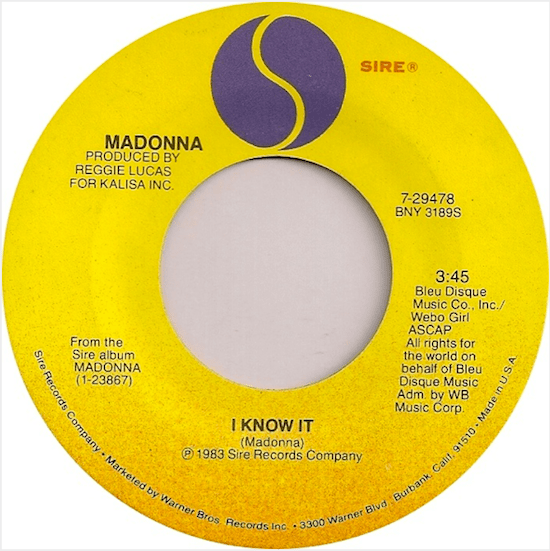
On October 29 1983, Madonna’s Holiday entered the Billboard Hot 100 US singles chart at #88.

Holiday was released on September 7, 1983, and became Madonna’s first hit single, reaching a peak of #16 on January 18, 1984.

Since arriving on the Hot 100 with Holiday, Madonna has earned a total of 56 chart hits (so far), including a record 38 top 10 singles. Madonna has more top 10 hits than any other artist in the 55-year history of the chart. The Beatles are in second place, with 34 top 10 hits.

Lyrics:

Holiday
Celebrate
Holiday
Celebrate

If we took a holiday
Took some time to celebrate
Just one day out of life
It would be, it would be so nice

Everybody spread the word
We’re gonna have a celebration
All across the world
In every nation

It’s time for the good times
Forget about the bad times, oh yeah
One day to come together to release the pressure
We need a holiday

If we took a holiday
Took some time to celebrate
(Come on, let’s celebrate)
Just one day out of life
(Holiday)
It would be, it would be so nice

If we took a holiday
(Oo yeah, oo yeah)
Took some time to celebrate
(Come on, let’s celebrate)
Just one day out of life
(Just one day out of life)
It would be, it would be so nice

You can turn this world around
And bring back all of those happy days
Put your troubles down
It’s time to celebrate

Let love shine
And we will find
A way to come together
Can make things better
We need a holiday

If we took a holiday
(Holiday)
Took some time to celebrate
(Come on let’s celebrate)
Just one day out of life
(Just one day out of life)
It would be, it would be so nice

Oo yeah, oo yeah
Come on, lets celebrate
We have got to get together

Holiday
Celebrate
Holiday
Celebrate

If we took a holiday
(Oh yeah, oh yeah)
Took some time to celebrate
(Come on, let’s celebrate)
Just one day out of life
(Holiday)
It would be, it would be so nice

Holiday
(Oo yeah, oo yeah)
Celebrate
(Come on, let’s celebrate)
Holiday
(Just one day out of life)
Celebrate
(It would be so nice)

Holiday
(Holiday, celebration)
Celebrate
(Come together in every nation)
Celebrate
(Holiday, celebration)
Holiday
(Come together in every nation)

Holiday
Celebrate
Holiday
Celebrate

Holiday
(We got to get together)
Celebrate
(Take some time to celebrate)
Holiday
(Just one day out of life)
Celebrate
(It would be so nice)
Holiday
(Holiday, celebration)
Celebrate
(Come together in every nation)
Holiday
(Holiday, celebration)

Today in Madonna History: October 17, 1987

On October 17 1987, Billboard magazine featured a two-page spread taken out by Madonna’s manager, Freddy DeMann, thanking everyone involved with Madonna’s massively successful Who’s That Girl World Tour, which had wrapped up in Europe the month before.

In the same issue of Billboard, Chart Beat columnist Paul Grein marked Madonna’s 13th consecutive top-5 hit as Causing A Commotion moved into the #5 position on the Hot 100. Speculating on how long Madonna’s winning streak could last, he warned of the dangers of over-exposure and artistic complacency. Without the benefit of hindsight, the back-handed compliment and slightly patronizing advice is not altogether unreasonable, and is certainly not unusual for the time.

Less reasonable, however, is his summation that the severity of Madonna’s potential fall from grace would be compounded by the abundance of female singers of the era who “sound like Madonna”.

Because you know, all female singers are only that – female singers. Even though you’re co-writing and co-producing your own songs and radio can’t get enough, neither can your audience or even your peers, you’re breaking records set by top male and female artists alike, you’re selling out stadiums around the world and earning high praise as a live performer – don’t think any of these things should afford you any respect. You may not have entered the business through the back door and you may have paid your dues and then some, but you’ve still just been lucky, that’s all. You couldn’t possibly possess the talent or the drive to evolve or the insight to be able to stay in the game once your luck runs out. Even though you are the one that everyone is copying – you’re still just another female singer, and they’re a dime a dozen.

While we no longer need hindsight to spot the glaring absurdity and blatant sexism of such an argument today, would it be as obvious if Madonna hadn’t stuck around to dispel it?

Today in Madonna History: September 30, 1995

On September 30 1995, Billboard magazine featured an exclusive interview with Madonna in a piece by Timothy White to promote her upcoming ballads collection, Something To Remember.  Focusing primarily on the connection between Madonna’s introspective ballads and the loss of her mother, the article (which appears in an abridged version below) was titled “‘Something’ In the Way She Grieves.”

“Listening to this record took me on my own journey,” says Madonna with a sad smile, shifting on the couch in her apartment overlooking Central Park. “Each song is like a map of my life. I don’t really listen to my records once I’ve done them, I’m onto the next thing. And I think most of the time when my records come out, people are so distracted by so much fanfare and controversy that nobody pays attention to the music. But this is, for the most part, a retrospective, and I just wanted to put it out in a very simple way. The songs, they choke me up, and I wrote them. Isn’t that weird? I can’t tell you how painful the idea of singing Like A Virgin or Material Girl is to me now. I didn’t write either of those songs and wasn’t digging deep then. I also feel more connected emotionally to the music I’m writing now, so it’s more of a pleasure to do it.”

Madonna has included three new songs on Something To Remember: a moody cover of Marvin Gaye’s 1976 hit I Want You, which was suggested and subsequently produced by Nellee Hooper and features Massive Attack, and two bittersweet serenades (You’ll See and One More Chance), co-created with David Foster during the third weekend of September in a whirlwind writing/recording session. Shortly after this talk, she was to leave for London to start recording the music for the film version of Evita, the musical that was the toast of Broadway in 1979–the year Madonna wrote her first song in the basement of a dormant Queens, NY synagogue.

“I remember calling up my father back in Detroit and making him hear it on the tape recorder over the phone,” she confides, blushing. “He said, ‘Oh, that’s very nice.’ I felt proud. The song was called Tell The Truth.”

A self-assessed “roller-coaster Catholic,” Madonna grew up sharing the middle bunk in a three-tier bed with two of her sisters. “I didn’t have any free time as a child,” she says. “My mother died of breast cancer when I was 7, and then my father remarried when I was 10. I had a lot of responsibility, taking care of my younger brothers and sisters.”

Like her siblings, Madonna was obliged to study music, specifically piano. “But I couldn’t sit still, and I begged my father to let me take dance lessons,” which served as a means of escape. Madonna was in the church choir and acted in school musicals, while sharing her mother’s mantra-like habit of idly intoning her favorite tunes. “As a teenager, I loved Aretha Franklin’s A Natural Woman, and in high school I worshiped Joni Mitchell and sang everything from Court And Spark, my coming-of-age record.”

But her pivotal developmental trial was the death of her mother, and as Madonna passes this fall afternoon discussing the themes behind her often acutely wistful ballads, she ultimately says, “My mother is part of a lot of my music.”

Although love songs, such as Live To Tell, One More Chance and I’ll Remember, also invoke the early fever of a failed marriage to Sean Penn, tensions with a stepmother who could not replace her lost parent, or later relationships that fell short, a larger phantom overshadows each mourning of life’s missed linkages.

“I think about my mother and a certain emptiness–a longing–in my songs. There are tragic, traumatic moments where I think ‘I wish that I could call my mother.’ It’s this primal thing that has been a springboard for the work I do.”

How did she learn her mother was gone?

“I was at my grandmother’s house. The phone rang, and it was my father, and he told my grandmother that my mother had died. I’d just seen her in the hospital. The rest of the day I blocked out–I probably went outside and played. I was majorly into denial and didn’t really understand. And it unfortunately wasn’t something that my father ever really prepared us for or discussed afterward. I suddenly developed a strange throwing-up disease, where every time I would leave the house, I would throw up. If I was away from my father, I threw up. It was a nervous condition.”

In recent years, when Madonna was under attack for her frank Erotica album and Sex book, the artist says she drew strength from her late parent’s nonjudgmental “fervor” for fulfilling one’s personal vision: “She had an unbelievable level of tolerance and forgiveness. She was tremendously religious in a really passionate–almost sexual–way, like she was in love with God. If you read the letters she wrote, even when she was sick and dying, she was completely happy about everything. It was frightening, there was just that faith of hers. My mother loved to take care of people. My older brothers and I were sometimes brutal to her, and she never complained.”

It sounds like the materfamilias had an essential serenity. “Exactly,” says her daughter. “And I could probably use more of it in my life.”

A brisk September breeze catches the leafy scent rising from the freshly mowed lawns of Central Park, the tangy end-of-season smell betokening the coming solstice. Madonna shivers slightly as she sips the last of her tea.

“I think my mother made people angry, because they couldn’t shake her beliefs,” she concludes in a near whisper. “And she was just 32 when she died–just a baby, Madonna Louise. So basically, I’m here to take her place.”

Today in Madonna History: August 27, 1983

On August 27 1983, Madonna’s debut album was reviewed in Billboard magazine. In the same issue, the album made its chart debut at #201 on the Bubbling Under LP chart.

Today in Madonna History: July 7, 1984

On July 7 1984, Warner Bros. Records took out a full-page ad in Billboard magazine to congratulate Madonna on the Gold certification of her self-titled debut album.

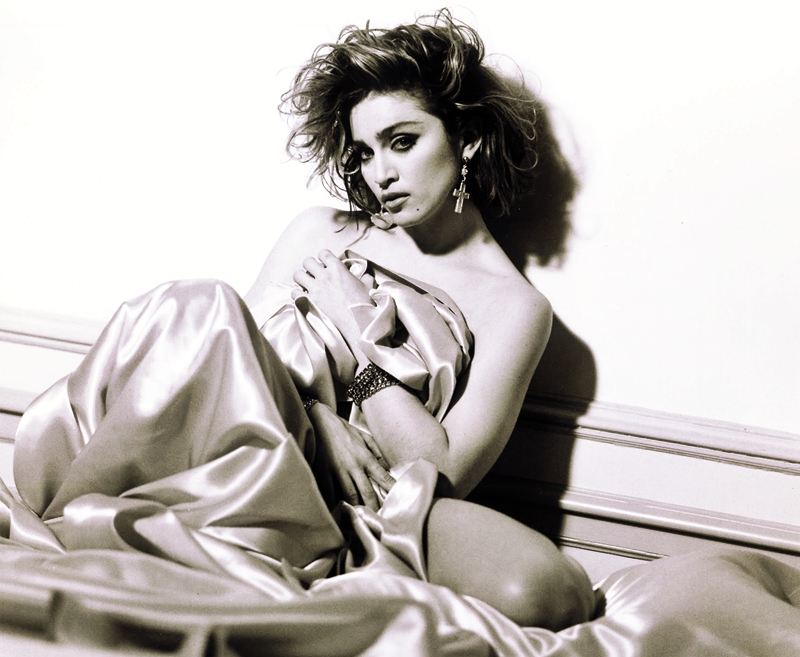
The ad featured the first look at a new photo shoot Madonna had recently completed with Steven Meisel. This image would later appear on the back cover of her next album, Like A Virgin.