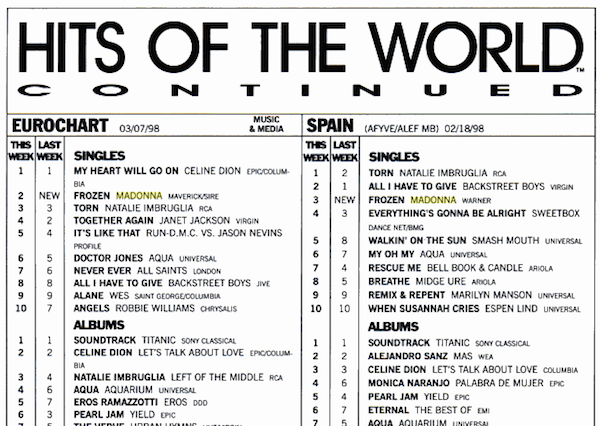
On March 7 1998, Madonna’s Frozen climbed to #2 on the Billboard Eurochart (in its second week), behind Celine Dion’s #1 My Heart Will Go On.


On March 7 1998, Madonna’s Frozen climbed to #2 on the Billboard Eurochart (in its second week), behind Celine Dion’s #1 My Heart Will Go On.

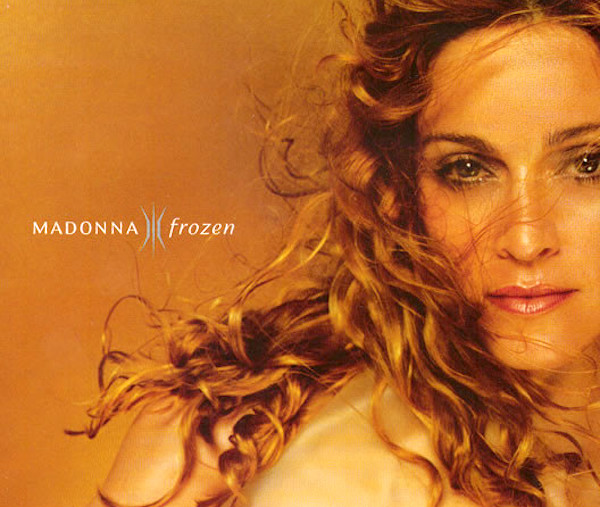
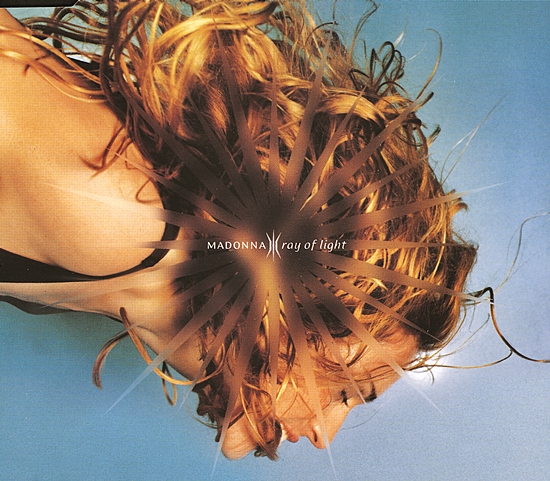
On February 23 1998, Frozen was released by Maverick records as the lead single from Madonna’s seventh studio album, Ray of Light. The song was written by Madonna & Patrick Leonard and was produced by Madonna, Leonard & William Orbit.
Madonna has mentioned that she considers Frozen as part of a thematic trilogy with The Power Of Good-Bye and To Have And Not To Hold. In an interview with Barry Walters for Spin magazine, Madonna commented on the inspiration behind the song:
“I was so obsessed with the movie The Sheltering Sky and that whole Moroccan/orchestral/super-romantic/man-carrying-the-woman-he-loves-across-the-desert vibe. So I told [Patrick Leonard] that I wanted something with a tribal feel, something really lush and romantic. When he started playing some music, I just turned the DAT on and started free-associating and came up with the melody.”
Initially unsure of which song should be released as the album’s first single, Madonna was eventually convinced by Warner Bros. executives that Frozen would be a perfect way to bridge the Adult Contemporary leanings of her most recent hits (Take A Bow, You’ll See and the singles from Evita) with the more cutting-edge, electronic sounds of Ray Of Light.
On November 7 1998, Sky Fits Heaven peaked at #41 on Billboard’s Hot Dance/Club Play chart in the US.
Although the song was not released commercially or promotionally in North America, remixes by Sasha and Victor Calderone released abroad on the Drowned World/Substitute For Love single managed to garner enough club play in the U.S. to merit a six-week run on the chart (plus one week on the Hot Dance Music Breakouts chart).
A remix video of Sky Fits Heaven (Sasha Remix) featuring outtakes from the Ray Of Light music video was serviced to select clubs, and this non-traditional form of promotion may have contributed to its chart placement.
On October 15 1998, an article by Chuck Philips ran in the LA Times regarding a dispute between the principal shareholders of Maverick Records – Freddy DeMann, Guy Oseary and Madonna.
A feud between the founders of Madonna’s Maverick Records, one of the most successful start-up labels of the decade, is threatening to undercut the label’s value if it goes up for sale next year. Sources said Maverick co-Chairman Freddy DeMann might leave the company before January with a buyout package worth more than $20 million. Representatives for Madonna, DeMann and Maverick minority owner Guy Oseary have been meeting regularly in Burbank to resolve the matter with senior brass at Time Warner’s Warner Music Group, which owns 50% of Maverick. None of the principals involved in the discussions would comment, but sources said Madonna and Oseary have wanted DeMann to leave for more than a year and have asked Warner to underwrite his exit. The disagreement is likely to undercut the trio’s bargaining power when its joint-venture deal with Warner runs out in July.
Maverick could command as much as $200 million on the open market if Warner chooses not to exercise its option to buy the company next year, sources said. The label has generated more than $750 million in revenue since 1992 selling music by such acts as Alanis Morissette, Prodigy and Candlebox. Discord among Maverick’s principals, however, has hampered the trio’s ability to attract suitors and has given Warner the upper hand in the negotiations, sources said. Indeed, one proposal on the table calls for Warner to put up the money to finance DeMann’s exit and possibly give Madonna and Oseary a higher stake in the label in exchange for a commitment from them to extend their joint venture with Warner for five to seven years, sources said.
The size of DeMann’s exit package will depend on what value the parties assign Maverick, sources said. DeMann is likely to walk away with at least $20 million to cover his 20% stake in Maverick but could be paid twice that amount before the talks conclude, sources said. DeMann is being represented in the negotiations by financier Jerry Perenchio, a longtime friend. One source said the 59-year-old DeMann is upset because he wants to sell Maverick in July and cash out, but Oseary and Madonna prefer to negotiate for a bigger stake in the company, with plans to sell in six years. Other sources, however, said DeMann is being forced out by Madonna and Oseary–who, until recently, have relied on his expertise to navigate their careers, as well as manage the record label now at the center of the dispute.
Madonna and DeMann launched Maverick in 1992 as a joint venture with Warner, which put up about $10 million to finance the partnership. Initially, the company was viewed as little more than a vanity label–a bargaining chip used by Warner to sweeten its offer during contract renegotiations with Madonna, who is signed to the company as a recording artist. DeMann had pitched the label concept to Madonna, whose career he had managed since her arrival on the pop music scene in the early 1980s. He then built the label from scratch, hired its staff and even came up with the company’s name–a combination of letters culled from Madonna, Veronica (the singer’s middle name) and Frederick (his first name).
One of DeMann’s first hires at Maverick was Oseary, a 19-year-old with virtually no experience in the music business who was a friend of DeMann’s daughter. DeMann took Oseary under his wing and gave him a job as Maverick’s artist and repertoire man, the employee responsible for discovering musical talent. Oseary delivered his first hit in 1993 with the Seattle rock act Candlebox, whose debut album sold 4 million copies. Oseary then came across a tape of Morissette, an unknown Canadian singer whose demo had been rejected by every major record company. He liked what he heard and played it for DeMann, who agreed to sign her to Maverick. The album eventually sold more than 28 million copies worldwide. Following Morissette’s success, Oseary’s profile rose dramatically. The young executive was rewarded with a minority stake in Maverick and tensions soon began to mount within the company, sources said.
In 1996, Madonna dumped DeMann as her manager and ultimately hired Q-Prime’s Cliff Bernstein and Peter Mench to represent her. A friend of Oseary’s is said to have helped facilitate the singer’s move to Q-Prime, sources said. Within a year, representatives for Madonna and Oseary began to lobby Warner for help in financing an exit package for DeMann, sources said. Warner turned the request down last October but resumed discussions with representatives for the trio a few months ago after rumors surfaced that Sony Music might be interested in acquiring Maverick or hiring Oseary and Madonna next year to start a new label, sources said.
It is unclear why Madonna, Oseary and DeMann couldn’t maintain a united front until after their Warner deal runs out in July. The dispute, however, appears to be heating up as Maverick prepares for the Nov. 3 release of Morissette’s follow-up album, one of the most widely anticipated projects of the year. During the last few weeks, executives from Warner have held meetings with Madonna’s attorney Allen Grubman, Oseary’s lawyer John Branca and DeMann’s representatives Perenchio and attorney Larry Kartiganer. While nothing has been decided, sources said the matter is expected to be resolved by the end of the year and possibly even before Morissette’s album hits the street.