Today in Madonna History: March 26, 1986

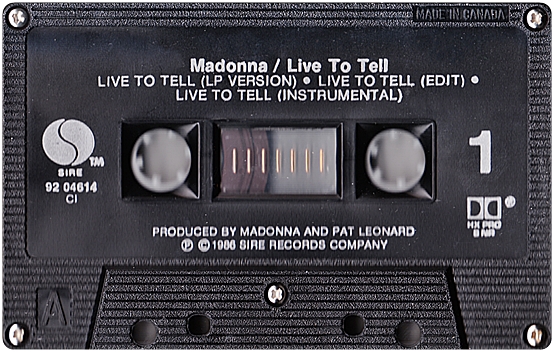
Live To Tell - Video Set - Herb Ritts Live To Tell - Canadian Cassette Maxi-Single Cover Live To Tell - Canadian CMS - Inner Sleeve Live To Tell - Canadian CMS - Back Sleeve Live To Tell - Canadian CMS - Cassette

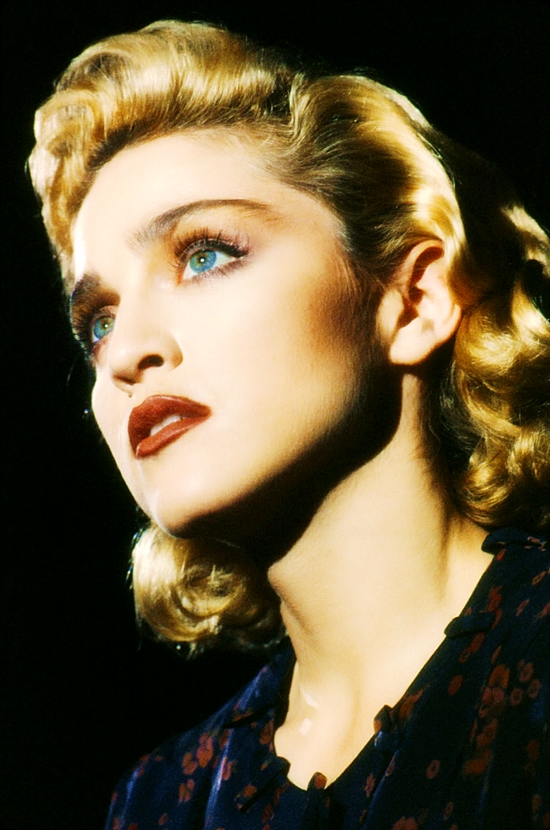
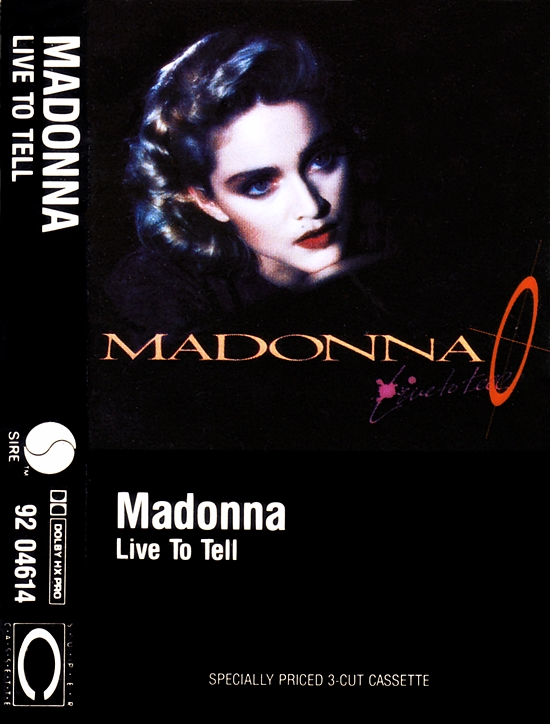
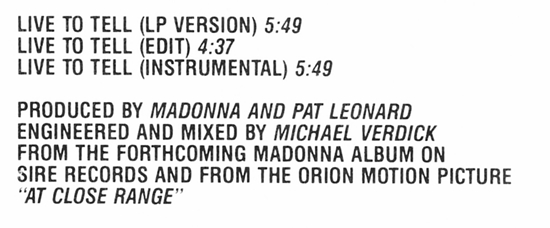
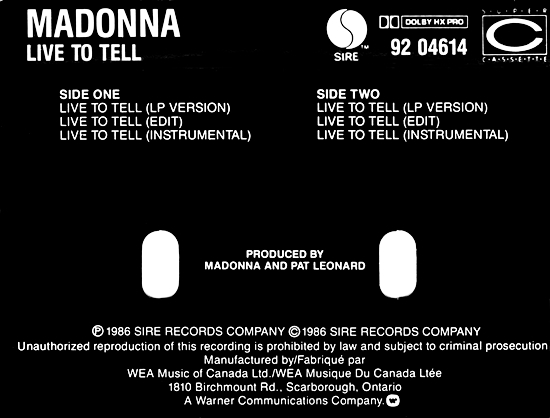
On March 26 1986, Live To Tell was released as a single in North America by Sire Records. The haunting and dramatic ballad, written and produced by Madonna & Patrick Leonard, was the first commercially released collaboration between the pair – a songwriting partnership that is viewed by many fans as one of her most creatively successful.

Leonard had previously been involved with Madonna’s Virgin Tour as musical director, and when Madonna agreed to participate in Live Aid in the Summer of 1985, she asked him to collaborate on a new song for the performance, which evolved into Love Makes The World Go Round.

Although both songs would find their way on to Madonna’s next studio album, True Blue, at the time of Live To Tell’s release the album’s title had not yet been decided. Instead, the song was used to promote Sean Penn’s film At Close Range, in which it was featured alongside an original score composed by Leonard.

He had initially composed the music that evolved into Live To Tell for another film he had been invited to score for Paramount, titled Fire With Fire. The producers of the film passed on the theme. Leonard recalled the subsequent series of events that led to the song’s completion in The Billboard Book of Number One Hits by Random House:

“Madonna said ‘This song would be great for Sean’s new movie.’ She wrote the lyrics–she just wrote them on the spot, which is what we always do. I don’t think we’ve ever taken more than three hours to complete a song from start to finish. She sang it on the demo only once and left with the cassette. That day I went to work with Michael Jackson on some transcriptions for material he was writing for the Bad album. The phone rang at Michael’s and it was Sean. He said ‘I’m over at the director’s house and Madonna just brought the song over. We love it and we’d like to talk to you about it.’ … We recut the song, but we used the same vocal. She only sang it once for the demo and that was the vocal we used because it was so innocent and so shy. She had a legal pad in her hand and you can hear the paper. It’s as raw as raw can be and that’s part of what gave it all its charm.”

When the demo recording of Live To Tell eventually surfaced, it became evident that Madonna had in fact re-recorded the first verse, but all remaining vocals do indeed appear to have been carried over from the demo to the final mix (along with a generously added dose of reverb to smooth over the rough edges of the demo take).

Given the song’s dark undercurrents and unresolved narrative, it was a bold choice for a single release. It marked a dramatic shift from the yearning love song, Crazy For You – her only other ballad to have been issued as a single at the time. But any radio programmers who were hesitant to consider Madonna as a serious artist simply couldn’t deny the artistry of the song and nor could record buyers, with the combined support sending Live To Tell straight to the top of the pop charts. It was also a significant Adult Contemporary crossover success, becoming her first single to reach number-one on Billboard’s Hot AC chart where it reigned for three weeks.

Today in Madonna History: March 9, 1983

On March 9 1983, Madonna’s second single, the classic double A-side Burning Up/Physical Attraction, was released on 12″ vinyl.

The sleeve of the single featured a series of sketches of Madonna created by her close friend, Martin Burgoyne.


Today in Madonna History: January 30, 1990

Keep It Together CD Cover 550

On January 30 1990, Keep It Together was released in North America as the fifth and final single from Like A Prayer. It also received a commercial release in Japan, Australia, Ecuador and the Philippines, while some European markets opted to include it as the b-side to Madonna’s next single, Vogue.

As fate would ironically have it, Madonna’s soulful ode to remembering ones roots would turn out to be the last Madonna-performed single co-written and co-produced with longtime collaborator Stephen Bray, whom she had befriended (or by some accounts, dated) during her days as a student at the University of Michigan. A final collaboration written by the pair, Get Over – which is speculated to have been written as a potential new track for The Immaculate Collection but was instead given to fellow Warner recording artist Nick Scotti – was released as a single in 1993, after first appearing on the Nothing But Trouble soundtrack in 1991.

Although no music video was produced for Keep It Together, the maxi-single – jam-packed with memorable remixes by Shep Pettibone and DJ Mark “The 45 King” with Stephen Bray – made the single a must-have for fans around the world. And despite its exclusion from her greatest hits releases, Madonna’s show-closing (and show-stopping) performance of the song during her legendary Blond Ambition Tour – and its accompanying documentary Truth Or Dare – has also served to keep the song alive in the hearts and minds of fans.

Today in Madonna History: December 24, 1995

oh-father-uk-cd-cover

On December 24 1995, Oh Father was released as the second UK single from Madonna’s ballads retrospective, Something To Remember.

Warner had initially declined the option to release Oh Father in most European markets when it became the fourth North American single from Like A Prayer in late 1989, instead opting for a more by-the-numbers portrait of childhood innocence with the release of Dear Jessie. Why it was determined to be a better idea in 1995, following its poor showing on the U.S. charts, is anyone’s guess. One possibility is that Oh Father‘s brilliant preexisting music video provided an easy, cost-free means of promoting the song while Madonna remained unavailable due to her recording commitments for the Evita soundtrack.

While I would personally rank Oh Father among Madonna’s very best musical and lyrical efforts, and its music video an underrated classic – it never had the makings of a commercial hit. And history repeated itself when the song’s dark subject matter once again stunted its ability to gain momentum on radio for its British release. It became only her third UK single at the time to peak outside the top-ten when it stalled at #16 in its first charting week. It fared better in Finland and Italy, however, reaching #6 in both countries.

Today in Madonna History: November 25, 1987

On November 25 1987, The Look of Love was released as the third and final single from the Who’s That Girl soundtrack in Europe.

The Look Of Love was also released as a single in Japan in January, 1988.

Today in Madonna History: November 17, 1984

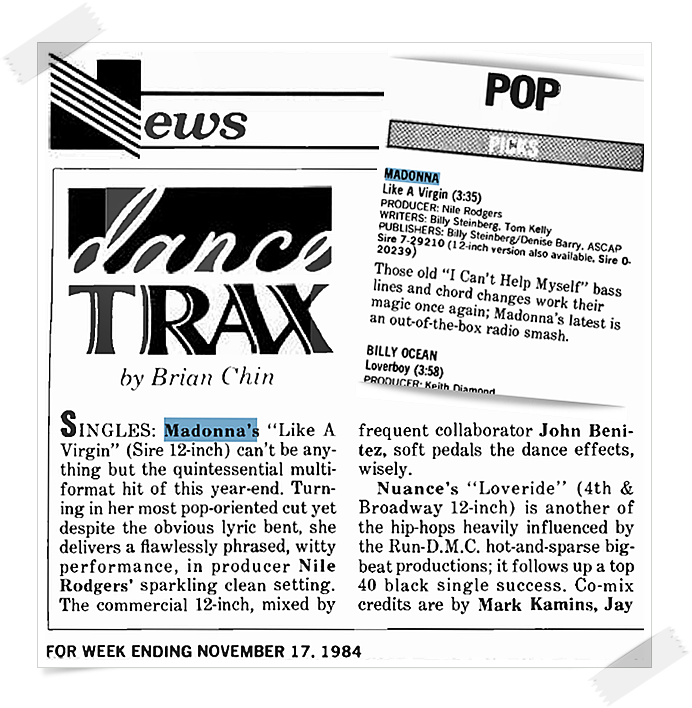
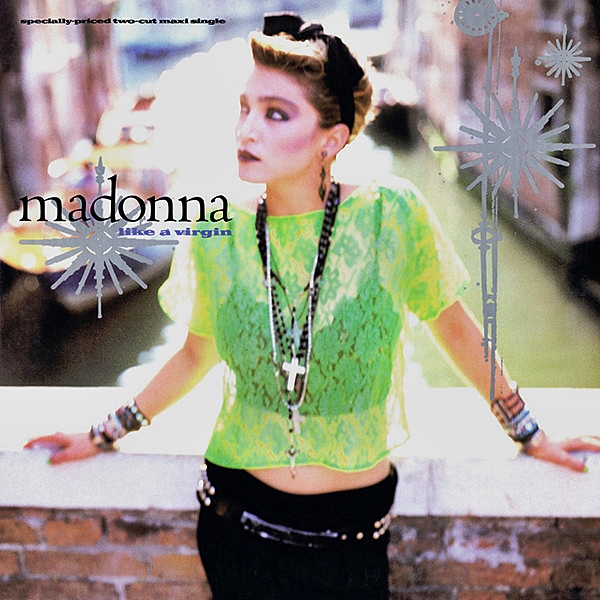
On November 17 1984, the title-track and lead single from Madonna’s Like A Virgin album entered the Billboard Hot 100 at #48 – the week’s highest debut – hot on the heels of its commercial release as a 7-inch single in the preceding sales week. A commercial 12-inch single was also issued in North America during the chart week ending November 17th, with Like A Virgin pouncing onto the Hot Dance/Disco Sales chart at #26 in the November 24th issue of Billboard.

Created by the successful pop songwriting team of Tom Kelly & Billy Steinberg and produced by Nile Rodgers, the demo of Like A Virgin – sung by Kelly – was initially introduced to Madonna by Warner Bros. Records’ A&R rep Michael Ostin (son of then-CEO of Warner, Mo Ostin).

In a 2009 interview for Rolling Stone magazine, Madonna recalled her impressions upon first listening to the demos of Like A Virgin and its follow-up single, Material Girl:

“I liked them both because they were ironic and provocative at the same time but also unlike me. I am not a materialistic person, and I certainly wasn’t a virgin, and, by the way, how can you be like a virgin? I liked the play on words; I thought they were clever. They’re so geeky, they’re cool. I never realized they would become my signature songs, especially the second one.”

As audio engineer Jason Corsaro noted in a 2007 interview with Sound On Sound magazine, although she officially ceded production credit to Rodgers, Madonna was actively engaged in all aspects of the recording sessions for the album and title-track:

“Nile was there most of the time, but she was there all of the time. She never left.”

Like A Virgin made a high-profile debut via live performance during the first annual MTV Video Music Awards on September 14th, 1984.

With previous single Lucky Star still ascending the North American charts, however, the official release of Like A Virgin was held back by Warner Bros. Records in a bid to allow the former (along with its parent album) to reach its full chart potential. This strategy proved successful, with Madonna earning her first U.S. Top-5 single with Lucky Star in the October 20th issue of Billboard, while Like A Virgin would reach #1 in the December 22nd issue.

Today in Madonna History: October 24, 1989

oh father usa sheet music 550oh father set 11 550

On October 24 1989, Oh Father was released in North America as the fourth single from the Like A Prayer album. France, Japan, the Philippines and Australia also opted to issue the single in 1989, while other European markets waited for Madonna’s 1995 ballads compilation, Something To Remember, to promote the song. Oh Father was written and produced by Madonna & Patrick Leonard.

According to the song’s string arranger, Bill Meyers, Oh Father was recorded in a “dingy studio” in New York City’s Garment District while Madonna was appearing in the play, Speed-The-Plow. Since the bulk of the album would be completed in California after the completion of her Broadway run, this would suggest that Oh Father was likely the first song recorded for the project. Leonard recently provided further evidence of this when he shared an image of a demo tape sleeve containing working titles of songs from the latter sessions on his Instagram, noting that Oh Father was not among the tracks listed because it had been completed earlier.

Leonard recalled the recording of the track in a 2014 interview with Billboard Magazine:

My favorite thing that we ever recorded, ever – or wrote – is Oh Father. That to me is the best thing we ever did. So, it didn’t surprise me because we knew when we did it, that there was something about this that was in a way kind of the most real thing.

For that song, the ‘record’ button was only pressed three times. It was pressed to do the track, live, with her singing live. Then we did the orchestra. And then we did a double of her vocal when we were mixing. That’s it. So it’s real. It’s something that I really wanted to do and she was kind enough to say “let’s try this,” and it was not easy.

There’s two or three guitar players playing. I’m playing keyboards. Jai Winding was playing keyboards. There was a percussionist and a drummer – and she’s singing – all at the same time.

These days, people go “wow, that seems crazy.” Those days it wasn’t uncommon for everybody to be playing together even though you’re not a band. But it was one of those things where the arrangement was tricky enough, that it really took some working out to get it all right.

Even all those weird synth overdubs and things – all those things were being done live. We worked out all the parts, had all the sounds. I remember that we cut it live, and then put the orchestra on. You’re not doubling the orchestra, so it’s one pass for the orchestra.

When I say [the ‘record’ button was] pressed three times, it might have gotten pressed 10 times that day, but it was ultimately one that stayed there. If you see what I’m saying. When we were mixing it, [mixer] Bill Bottrell suggested that we double the choruses. I remember even being a little upset about it (laughs). Like, look, “we’ve got an amazing record that we only pressed the record button twice – can’t we leave it?” He said, “three isn’t exactly shameful.” We doubled the lead vocal on the choruses, and that was it.