
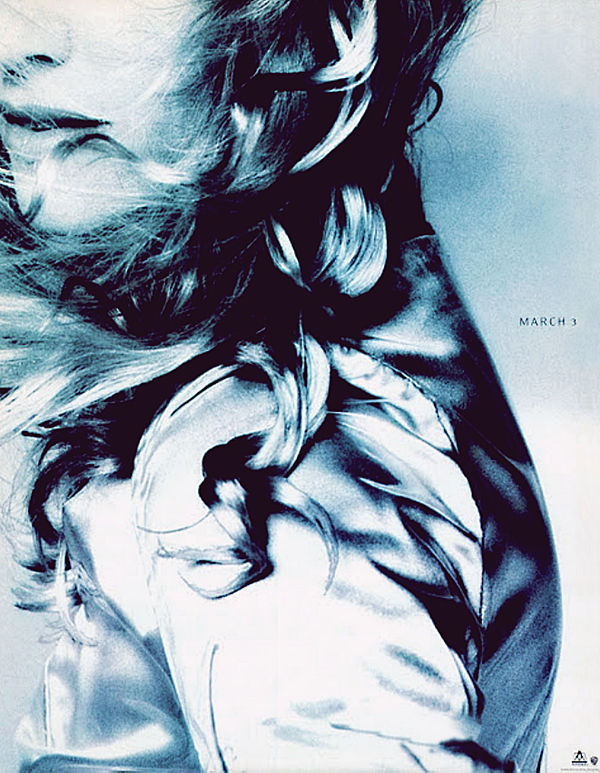
On February 21 1998, an article by Larry Flick focusing on the anticipation building around the release of Madonna’s album, Ray Of Light, was published in Billboard magazine. The feature included interviews with Madonna and William Orbit along with a teaser of the album cover.
NEW YORK – Is the world ready for a spiritually enlightened Madonna? The numerous pre-release radio and Internet leaks of “Frozen,” the lead single from the pop chameleon’s new Maverick/Warner Bros. album, “Ray Of Light,” certainly hint that she may be embarking on her most successful musical voyage to date.
With its worldwide release slated for March 3, the album is unarguably her most adventurous. She has teamed with techno pioneer William Orbit for a collection that sews intense, soul-searching words into edgy electronic/dance instrumentals. The result is a brave, visionary effort with the commercial potency needed to finally elevate electronica beyond its current status as a limited hipster movement into a true mass-appeal attraction.
“My intention was to make a record that I’d enjoy listening to,” Madonna says of her first studio set since 1994’s “Bedtime Stories,” which has sold 2 million units in the U.S., according to SoundScan. “This album is reflective of where I am in my life right now – in terms of my musical interests and in terms of my personal beliefs. I feel like I’ve been enlightened, and that it’s my responsibility to share what I’ve learned so far with the world.”
It appears much of the world is clamoring to hear the results. The Singapore Madonna Link, an unofficial, fan-operated World Wide Web site, began offering an unauthorized snippet of “Frozen” Jan. 23. The site has received more than 140,000 hits.
There have also been approximately a dozen leaks of “Frozen” on top 40 radio around the U.S. since Jan. 26. WKTU New York is among those stations that played “Frozen” to rabid listener response.
“The phones blew up,” says assistant PD/GM Andy Shane, adding that the station has continued sneaking the single on the air in advance of its official airplay date of Thursday (19). “For the days we haven’t had it on, people have been calling nonstop begging to hear it.”
Erik Bradley, music director at WBBM (B-96) Chicago, witnessed similar listener response when his station leaked “Frozen” Feb. 7. “People are going crazy for it,” he says. “It’s a compelling record that you can’t shake from your mind after you hear it. That’s the mark of a smash. Clearly, American pop radio needs Madonna.”
So does the rest of the world, apparently. “Frozen” has had “fantastic” early support across Europe, according to Jon Uren, marketing director, U.S. labels, for Warner Music Europe. The single has been A-listed at BBC Radio 1 in the U.K. and hit the airplay charts in France, the Netherlands, and Germany in its first week after a Jan. 23 release.
The project’s retail forecast is equally bright, with Jonathan Rees, head of rock and pop for the HMV chain in the U.K., describing its prospects as `very positive.”
Tim Devin, GM of Tower Records in New York, wholeheartedly agrees. “Quite frankly, I can’t wait for it. The anticipation surrounding this album is amazing. The industry needs an exciting, mega-star release, and this will fill that important void.”
That’s precisely how Phil Quartararo, president of Warner Bros. (U.S.), views “Ray Of Light.” “What Madonna does that’s so admirable is that she always manages to land on the cusp of what we call contemporary music,” he says. “In 1998, every established artist faces the dilemma of maintaining their importance and relevance. Madonna never fails to be relevant.”
The creative seeds for “Ray Of Light” were planted last year, when Madonna phoned Orbit and asked if he was interested in co- writing a few songs. “I’ve been a fan of all kinds of electronic music for many years, and I wanted to incorporate that sound into my music,” she says, adding that her admiration for Orbit’s catalog of recordings put him at the top of her wish list of collaborators. “I love the haunting, trance-like quality of his records. I’ve also always found something melancholy about his music. Since I’m attracted to that sound, and since I tend to write a lot of sad songs, we seemed like a good match.”
Upon introduction, Orbit handed Madonna a tape of five instrumental tracks. “It basically was a sketchbook of fantastic ideas,” she says. “Every track was so inspiring. I took them and gave them structure.”
Among the first songs to evolve from that tape was “Swim,” a guitar-driven electro-funk odyssey on which Madonna meditates on the perils of bad karma and its ongoing effect on the world at large. “It gave me shivers the first time I heard it,” Orbit says. “We both knew we were onto something special.”
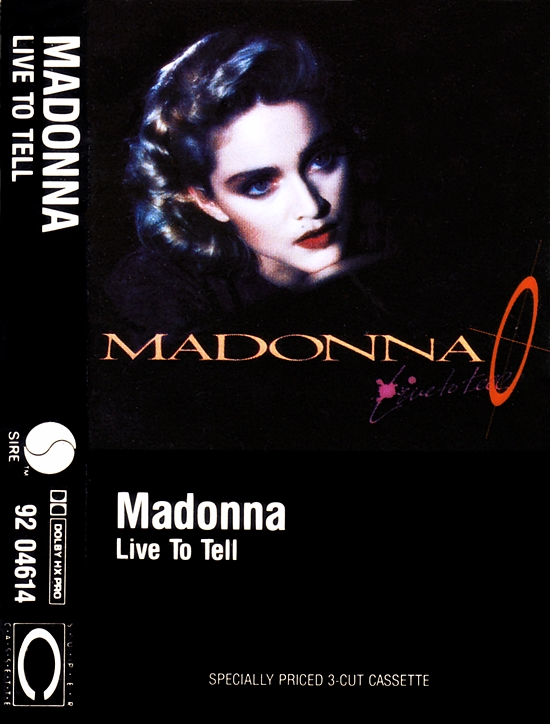
From there, the two decided to guide the overall production of “Ray Of Light” together. In addition to the five songs she wrote with Orbit, Madonna collaborated with veteran pop tunesmith Rick Nowels, Nellee Hooper protégé Marius De Vries, and Patrick Leonard, with whom she created such early hits as “Live To Tell” and “Open Your Heart.” Leonard co-wrote “Frozen.”
After locking themselves away in the studio for six months “like a pair of mad scientists,” as Orbit puts it, they emerged with a high- concept collection that combines cutting-edge underground club elements with pure pop melodies and a generous slathering of what they call “teenage-angst guitars.”
Fresh from the rigors of 1996’s “Evita” film and soundtrack, Madonna has also found comfortable new vocal ground between the theatrical demands of that project and the more casual vibe of her early recordings, showcasing a fluid, flexible range that’s executed to haunting effect. “Training my voice has opened me up immeasurably, and it’s allowed me to do things with my voice that I never thought were possible,” she says.
“I’m so proud of the way the album came out,” Madonna adds. “But for a moment after I first finished it, I cringed. I thought, `What have I done ?’ Emotionally and sonically, it went in such a different territory for me.”
Orbit is equally pleased with the set’s results, primarily because Madonna “wasn’t at all interested in compromising or watering down” the electronic textures of his productions. If anything, he says, she `insisted upon purity in the arrangements, which worked astonishingly well with her pop songs at the core.”
Of those songs, both are irreversibly stuck on the title cut – the likely single follow-up to “Frozen” – which is a euphoric, deliciously over-the-top anthem that builds from a percolating trance-disco groove into a collision course of futuristic keyboards and assaulting metal riffs. “It’s totally out of control,” she says, laughing. “The original version is well over 10 minutes long. It was completely indulgent, but I loved it. It was heartbreaking to cut it down to a manageable length.”
The sprawling, unedited version of “Ray Of Light” is already earmarked for inclusion on “Veronica Electronica,” a compilation of single remixes and album outtakes, due in the fall.
“Veronica Electronica” is also a potential stage persona that Madonna is toying with as she ponders hitting the road for her first concert trek since 1993’s Girlie tour. Unlike that eye-popping spectacle, she says she’d like to do something “totally scaled down” this time, with a set list culled exclusively from “Ray Of Light,” “Bedtime Stories,” and 1992’s “Erotica.” If she decides to tour, it won’t happen until late summer/early fall.
Until then, she’ll test live waters with several European TV performances, including a gig on the U.K.’s “National Lottery Live” show Saturday (21), as well as her first U.S. club date in more than 10 years. On Saturday (14), she’ll take the stage of New York’s Roxy nightclub for a performance of three tunes from the album.





 Today In Madonna History