Tag Archives: Remix Videos
Today in Madonna History: November 19, 1994
Today in Madonna History: November 17, 1984
On November 17 1984, the title-track and lead single from Madonna’s Like A Virgin album entered the Billboard Hot 100 at #48 – the week’s highest debut – hot on the heels of its commercial release as a 7-inch single in the preceding sales week. A commercial 12-inch single was also issued in North America during the chart week ending November 17th, with Like A Virgin pouncing onto the Hot Dance/Disco Sales chart at #26 in the November 24th issue of Billboard.
Created by the successful pop songwriting team of Tom Kelly & Billy Steinberg and produced by Nile Rodgers, the demo of Like A Virgin – sung by Kelly – was initially introduced to Madonna by Warner Bros. Records’ A&R rep Michael Ostin (son of then-CEO of Warner, Mo Ostin).
In a 2009 interview for Rolling Stone magazine, Madonna recalled her impressions upon first listening to the demos of Like A Virgin and its follow-up single, Material Girl:
“I liked them both because they were ironic and provocative at the same time but also unlike me. I am not a materialistic person, and I certainly wasn’t a virgin, and, by the way, how can you be like a virgin? I liked the play on words; I thought they were clever. They’re so geeky, they’re cool. I never realized they would become my signature songs, especially the second one.”
As audio engineer Jason Corsaro noted in a 2007 interview with Sound On Sound magazine, although she officially ceded production credit to Rodgers, Madonna was actively engaged in all aspects of the recording sessions for the album and title-track:
“Nile was there most of the time, but she was there all of the time. She never left.”
Like A Virgin made a high-profile debut via live performance during the first annual MTV Video Music Awards on September 14th, 1984.
With previous single Lucky Star still ascending the North American charts, however, the official release of Like A Virgin was held back by Warner Bros. Records in a bid to allow the former (along with its parent album) to reach its full chart potential. This strategy proved successful, with Madonna earning her first U.S. Top-5 single with Lucky Star in the October 20th issue of Billboard, while Like A Virgin would reach #1 in the December 22nd issue.
Today in Madonna History: November 14, 2004
On November 14 2004, Michael Colombier – the composer/arranger who produced the beautiful string arrangements for Madonna’s songs Die Another Day, Don’t Tell Me & Easy Ride, and composed the soundtrack for Swept Away (perhaps the film’s most memorable attribute) – passed away at age 65.
Colombier was one of the most prolific and versatile French musicians of his generation. Besides his career as a film composer scoring over 100 feature, cable and television films since the early 1960’s – Colombier was a prolific songwriter and arranger who worked with artists such as Joni Mitchell, Prince, Serge Gainsbourg, The Beach Boys, Herbie Hancock, Air, Barbra Streisand & Earth Wind And Fire.
As a film composer, Michel Colombier scored many French and American films, including The Golden Child, Ruthless People, New Jack City, How Stella Got Her Groove Back and The Money Pit. His background in jazz was evident in the majority of his film scores, and his ability to compose original score music that merged seamlessly with pop songs made him the perfect composer for 1980’s films with song-heavy soundtracks, including White Nights, Against All Odds and Purple Rain (which won a Grammy Award as well as an Academy Award for Best Original Score).
Today in Madonna History: November 7, 1998
On November 7 1998, Sky Fits Heaven peaked at #41 on Billboard’s Hot Dance/Club Play chart in the US.
Although the song was not released commercially or promotionally in North America, remixes by Sasha and Victor Calderone released abroad on the Drowned World/Substitute For Love single managed to garner enough club play in the U.S. to merit a six-week run on the chart (plus one week on the Hot Dance Music Breakouts chart).
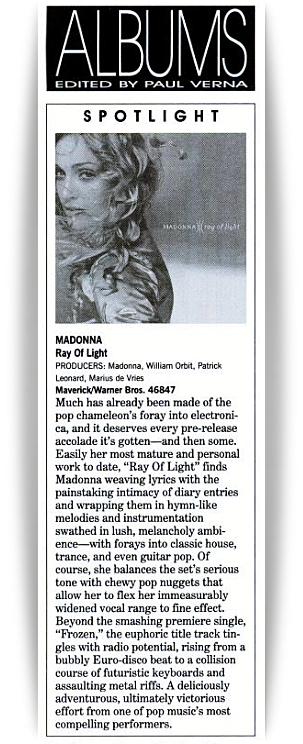
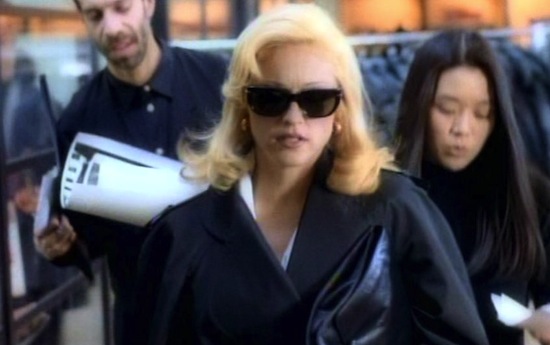
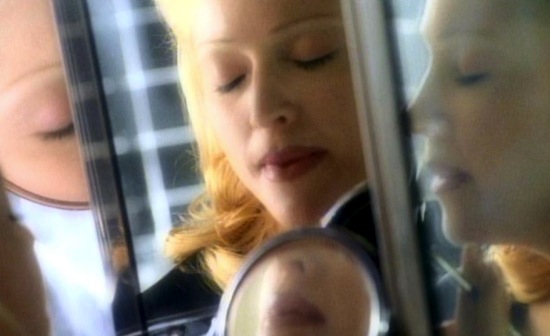
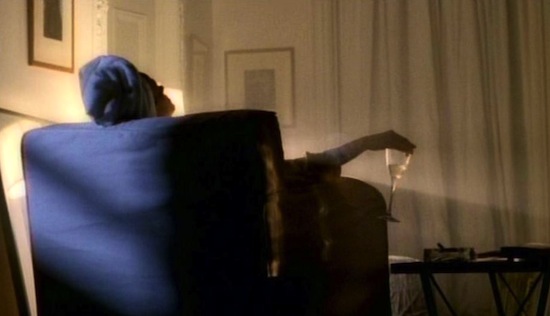
A remix video of Sky Fits Heaven (Sasha Remix) featuring outtakes from the Ray Of Light music video was serviced to select clubs, and this non-traditional form of promotion may have contributed to its chart placement.
Today in Madonna History: October 31, 2006
On October 31 2006, Jump was released as the fourth and final single from the album Confessions On Dance Floor. It was written by Madonna, Stuart Price & Joe Henry and produced by Madonna & Stuart Price.
In Canada, the CD maxi-single for Jump is notable for being Madonna’s last physical single to be issued domestically. The Hard Candy-era singles were imported from the U.S. by Warner Music Canada, while her Interscope singles have only been released in digital form for the North American market.
Today in Madonna History: September 30, 1995
On September 30 1995, Billboard magazine featured an exclusive interview with Madonna in a piece by Timothy White to promote her upcoming ballads collection, Something To Remember. Focusing primarily on the connection between Madonna’s introspective ballads and the loss of her mother, the article (which appears in an abridged version below) was titled “‘Something’ In the Way She Grieves.”
“Listening to this record took me on my own journey,” says Madonna with a sad smile, shifting on the couch in her apartment overlooking Central Park. “Each song is like a map of my life. I don’t really listen to my records once I’ve done them, I’m onto the next thing. And I think most of the time when my records come out, people are so distracted by so much fanfare and controversy that nobody pays attention to the music. But this is, for the most part, a retrospective, and I just wanted to put it out in a very simple way. The songs, they choke me up, and I wrote them. Isn’t that weird? I can’t tell you how painful the idea of singing Like A Virgin or Material Girl is to me now. I didn’t write either of those songs and wasn’t digging deep then. I also feel more connected emotionally to the music I’m writing now, so it’s more of a pleasure to do it.”
Madonna has included three new songs on Something To Remember: a moody cover of Marvin Gaye’s 1976 hit I Want You, which was suggested and subsequently produced by Nellee Hooper and features Massive Attack, and two bittersweet serenades (You’ll See and One More Chance), co-created with David Foster during the third weekend of September in a whirlwind writing/recording session. Shortly after this talk, she was to leave for London to start recording the music for the film version of Evita, the musical that was the toast of Broadway in 1979–the year Madonna wrote her first song in the basement of a dormant Queens, NY synagogue.
“I remember calling up my father back in Detroit and making him hear it on the tape recorder over the phone,” she confides, blushing. “He said, ‘Oh, that’s very nice.’ I felt proud. The song was called Tell The Truth.”
A self-assessed “roller-coaster Catholic,” Madonna grew up sharing the middle bunk in a three-tier bed with two of her sisters. “I didn’t have any free time as a child,” she says. “My mother died of breast cancer when I was 7, and then my father remarried when I was 10. I had a lot of responsibility, taking care of my younger brothers and sisters.”
Like her siblings, Madonna was obliged to study music, specifically piano. “But I couldn’t sit still, and I begged my father to let me take dance lessons,” which served as a means of escape. Madonna was in the church choir and acted in school musicals, while sharing her mother’s mantra-like habit of idly intoning her favorite tunes. “As a teenager, I loved Aretha Franklin’s A Natural Woman, and in high school I worshiped Joni Mitchell and sang everything from Court And Spark, my coming-of-age record.”
But her pivotal developmental trial was the death of her mother, and as Madonna passes this fall afternoon discussing the themes behind her often acutely wistful ballads, she ultimately says, “My mother is part of a lot of my music.”
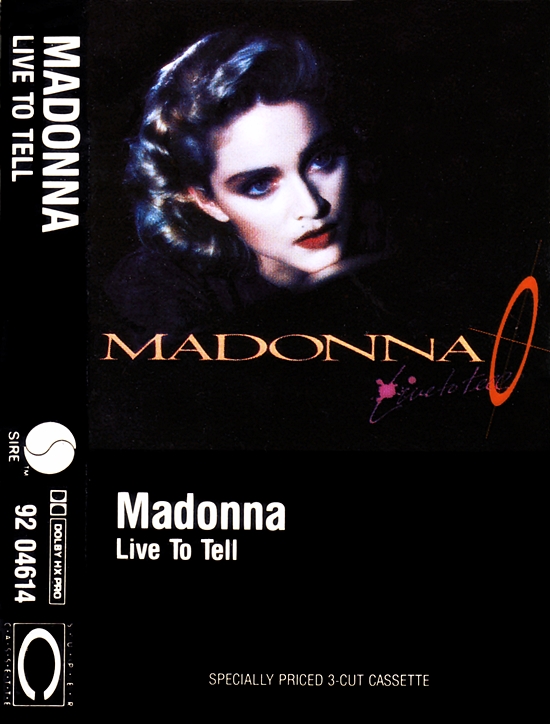
Although love songs, such as Live To Tell, One More Chance and I’ll Remember, also invoke the early fever of a failed marriage to Sean Penn, tensions with a stepmother who could not replace her lost parent, or later relationships that fell short, a larger phantom overshadows each mourning of life’s missed linkages.
“I think about my mother and a certain emptiness–a longing–in my songs. There are tragic, traumatic moments where I think ‘I wish that I could call my mother.’ It’s this primal thing that has been a springboard for the work I do.”
How did she learn her mother was gone?
“I was at my grandmother’s house. The phone rang, and it was my father, and he told my grandmother that my mother had died. I’d just seen her in the hospital. The rest of the day I blocked out–I probably went outside and played. I was majorly into denial and didn’t really understand. And it unfortunately wasn’t something that my father ever really prepared us for or discussed afterward. I suddenly developed a strange throwing-up disease, where every time I would leave the house, I would throw up. If I was away from my father, I threw up. It was a nervous condition.”
In recent years, when Madonna was under attack for her frank Erotica album and Sex book, the artist says she drew strength from her late parent’s nonjudgmental “fervor” for fulfilling one’s personal vision: “She had an unbelievable level of tolerance and forgiveness. She was tremendously religious in a really passionate–almost sexual–way, like she was in love with God. If you read the letters she wrote, even when she was sick and dying, she was completely happy about everything. It was frightening, there was just that faith of hers. My mother loved to take care of people. My older brothers and I were sometimes brutal to her, and she never complained.”
It sounds like the materfamilias had an essential serenity. “Exactly,” says her daughter. “And I could probably use more of it in my life.”
A brisk September breeze catches the leafy scent rising from the freshly mowed lawns of Central Park, the tangy end-of-season smell betokening the coming solstice. Madonna shivers slightly as she sips the last of her tea.
“I think my mother made people angry, because they couldn’t shake her beliefs,” she concludes in a near whisper. “And she was just 32 when she died–just a baby, Madonna Louise. So basically, I’m here to take her place.”