Today in Madonna History: October 2, 1986

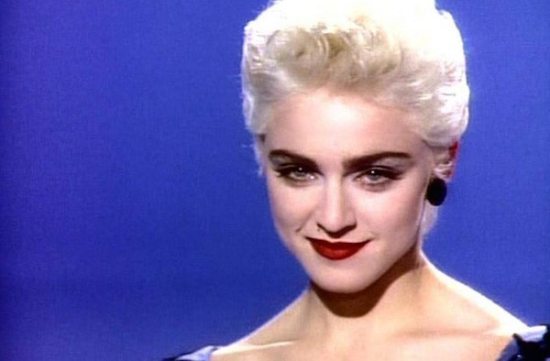
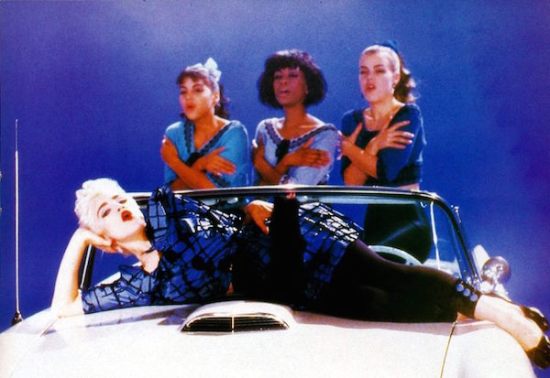
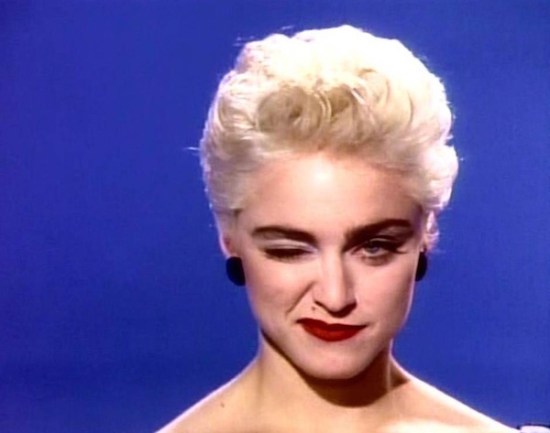
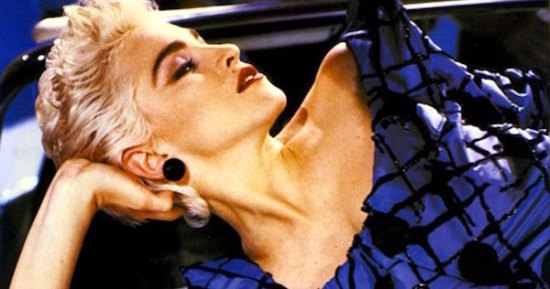
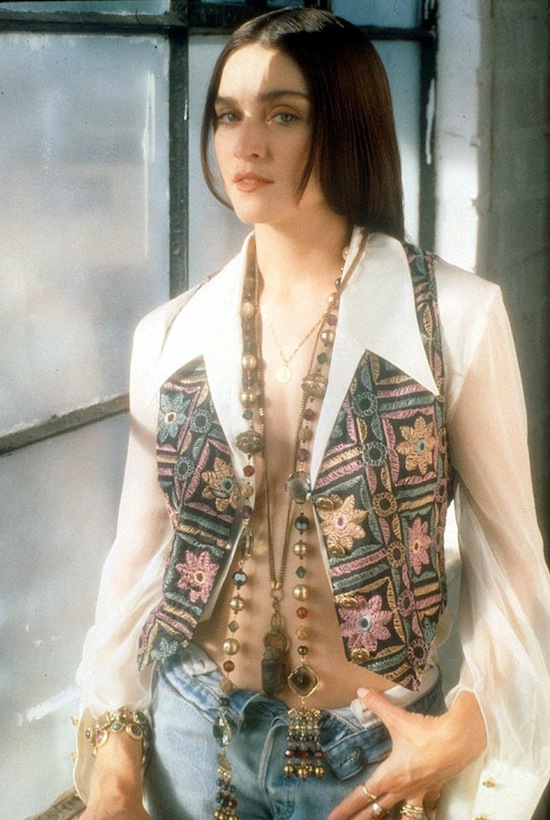
On October 2 1986, Madonna’s True Blue music video premiered on BBC1-TV’s Top Of The Pops. The video was directed by James Foley and shot in early September (1986) in New York.

Two of Madonna’s closest friends (at the time), Erika Belle and Debi Mazar, appeared in the video.

A second video for True Blue (which does not include Madonna) was shown on MTV in the USA. The second video was the winner of Madonna’s ‘Make My Video’ Contest. The winners (Angel Gracia and Cliff Guest) were flown to MTV’s New York studio where Madonna presented them a $25,000 check live on MTV.


Today in Madonna History: October 1, 1983

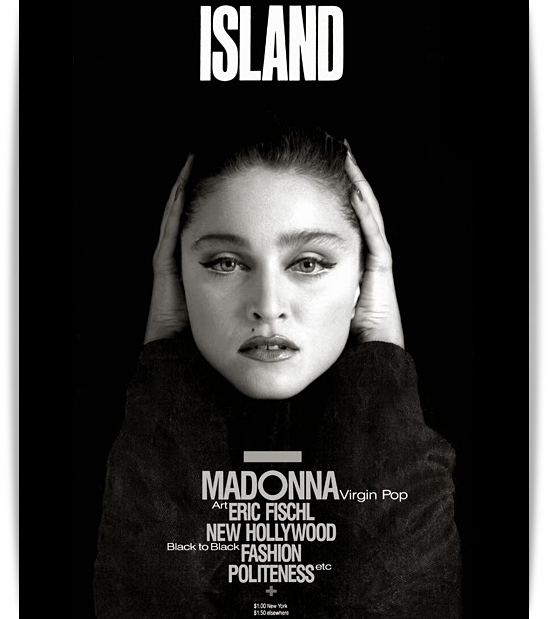
On October 1 1983, Madonna appeared on her first magazine cover for Island magazine, shot by Curtis Knapp. The black & white cover image stands out from the many other Madonna photographs of the era due to its minimalist feel, focusing solely on Madonna’s facial features.

The magazine also featured an exclusive Q&A with Madonna:

Interviewer: Madonna.

Madonna: What?

Interviewer: Let’s go deep into your personal life.

Madonna: No way.

Interviewer: Come on. What do you like? Start with fashion. You’re a girl. You always wear all these great clothes on stage.

Madonna: No I don’t.

Interviewer: Everybody has the Madonna look now.

Madonna: I know. Crotchless jeans, (laughter). Most of the clothes I wear look the way they do because they’re so worn out.

Interviewer: Where’s that stage style from?

Madonna: It’s pseudo-Puerto Rican punk rock freak out. A Motorcycle baby. It’s a combination of my two oldest fantasies. One was to be Nancy Sinatra; the other was to be a nun.

Interviewer: Do you ever do that song “These Boots are Made for Walkin’”?

Madonna: I used to do it in front of the mirror in my uniform skirt.

Interviewer: You went to Catholic school?

Madonna: Uh-huh. The Sacred Heart Academy.

Interviewer: What do you want to achieve now?

Madonna: Stardom.

Interviewer: Make lots of records, or make lots of money?

Madonna: I want to make a lot of love. (whistle in the background) I don’t think about money. It just gets there. Up until a year ago I was still broke and living on the street. But I still feel the same way. Money will never be a problem for me. If you worry about it, it’s a problem.

Interviewer: Did you draw when you were a kid?

Madonna: Phallic symbols. You know Catholics. I used to draw people naked all the time in my art class and my nun teachers used to tell me I had to put clothes on them. So I just drew lines around their bodies. See-through clothes.

Interviewer: Had you ever seen a naked body at that time?

Madonna: No. I never saw naked bodies. I never saw my parents naked. Gosh, when I was seventeen I hadn’t seen a penis.

Interviewer: So were you shocked when you saw the first one?

Madonna: Yeah. I thought it was really gross (laughter). And I’m not saying anymore.

Interviewer: Did you ever fall in love?

Madonna: I’m always falling in love. But I get in trouble because I think it’s love then I realize it’s not, but the other person is in love and then I have this problem til I think it’s love again and have the courage to get out of the last one.

Interviewer: Your songs are very fantasy. Maybe they help people think they’re in love when they’re not. Is that okay?

Madonna: Yeah. Fantasies are essential. Without fantasies I would have died of starvation.

Interviewer: In New York it’s difficult to be polite sometimes. Do you think being polite is a virtue? Or is it something you don’t have to think about?

Madonna: I think it’s a virtue. I’m sincere to people who are sincere.

Interviewer: What about people like the president of Warner Brothers Records?

Madonna: I’m just charming.

Interviewer: That makes sense. Your new manager is also Michael Jackson’s manager. And you’re planning you first tour with a band?

Madonna: Yeah I’m madly in love with my manager. And you can print that. I’m rehearsing now with singers and dancers, and I’ll have two guitarists, and two synthesizers, the drums and bass will be pre-recorded. We’re doing an American tour, and European track dates. Not til the beginning of the year.

Interviewer: You were talking before about reincarnation. What were your past lives like?

Madonna: I don’t really…I only have images and feelings, no specific chronological events or anything like that. I do feel really transient in a way. I feel like when I meet people I can absorb their character and be them. And I find that no matter what I’m doing I’m always doing the same thing. Basically. What ever it looks like on the outside. And it just makes me feel..I don’t know…I can’t really describe it verbally because no one’s ever asked me this before, no one really cares. Haha! People just want to hear me sing.

Interviewer: How come you do soul music…soul pop?

Madonna: Because I have soul. Because you can dance to it. Cause you can, you know. I grew up in an all black neighborhood and I wanted to be a black girl. I really did. There was something about me that was so much freer than the white kids I knew and they didn’t go to the Catholic schools I went to. They went to other schools and they wore short dresses and they didn’t have to take baths all the time and their knees were always dirty…I liked the fact that they could braid their hair and it would be sticking up…that’s not why I’m braiding my hair right now…First of all, all the black girls in my neighborhood had these dances in their yard where they had these little turntables with 45 records and they’d play all this Motown stuff and they would dance, just dance, all of them dancing together and none of the white kids I knew would ever do that. They were really boring and stiff. And I wanted to be part of the dancing. I didn’t like my friends. I had to be beaten up so many times by these little black girls before they would accept me and finally one day they whipped me with a rubber hose till I was like, lying on the ground crying. And then they just stopped doing it all of a sudden and let me be their friend, part of their group.

Today in Madonna History: September 30, 1995

On September 30 1995, Billboard magazine featured an exclusive interview with Madonna in a piece by Timothy White to promote her upcoming ballads collection, Something To Remember.  Focusing primarily on the connection between Madonna’s introspective ballads and the loss of her mother, the article (which appears in an abridged version below) was titled “‘Something’ In the Way She Grieves.”

“Listening to this record took me on my own journey,” says Madonna with a sad smile, shifting on the couch in her apartment overlooking Central Park. “Each song is like a map of my life. I don’t really listen to my records once I’ve done them, I’m onto the next thing. And I think most of the time when my records come out, people are so distracted by so much fanfare and controversy that nobody pays attention to the music. But this is, for the most part, a retrospective, and I just wanted to put it out in a very simple way. The songs, they choke me up, and I wrote them. Isn’t that weird? I can’t tell you how painful the idea of singing Like A Virgin or Material Girl is to me now. I didn’t write either of those songs and wasn’t digging deep then. I also feel more connected emotionally to the music I’m writing now, so it’s more of a pleasure to do it.”

Madonna has included three new songs on Something To Remember: a moody cover of Marvin Gaye’s 1976 hit I Want You, which was suggested and subsequently produced by Nellee Hooper and features Massive Attack, and two bittersweet serenades (You’ll See and One More Chance), co-created with David Foster during the third weekend of September in a whirlwind writing/recording session. Shortly after this talk, she was to leave for London to start recording the music for the film version of Evita, the musical that was the toast of Broadway in 1979–the year Madonna wrote her first song in the basement of a dormant Queens, NY synagogue.

“I remember calling up my father back in Detroit and making him hear it on the tape recorder over the phone,” she confides, blushing. “He said, ‘Oh, that’s very nice.’ I felt proud. The song was called Tell The Truth.”

A self-assessed “roller-coaster Catholic,” Madonna grew up sharing the middle bunk in a three-tier bed with two of her sisters. “I didn’t have any free time as a child,” she says. “My mother died of breast cancer when I was 7, and then my father remarried when I was 10. I had a lot of responsibility, taking care of my younger brothers and sisters.”

Like her siblings, Madonna was obliged to study music, specifically piano. “But I couldn’t sit still, and I begged my father to let me take dance lessons,” which served as a means of escape. Madonna was in the church choir and acted in school musicals, while sharing her mother’s mantra-like habit of idly intoning her favorite tunes. “As a teenager, I loved Aretha Franklin’s A Natural Woman, and in high school I worshiped Joni Mitchell and sang everything from Court And Spark, my coming-of-age record.”

But her pivotal developmental trial was the death of her mother, and as Madonna passes this fall afternoon discussing the themes behind her often acutely wistful ballads, she ultimately says, “My mother is part of a lot of my music.”

Although love songs, such as Live To Tell, One More Chance and I’ll Remember, also invoke the early fever of a failed marriage to Sean Penn, tensions with a stepmother who could not replace her lost parent, or later relationships that fell short, a larger phantom overshadows each mourning of life’s missed linkages.

“I think about my mother and a certain emptiness–a longing–in my songs. There are tragic, traumatic moments where I think ‘I wish that I could call my mother.’ It’s this primal thing that has been a springboard for the work I do.”

How did she learn her mother was gone?

“I was at my grandmother’s house. The phone rang, and it was my father, and he told my grandmother that my mother had died. I’d just seen her in the hospital. The rest of the day I blocked out–I probably went outside and played. I was majorly into denial and didn’t really understand. And it unfortunately wasn’t something that my father ever really prepared us for or discussed afterward. I suddenly developed a strange throwing-up disease, where every time I would leave the house, I would throw up. If I was away from my father, I threw up. It was a nervous condition.”

In recent years, when Madonna was under attack for her frank Erotica album and Sex book, the artist says she drew strength from her late parent’s nonjudgmental “fervor” for fulfilling one’s personal vision: “She had an unbelievable level of tolerance and forgiveness. She was tremendously religious in a really passionate–almost sexual–way, like she was in love with God. If you read the letters she wrote, even when she was sick and dying, she was completely happy about everything. It was frightening, there was just that faith of hers. My mother loved to take care of people. My older brothers and I were sometimes brutal to her, and she never complained.”

It sounds like the materfamilias had an essential serenity. “Exactly,” says her daughter. “And I could probably use more of it in my life.”

A brisk September breeze catches the leafy scent rising from the freshly mowed lawns of Central Park, the tangy end-of-season smell betokening the coming solstice. Madonna shivers slightly as she sips the last of her tea.

“I think my mother made people angry, because they couldn’t shake her beliefs,” she concludes in a near whisper. “And she was just 32 when she died–just a baby, Madonna Louise. So basically, I’m here to take her place.”

Today in Madonna History: September 29, 1992

Erotica US CD Single 550Erotica US CD Single Back Sleeve 550Erotica US CD Single Disc 550

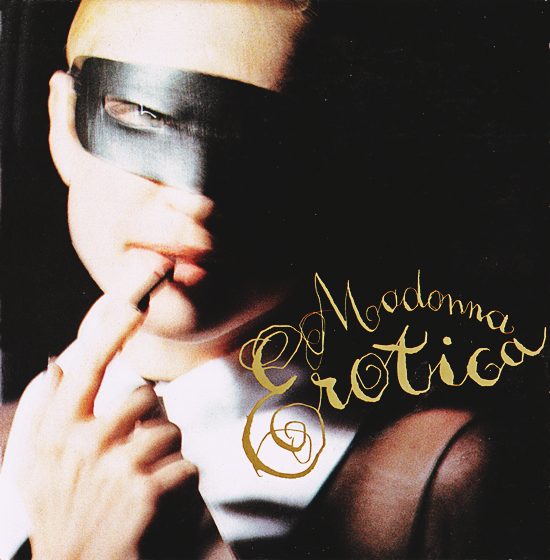
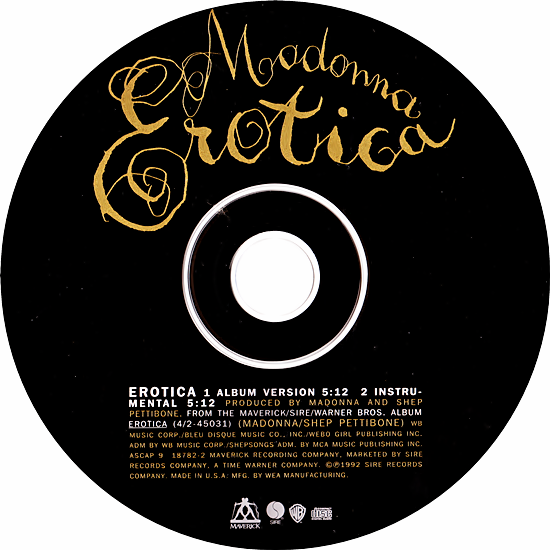
On September 29 1992, Madonna’s Erotica single was released to radio. Originally credited to Madonna & Shep Pettibone, Pettibone’s partner Tony Shimkin was later granted co-writing credit for nearly all of the Pettibone collaborations on the album, including Erotica. The debut release to feature the imprint of Maverick Records, the song was produced by Madonna & Pettibone.

As several leaked demo versions of the song can now attest, the track had gone through numerous incarnations before Madonna settled on lyrics that positioned her in the perspective of Dita – the alter-ego she had created for her Sex book. The song’s original chorus (“You thrill me…”) was reincorporated into the song when Madonna performed it during her 2006 Confessions Tour. Alternate verses were also used to create the track Erotic, which was included with the Sex book – these lyrics were also featured in a William Orbit remix that was included on the Erotica maxi-single.

French art director and photographer Fabien Baron designed the artwork for the single, the album and the Sex book. He also directed the Erotica music video, which included footage he had shot on Super 8mm during the making of the book. Baron recalled his first meeting with Madonna to discuss their potential collaboration in a 2009 interview with Hint Fashion Magazine:

“I met Madonna at her home on Central Park West to talk about working on her Sex book. It was very comfortable but very uncomfortable at the same time, which is a very interesting feeling. She’s very imposing and knows what she wants. She’s very informed and opinionated, which makes her genius. She takes you in and swallows you up — and you don’t mind it –  you actually enjoy it. There’s an unspoken seduction that goes on. I was young…she was young, too – and beautiful. That was an unforgettable era. She put that book out at the best moment. She timed it very well…she knows what she’s doing. And such drive. Some people want to lift stones to see what’s under them. She’ll be on a beach with millions of stones and want to lift every one of them.”

Today in Madonna History: September 28, 1998

empress-2 empress-1 empress-3 empress-4

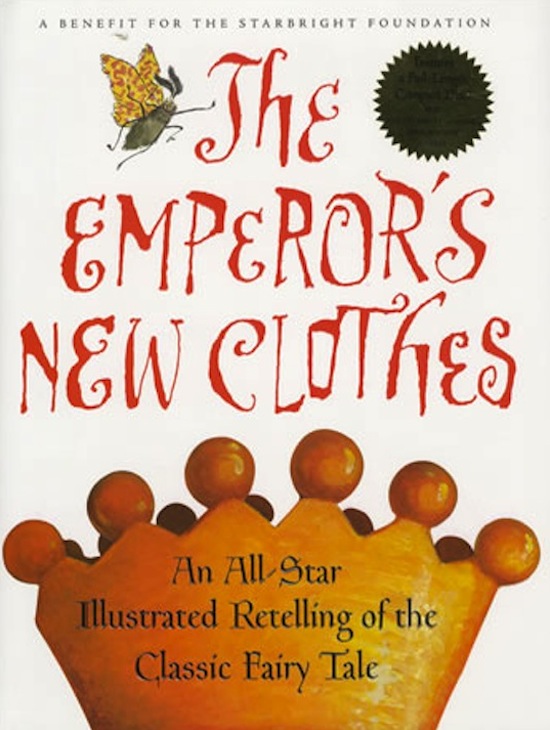
On September 28 1998, Hans Christian Anderson’s The Emperor’s New Clothes was released as a book with audio CD by the Starbright Foundation, to benefit seriously ill children.

Each snippet of the story is performed on an audio CD by one of 23 celebrities, including: Jay Leno, Liam Neeson, Angela Lansbury, Madonna, Carrie Fisher, Jeff Goldblum, Dan Ackroyd, Robin Williams, Joan Rivers, Steven Spielberg, General Norman Schwarzkopf, John Lithgow, and others. Contributing illustrators include Maurice Sendak, Mark Teague, Chris Van Allsburg, Berkeley Breathed, Steven Kellogg, Tomie de Paola, Graeme Base and others.

On the CD Madonna tells the story from the perspective of the Emperor’s Wife (illustrated as Marie Antoinette by Daniel Adel).

Today in Madonna History: September 27, 2002

dieanotherday usa sheet music die another day rit 550

On September 27 2002, the theme and title-track for the twentieth film in the James Bond franchise, Die Another Day, received its world premiere on New York radio station Z100. The song had been due to hit the airwaves on October 10th, but when Z100 got their hands on the track ahead of schedule they immediately added it to their heavy rotation playlist. Other stations quickly followed suit, prompting an early but very strong debut at #41 on the Billboard Hot 100 in the U.S. and becoming the chart’s highest first-week entry of the year.

Die Another Day was written and produced by Madonna and Mirwais with string arrangement by the late, great Michel Colombier. After being introduced to Madonna through Mirwais, Colombier arranged strings for Madonna’s 2000 hit Don’t Tell Me, scored her film Swept Away and arranged the American Life tracks Nothing Fails and Easy Ride. Colombier sadly lost a brief battle with cancer in 2004, leaving behind a legacy of celebrated collaborations with the likes of Serge Gainsbourg, Prince and Joni Mitchell, to name only a few.

Madonna’s Bond theme was first performed during 2004’s Re-Invention Tour, where it became a visual showstopper with its ambitious and impressively executed tango-influenced choreography.

Today in Madonna History: September 26, 1988

On September 26 1988, Madonna began recording the Like A Prayer album in Los Angeles, California with collaborators Patrick Leonard and Stephen Bray.

Madonna had begun writing for the album during the down time of her Broadway run in David Mamet’s Speed-The-Plow, for which she gave her final performance in late August. With her marriage to Sean Penn on the rocks, Madonna found herself at a personal and creative crossroads – with plenty to express.