
On September 23 2000, Madonna’s hit single, Music, spent a second week at #1 on the Billboard Hot 100 in the USA.
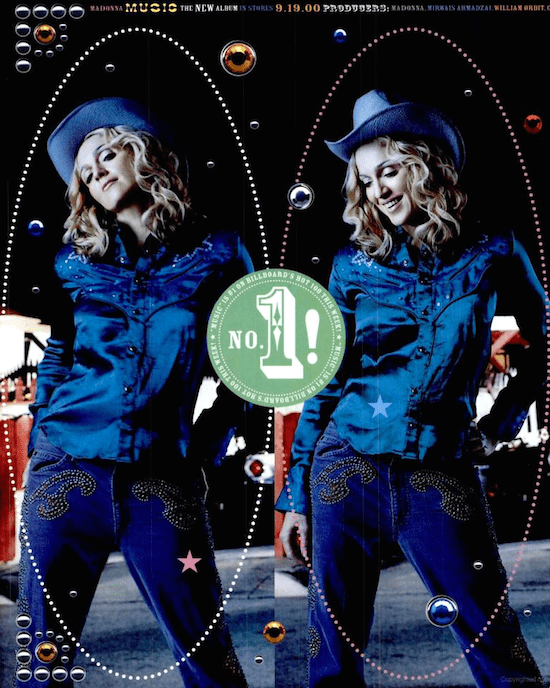

On September 23 2000, Madonna’s hit single, Music, spent a second week at #1 on the Billboard Hot 100 in the USA.
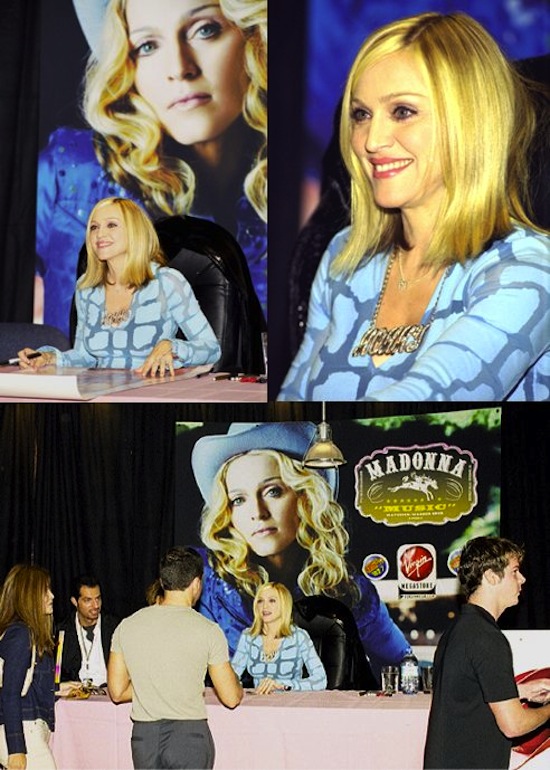
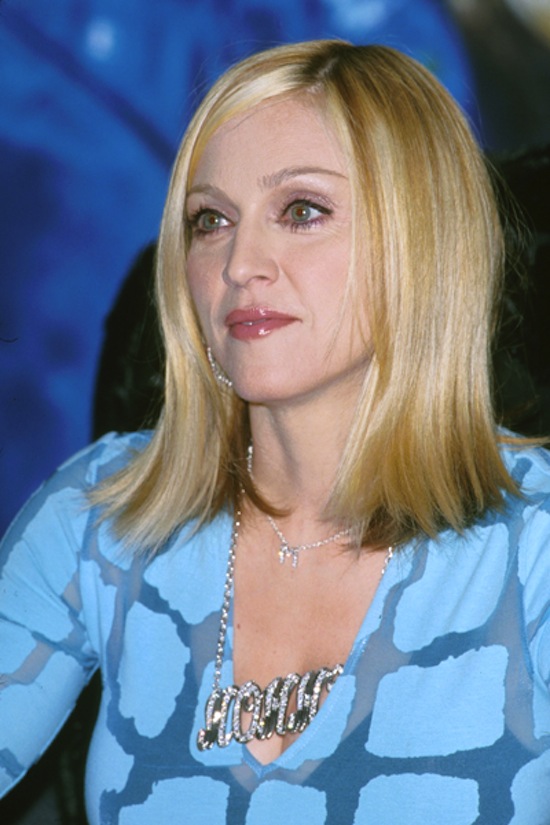
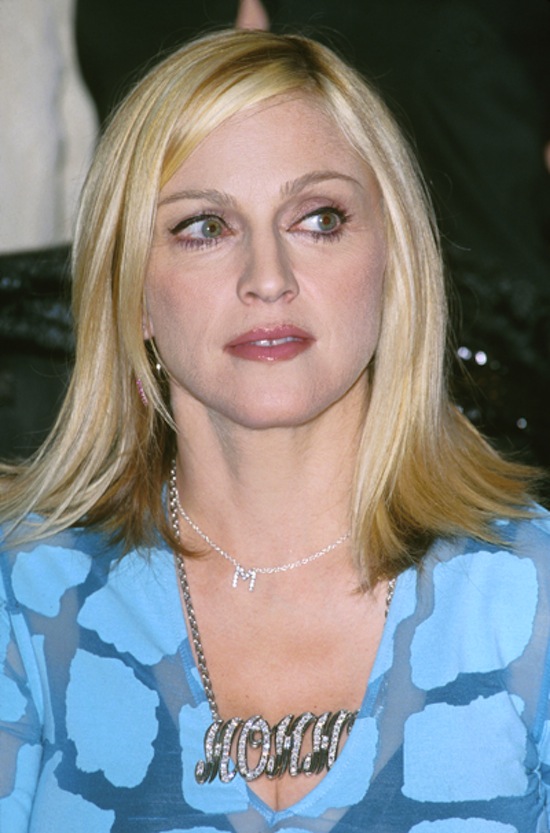

On September 22 2000, Madonna made a surprise in-store appearance at the Virgin Megastore in West Hollywood, California, to sign copies of her Music CD.
Did you attend? Do you have a Madonna autograph? What does it say or look like?

On September 21 1989, Madonna was featured in People magazine’s list of the 20 Who Defined the Decade.
Launching a Navel Offensive Against Every Pop Piety, the Material Girl Navigated the Shark-infested Shoals of Showbiz Like Anything but a Virgin
When she first appeared on the scene six years ago, not much about Madonna marked her for transcendent stardom except her ferocious will. Early hits like Borderline and Holiday proved she had a good ear for a musical hook. But her voice had the range of a penny whistle, her songs were simpler than the alphabet, and around her famous navel the MTVenus packed a little mound of tummy blub.
No matter, she knew that image—or better still, a succession of images—had become as important to a pop career as musical gifts. Sticking her tongue out at critics, then lodging it firmly in cheek, she put on a series of brazen attitudes—the Material Girl, the blond bombshell, the Catholic penitent in a negligee. More than just a cartoon of vice, Madonna was a one-woman vice squad, a whole collection of public images crafted to tease our mixed feelings about lust, money and ambition. If you loved it, it was probably because there was something thrilling about seeing our secret passions so gleefully paraded. And if you didn’t love it—hey, Papa, don’t preach.
Madonna grasped very well that the best way to create scandal in an era that was blasé about old pieties was to twit the new ones. So she flipped a finger at the earnestness of the late ’60s and the ’70s, fashioning a persona of raw cunning and comically overcooked sexuality, a cross between Lady Macbeth and Betty Boop. And she tormented the feminists with her Boy Toy belt buckles and sex-cookie vamping, harking back to an era when a woman’s only leverage in life was the power of eye-batting sex. When Madonna dressed for success, it had nothing to do with getting into law school.
But the message she sent to the multitude of teen age wannabes was mostly about a dream of self-indulgence—a black-lace fantasy for a strait-laced generation.Madonna spread before them the agreeable but dubious proposition that you can play the cutie and still wield clout. In her case, of course, she had a point. Madonna is, after all, that rare cutie who heads a $30-million-a-year corporation. She co-writes her own songs, co-produces her own albums and has directed her mammoth concert tours from city to city as adroitly as Hannibal trotted his elephants across the Alps.
Madonna roamed across pop culture to find the models for her provocations. Her trash-flash wardrobe was pioneered by Bette Midler, her B-girl demeanor owed much to Blondie’s Debbie Harry, and Carol Channing beat her to the discovery that “Diamonds Are a Girl’s Best Friend.” Above all, her scrumptious sexuality was a variation on themes developed by Mae West and Marilyn Monroe, among quite a few others. But she never just appointed herself the next in their line.
Like an Elvis impersonator bringing the beloved back to life, she reenacted Marilyn’s career for us in a wish-fulfillment version, in which Marilyn gets to be both sexy and shrewd. She doesn’t kill herself; she slays everybody else. It was Marilyn without martyrdom, Marilyn for a decade that loved a winner. Sean Penn stood in for both of Monroe’s husbands, Joe DiMaggio and Arthur Miller. In this public revision of the Marilyn saga, he played both the slugger and the somber artist, the big biceps and the furrowed brow.
Madonna was canny enough never to become too closely identified with any of her incarnations. Her most brazen pronouncements were delivered with a wink. (You have to love somebody who can describe losing her virginity as “a career move.”) “Being the vixen, the heartbreaker and the incredibly provocative girl is a very marketable image,” she once admitted. Then she added, with the have-it-both-ways tease that is essential to her appeal: “But it’s not insincere—you just can’t take it seriously.”
It was that kind of “only kidding” come-on that made Madonna the perfect temptress for the ’80s, when all of our pleasures were guilty pleasures, the age of Mothers Against Drunk Driving and “Just Say No,” when all of our excesses were conducted in the shadow of some impending calamity, whether it was AIDS or the national debt.
Madonna wasn’t just a mirror of her times. She was a hall of mirrors, reflecting back a cleverly mixed and fractured message that was just the thing for a decade in which people wanted to shake their hips while putting their shoulders to the wheel. Now that may be a hard position to hold. But like she says: Papa, don’t preach.

On September 20 1993, Madonna’s The Immaculate Collection (her first collection of greatest hits) was certified 4x platinum for shipment of 4 million units in the USA. 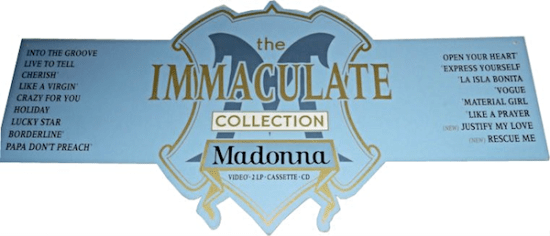

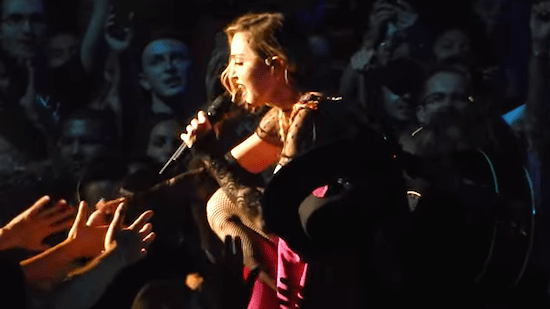


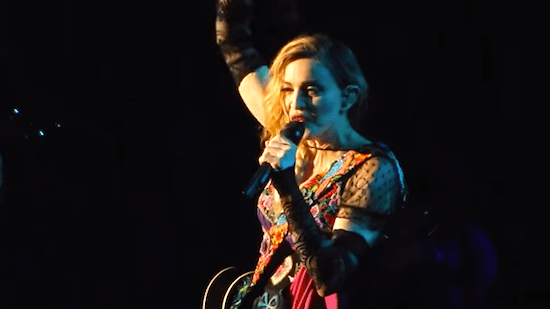


On September 19 2015, Madonna performed Ghosttown for the first time on tour during a sold out Rebel Heart Tour stop in Brooklyn.
Madonna had never intended to perform the single from Rebel Heart during the tour and she had not rehearsed it with the band. Watch the performance:
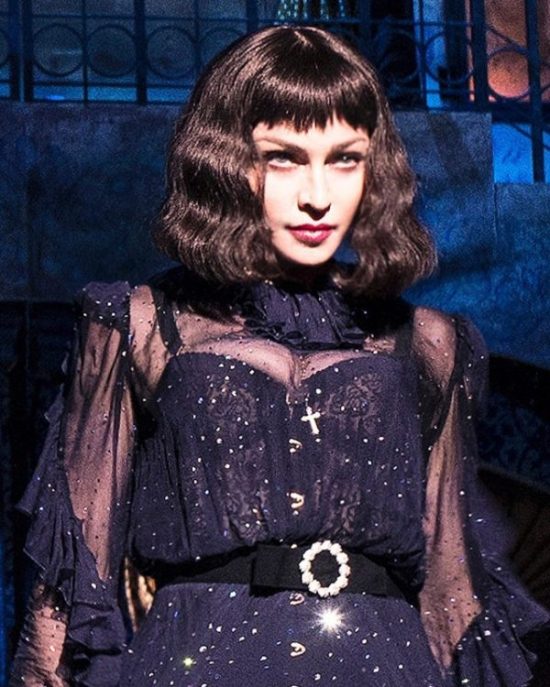
On September 18 2019, the New York Times published a review (Jon Pareles) of Madonna’s opening Madame X Tour show held the night before at the BAM Howard Gilman Opera House in Brooklyn:
“I’m not here to be popular. I’m here to be free,” Madonna declared to a packed, adoring audience on Tuesday night at the Brooklyn Academy of Music’s Howard Gilman Opera House. It was the premiere of her Madame X Tour, named after the album she released in June that she has said was influenced by the music in Lisbon, her adopted home. The show follows her decades of arena spectacles by scaling the same kind of razzle-dazzle — dancers! costumes! video! choir! — for a theater stage.
Unlike jukebox musicals or “Springsteen on Broadway,” Madame X is a concert focusing on new songs and the present moment. In other words, Madonna is still taking chances. She will reach arena-size attendance in only a handful of venues on the eight-city tour, but with much longer engagements; the Gilman Opera House holds 2,098, and she booked 17 shows there, through Oct. 12. Onstage, “selling” a selfie Polaroid to an audience member who happened to be Rosie O’Donnell, she claimed, “I’m not making a dime on this show.”
Concertgoers arrived to what was billed as a phone-free experience. Cellphones and smart watches were locked into bags at the door, though quickly unlocked afterward. It helped prevent online spoilers; it certainly removed the distractions of waving screens. (No photography was permitted, including press.)
As both album and show, Madame X is Madonna’s latest declaration of a defiant, self-assured, flexible identity that’s entirely comfortable with dualities: attentive parent and sexual adventurer, lapsed Catholic and spiritual seeker, party girl and political voice, self-described “icon” and self-described “soccer mom,” an American and — more than ever — a world traveler.
Yes, she is 61, but her music remains determinedly contemporary, with the drum-machine sounds of trap, collaborations with hip-hop vocalists (Quavo and Swae Lee, shown on video) and the bilingual, reggaeton-flavored Latin pop sometimes called urbano (with the Colombian singer Maluma, also shown on video). The concert, with most of its music drawn from the Madame X album, was packed with pronouncements, symbols and enigmatic vignettes to frame the songs. Madonna often wore an eye patch with an X on it, no doubt a challenge to her depth perception as a dancer.
By the time Madonna had completed just the first two songs, she had already presented an epigraph from James Baldwin — “Artists are here to disturb the peace” — that was knocked out onstage by one of the concert’s recurring figures, a woman (sometimes Madonna herself) at a typewriter.
Gunshots introduced God Control, which moves from bitter mourning about gun deaths to happy memories of string-laden 1970s disco, while Madonna and dancers appeared in glittery versions of Revolutionary War finery, complete with feathered tricorn hats, only to be confronted by police with riot shields. Dark Ballet had Joan of Arc references, a montage of gothic cathedrals and scary priests, a synthesizer excerpt from Tchaikovsky’s “Nutcracker” and Madonna grappling with masked dancers, until cops pulled her off the piano she had been perched on. The signifiers were already piling up.
And there were more. Film-noir detectives pursued and interrogated Madonna in another disco-tinged song, I Don’t Search I Find; Crave, which warns, “My cravings get dangerous,” flaunted a full-sized disco ball. A pair of robotic but sinuous dancers, with red lights for eyes, flanked Madonna as she sat at a piano for the ominous Future, while the video screen filled with images of urban and environmental destruction. She surrounded herself with a choir of brightly robed women and geometric Arabic designs in Come Alive, which used the metal castanets and triplet rhythm of Moroccan gnawa music to back her as, once again, Madonna’s lyrics rejected unwanted opinions and restrictions.
Madonna was more suited to the harder beat of Batuka a song based on the matriarchal, call-and-response Cape Verdean tradition of batuque. Backed by more than a dozen batuque drummers and singers — Orquestra Batukadeiras — and doing some hip-shimmying batuque moves, Madonna conveyed the delight of her discovery, even as the hand-played beat gave way to electronic percussion.
Forty-one musicians, dancers and singers appeared throughout the two-hour-plus show, which came with the same wardrobe changes as any of Madonna’s large-scale extravaganzas (one, before Vogue, was executed before the audience, shielded by a dressing table). The singer wasn’t onstage for one of the most powerful dance moments, a break between acts when a row of performers convulsed gracefully at the lip of the stage to irregular breaths, set to a recording of Madonna intoning lyrics from Rescue Me.
Madonna spoke to and with the audience repeatedly, taking advantage of the intimacy of the room to tell bawdy jokes, apologize for starting the show late and sip a fan’s beer. But in songs and stage patter, she sometimes conflated self-realization and self-absorption with social progress. Contrasting freedom and slavery after Come Alive, she announced that slavery “begins with ourselves,” forgetting that the slave trade was not the same as being “slaves to our phones.”
Yet with Madonna, the spirit is more about sounds and images than literalism. I Rise, which ends both the album and the concert, samples a speech by Emma Gonzalez, a survivor of the shooting at Marjory Stoneman Douglas High School in Parkland, Fla. then goes on to some clumsy lyrics. But in a small theater, with a gospelly beat, raised fists, images of protests worldwide, a rainbow flag, and Madonna and her troupe parading up the aisle — close enough for fans to touch — there was no denying the conviction.
Set List:

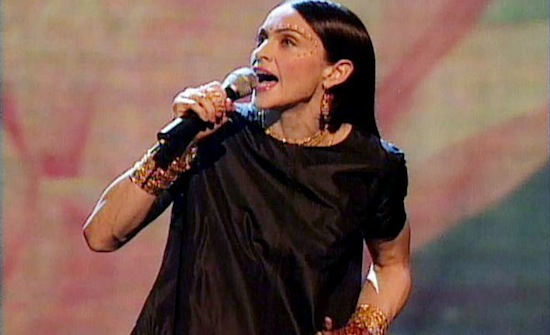

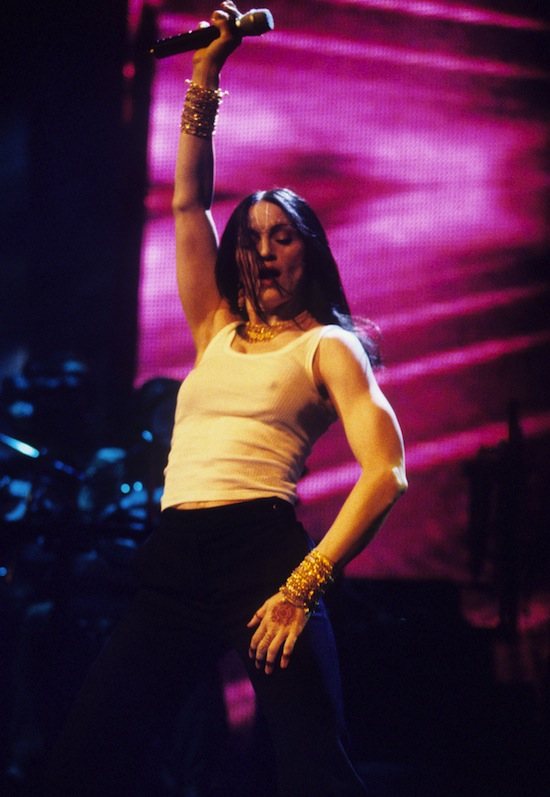

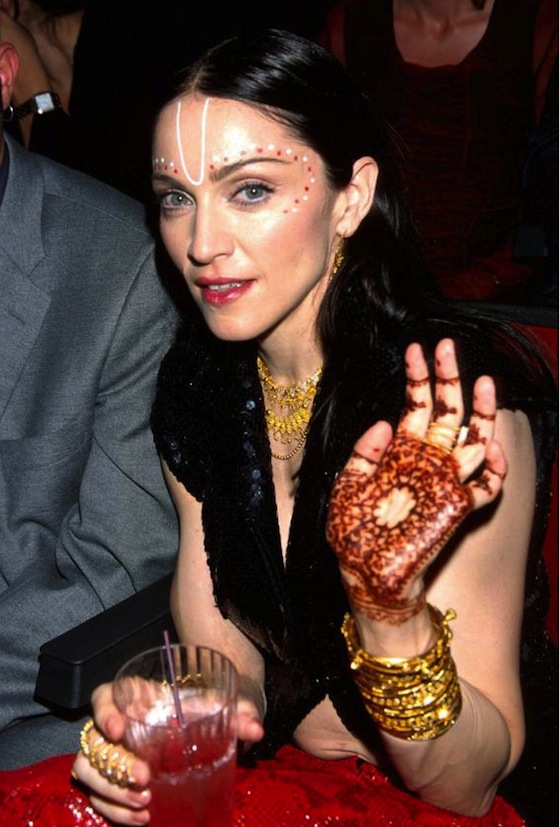
On September 17 1998, Madonna released a statement against the World Vaisnava Association’s criticism of her Ray of Light/Shanti MTV performance: “The essence of purity and divinity is non-judgement… they should practice what they preach… if they’re so pure, why are they watching MTV?”
 Today In Madonna History