Today in Madonna History: August 20, 2001

On August 20 2001, Sal Cinquemani published this review of Madonna’s Music album in Slant magazine:

After her hugely successful and critically-lauded Ray Of Light, Madonna could have gone in one of several possible directions: (1) a more hardcore trance route, enlisting a world-class DJ like Sasha (who remixed a few tracks from Ray Of Light and whom Madonna allegedly dismissed after collaborating on several tracks early in the recording process of this new album); (2) staying in safe territory by writing and recording once again with William Orbit, the mastermind behind Ray Of Light; or (3) a weird, more experimental direction, commissioning someone like French electronica guru Mirwais Ahmadzai. Madonna once told producer Shep Pettibone “You can never do the same thing twice…ever,” but two new collaborations with Orbit, “Runaway Lover” and “Amazing,” prove that when you do, it will probably be completely uninteresting. “Runaway Lover” sounds like a Ray Of Light outtake with uninspired couplets like “It doesn’t pay to give away what you lack/You’ll never get your money back.” But amid the clichés, Madonna throws in profound food for thought like “You get your education from your lovers.” “Amazing” is incredibly catchy and has a Supremes-like melody but that’s where it ends. The track borrows the drum loop Orbit used in “Beautiful Stranger” (which was originally the loop from his “Ray Of Light” remix), and proves that he may not have had enough tricks up his sleeve for an entire new album anyway (and perhaps Madonna knew that).

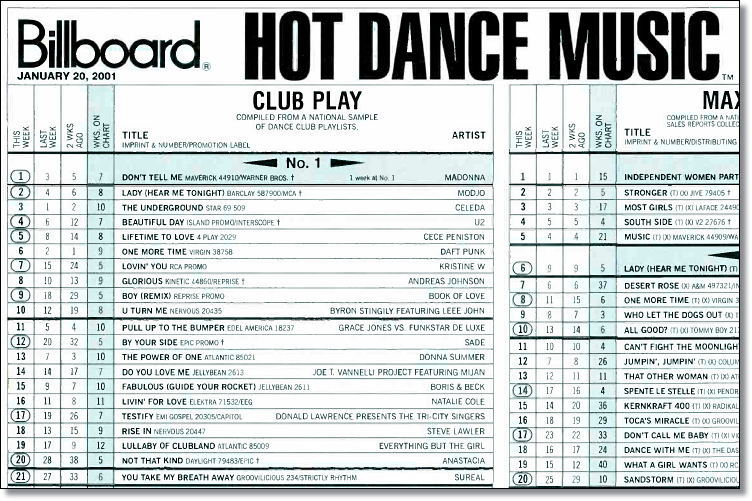
As such, Madonna enlisted Mirwais for most of the rest of the album in question, Music. The title track, a retro hands-in-the-air club song reminiscent of Debbie Deb’s “When I Hear Music” and Madonna’s own “Into The Groove,” is the singer’s best dance floor-beckoning track since “Vogue.” She sings “Music makes the people come together” like a track off of her debut album, and as an added bonus she uses words like “bourgeoisie” and “acid-rock” with equal abandon. If you can get past the initial horror of hearing Madonna’s voice get the Cher “Believe” treatment on “Nobody’s Perfect,” another Mirwais collaboration, you’ll find a brilliant song full of genuine sorrow. The track opens with an intentionally imperfect and somber “I feel so sad,” and it is indeed believable. Lyrics like “What did you expect? I’m doing my best” are sung with an intriguing juxtaposition of human emotion and mechanically detached vocalizations. Though hard to swallow at first (like most on the album), the track is one of the singer’s best creations. With its distorted vocals and grinding electronic burps, “Paradise (Not For Me)” is another distinctive Mirwais production. At a turning point in the song, Madonna awkwardly struggles to speak the words “There is a light above my head/Into your eyes my face remains” while strings swell and bring the song to a climax. It is at this point that “Paradise” resembles the cinematic grandeur of tracks like “Frozen,” and it is also one of the few moments throughout Music that recalls the spiritual introspection of Ray Of Light.

Two tracks take a striking folk direction. “I Deserve It” finds Madonna once again singing with a warm yet detached voice, but this time her vocals are completely untouched by effects. “Gone” ends the album and is possibly one of Madonna’s best performances. In the vein of “Live To Tell,” the song seems to sum up everything Madonna has tried to tell us about being the most famous woman in the world. Earlier attempts have seemed obvious and sometimes trite (“Goodbye To Innocence,” “Survival,” “Drowned World”), but this song seems to be particularly telling. It is also, perhaps, the most human she has ever been. Self-deprecation and vulnerability have never been Madonna’s strong-suits, but the way she sings “I won’t let it happen again/I’m not very smart” could make you wonder. Music seems more like a collection of songs than a cohesive album, and it is an unexpected answer to Ray Of Light. But strangely, in an attempt to make a “fun,” less-introspective album, Madonna has revealed more of herself than ever. No longer shrouded with pedantic spirituality, she has become even more human, exposing her fears on tracks like “Nobody’s Perfect” and “Paradise,” her soul on “Don’t Tell Me” and “What It Feels Like For A Girl,” and revealing her joys on “Impressive Instant” and “Music.”

Today in Madonna History: August 14, 1984

madonna-thefirstalbum1983albumcover2 Madonna1_lg

On August 14 1984, Madonna’s self-titled debut album was certified platinum by the RIAA to commemorate U.S. sales of more than one-million copies.

The album would eventually be certified five times platinum in the U.S.

Today in Madonna History: August 5, 2008

On August 5 2008, Madonna’s Give It 2 Me was released as an eight track CD maxi-single by Warner Bros. Records in the U.S. It included amazing club remixes by Eddie Amador, Paul Oakenfold, Fedde Le Grand, Tong & Spoon, Jody den Broeder, and a ragga mix by Sly & Robbie.

The single was also issued in the U.S. as a double-vinyl 12-inch set, a 12-inch vinyl picture disc and as a double-vinyl 7-inch set coupled with her previous single, 4 Minutes. Though no Canadian pressings of the single were issued, the U.S. CD maxi-single was distributed to Canadian retailers with a Warner Music Canada special import sticker.

Give It 2 Me was the second single from Hard Candy. It was written by Madonna & Pharrell Williams with production by Madonna & The Neptunes.

Today in Madonna History: July 17, 1993

Rain Canadian Cassette Single Cover 2 Rain Canadian Cassette Single Back Cover 2

On July 17 1993, Rain was released as a single in North America. It was the fourth and final North American single from the Erotica album.

Following a cold reception to Madonna’s previous North American single – the bleak-but-beautiful Bad Girl Rain was given a glossy makeover by French record producer Daniel Abraham to help ensure that it would receive a warmer welcome from radio programmers. The U.S. promotional CD that was serviced to radio by Maverick/Warner offered the choice between the sweetened “Radio Remix” (in full-length and edited form) or an edited album version, which was fittingly used in the song’s gorgeous music video. As her label had correctly predicted, radio indeed favored the smoother sound of the “Radio Remix” over the darker, more dynamic (and in our opinion – more interesting) production-work of the original mix. While not an all-out smash hit, Rain was the first single from the Erotica album to impact Billboard’s Hot AC chart, where it reached the Top 10, and it is generally viewed as an initial recovery step following the backlash Madonna had faced in the wake of the Sex book.

rain lyrics 550

Written and produced by Madonna & Shep Pettibone (unlike the majority of the tracks from Erotica, Tony Shimkin has not been added as co-writer, according to the Warner-Chappel publishing database), Rain was one of the earliest songs conceived during the Erotica album sessions. It appears as the first track on a two-cassette collection of demos from the album sessions submitted to the U.S. Library Of Congress for copyright registration. The infamously sought-after set is often referred to by fans as The Rain Tapes because of the song’s prominent placement in its sequencing and also due to the likely unintentional visual prominence of the song’s title in the handwritten sleeve notes that accompanied the tapes.

Rain US Cassette Maxi Single Inner Sleeve

The Rain maxi-single was perhaps most notable for its inclusion of a non-album track, Up Down Suite, which was for all intents and purposes a dub remix of album outtake, Goodbye To Innocence (which remained unreleased at the time, aside from some vocal samples used in a promo-only remix of Fever). A new remix (featuring Everlast) of the album track, Waiting, was also included on the North American maxi-single, while its original album version served as the single’s North American b-side.

With its poetically poignant and emotionally charged lyrics, percussive urgency and one of Madonna’s most ambitious uses of layered self-harmonization (not to mention it being accompanied by one of the most beautiful music videos ever created), it isn’t difficult to understand why Rain remains such an enduring fan favorite.

“It’s strange
I feel like I’ve known you before
And I want to understand you
More and more and more
When I’m with you
I feel like a magical child
Everything strange
Everything wild

Waiting is the hardest thing
I tell myself that if I believe in you
In the dream of you
With all my heart and all my soul
That by sheer force of will
I will raise you from the ground
And without a sound you’ll appear
And surrender to me, to love”


Today in Madonna History: June 28, 1986


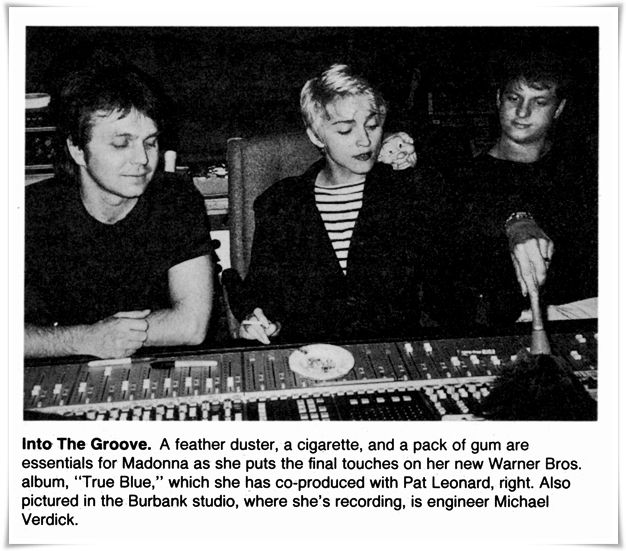
On June 28 1986, Billboard magazine reported that Madonna made a surprise appearance at WEA International’s annual manager’s meeting with Seymour Stein in New York earlier that month where she previewed tracks from her forthcoming album, True Blue.

Today in Madonna History: June 27, 2015

On June 27 2015, Bitch I’m Madonna earned Top Breakout and Most Added track on Billboard’s Hot Dance Club Play chart in the U.S.

Today in Madonna History: June 23, 1998

Ray Of Light Video Single_cover 550 Ray Of Light Video Single_back cover 550 Ray Of Light Video Single_tape 550 Ray Of Light Video Single_card insert

On June 23 1998, the music video for Ray of Light was released by Warner Reprise Video as a limited edition video single of 40,000 VHS copies. It sold 7,381 copies within its first month of release, becoming one of the best-selling video singles of the Nielsen SoundScan era. Madonna’s previous video single release, Justify My Love, which predated SoundScan, was certified quadruple-Platinum by the RIAA (for shipment of over 200,000 copies).

The reason behind Ray of Light being issued as a video single were twofold. Madonna was very pleased with the outcome of her first collaboration with director Jonas Åkerlund and her record company felt that there would be enough interest to warrant its commercial release. Secondly, Warner’s marketing team correctly sensed that the song’s then-experimental sound would be a tough sell at radio, so the decision was made to pull out all the stops to ensure the release outperformed on the sales chart. Another prong in this strategy was the inclusion of album outtake Has To Be as the b-side to the two-track single, while excluding it from the maxi-single in an attempt to persuade fans to purchase the single in multiple formats. The strategy proved successful, with the song’s number-five debut and peak on the Billboard Hot 100 mainly due to its sales strength. According to Billboard, the music video single boosted its first-week sales by roughly 7%, helping it to secure its place in the top-five.

Shortly after Ray of Light‘s release as a video single, Billboard magazine published an article musing on whether renewed interest in the relatively obscure format could ever prove lucrative for the music industry. A video buyer for a major retail chained remarked:

“Madonna’s Ray of Light video single is a success because she has a fervent fan base. There are very few artists with videos that consistently get people’s attention, but Madonna is one of those artists. It’s too early to tell if there’s a true market for video singles. Right now, it seems like record companies are trying video singles to see what happens. I think we’re going to see the lines becoming more blurred in how audio and video singles are marketed.”

Indeed. Within the next five years (and two Madonna video singles later), the emergence of online file sharing would obliterate the physical singles market in North America, and video streaming sites would soon spell an end to the prospect of marketing music video singles as a physical format. In digital form, however, music video singles may be selling in larger numbers than ever due to increased availability through iTunes. Strangely, however, sales of music videos through iTunes are not reported to Billboard and no longer count towards a single’s chart position (reportedly due to iTunes’ monopoly on digital sales of the format), while streams of music videos through sites like YouTube and Vevo are used in Billboard’s chart methodology.